
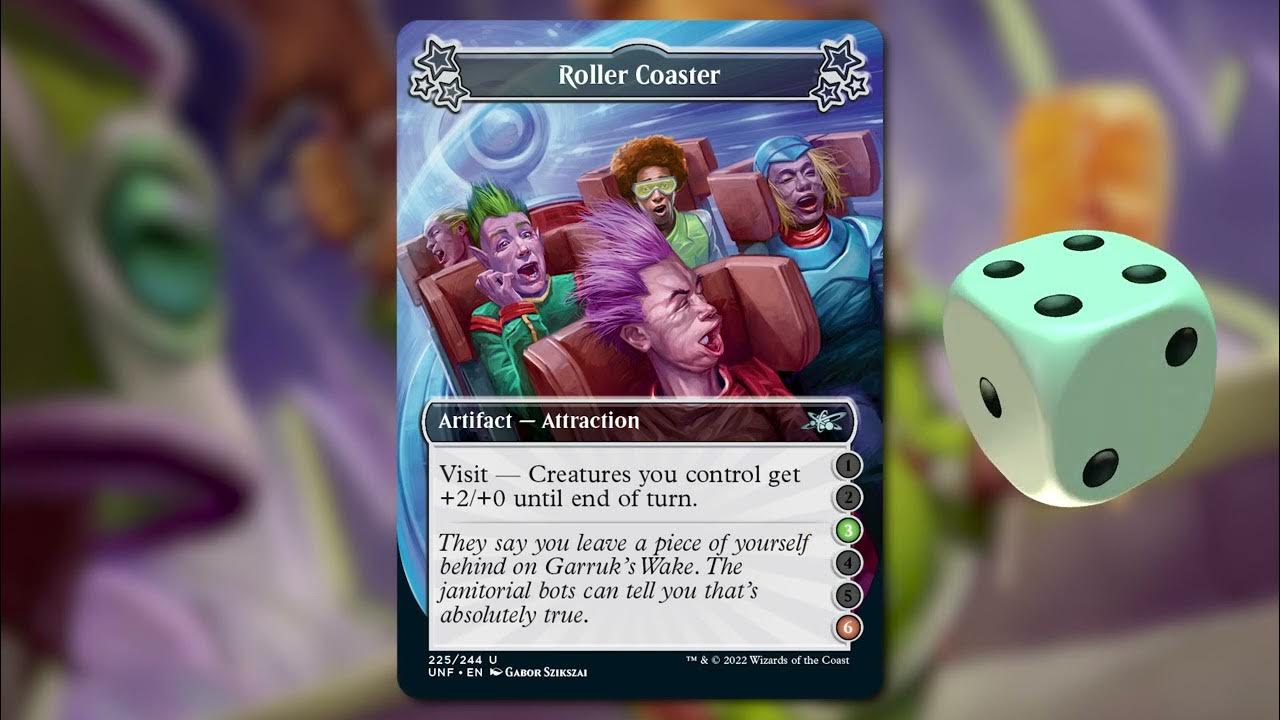
This post helps MTG players understand how Attractions work, so you can play them correctly (and stop arguing about when you roll) the next time Unfinity shows up at the table.
TLDR
- Attractions are artifact cards that live in a separate Attraction deck that starts in the command zone (they do not take up slots in your main deck).
- You only get Attractions if a card tells you to open an Attraction. Opening means put the top card of your Attraction deck onto the battlefield.
- If you control at least one Attraction, you roll one d6 at the start of your precombat main phase. That is “rolling to visit.”
- Any Attraction you control with a lit number matching the roll gets visited, and its Visit ability triggers.
- When an Attraction leaves the battlefield, it usually goes to a face-up pile in the command zone called your junkyard, not your graveyard.
You know how Magic has fifteen zones, a stack, and a rulebook thicker than your average fantasy novel? Unfinity looked at that and said: “What if we also added a theme park.”
So if you’ve ever asked how do Attractions work in MTG, here’s the clean, playable explanation, with timing, a full turn example, and the annoying little gotchas that cause the most table arguments.
What are Attractions in MTG?
Attractions are a special kind of artifact card introduced in Unfinity. They represent carnival rides and attractions (because of course they do), and each one has a Visit ability that can trigger when you roll a die at a very specific time.
The important part is that Attractions do not start in your main deck. They live in their own supplementary Attraction deck that begins the game in the command zone. Translation: you do not cut a land for a Ferris wheel.
The Attraction deck and the junkyard
Your Attraction deck (the “side deck” that is not called a sideboard)
If you “choose to play with Attraction cards,” you start the game with an Attraction deck in the command zone. It gets shuffled before the game begins.
In constructed, your Attraction deck must:
- have at least 10 Attraction cards, and
- have no duplicate English names (every Attraction name must be different)
In limited, it’s looser:
- you need at least 3 Attractions from your pool, and
- duplicates are allowed
Commander note: Commander already likes singleton, so the “different names” rule usually feels normal. The weird part is just that you brought extra cardboard.
The “junkyard” (why your Attractions do not go to the graveyard)
Attraction cards have a special card back (the “Astrotorium” back). Because of that, they follow a replacement rule: if an Attraction would go to most zones, it goes to the command zone instead.
Practically, that means when an Attraction leaves the battlefield (destroyed, bounced, sacrificed, whatever), it usually ends up in a face-up pile in the command zone called your junkyard. That pile is not a separate zone, and it is definitely not your graveyard, so a lot of normal recursion cards will stare at it blankly.
If you want one sentence to remember: You can blow up Attractions, but you usually can’t “reanimate” them.
How to open an Attraction
You do not open Attractions “because you feel like it.” You open one only when a card instructs you to open an Attraction.
When you open an Attraction:
- Take the top card of your Attraction deck (from the command zone),
- Turn it face up,
- Put it onto the battlefield under your control.
That’s it. No drafting minigame. No “pick from the top ten.” Magic is weird, but it’s not that weird here.
One more important rules-nerd detail that matters in real life: you can only open an Attraction in a game where you are playing with an Attraction deck. If you brought cards that open Attractions but no Attraction deck, you brought dreams, not resources.
Rolling to visit your Attractions
This is the core of the mechanic, and also the part that makes people ask “wait, when do I roll?”
When do you roll?
If you control one or more Attractions, you roll as your precombat main phase begins.
It’s a turn-based action, which means:
- it happens automatically (no one “responds” to the roll itself), and
- it happens before players get priority in your first main phase
So no, you cannot start your main phase by casting a spell “real quick” and then roll later. The theme park makes you roll at the door.
Also, if you control Sagas and Attractions, the game orders your chores for you: Sagas get lore counters first, then you roll to visit.
What does “visit” mean?
To roll to visit:
- Roll a six-sided die.
- Look at each Attraction you control.
- If the result matches a lit number on that Attraction, you visit it.
- Visiting causes that Attraction’s Visit ability to trigger.
You roll once, and you may visit multiple Attractions if they share the number you rolled. One die roll, many rides. It’s the only time Magic lets you have efficient fun.
The lights (why some Attractions trigger more often)
Each Attraction has the numbers 1 through 6 printed in a vertical row, and some are “lit.”
Rules of thumb:
- 1 is never lit
- 6 is always lit
- Different printings/versions of the same Attraction can have different lit numbers
So if an Attraction has:
- only 6 lit, it triggers about 1/6 of your turns (roughly)
- 6 + one more number, about 2/6
- 6 + two more numbers, about 3/6
- and so on
This is the main “balance knob” on Attractions. The stronger the effect, the fewer lights it tends to have (not always, but often enough to be a pattern).
Important: other die rolls do not “visit” Attractions
You only visit Attractions from the specific “roll to visit your Attractions” action, or if a card explicitly tells you to roll to visit again.
If you roll a d20 for something else, your Attractions do not suddenly decide they’re included. They are needy, but they are not psychic.
A full turn example (so it actually sticks)
Let’s say you control two Attractions:
- Bounce Chamber has 2, 4, 6 lit
- Ferris Wheel has 3, 6 lit
Start of your precombat main phase:
- You roll a d6 and get a 4.
Now check each Attraction:
- Bounce Chamber has 4 lit, so you visit it and its Visit ability triggers.
- Ferris Wheel does not have 4 lit, so nothing happens for it (this time).
Then the triggered Visit ability (or abilities) go on the stack the next time the game is putting triggers on the stack at the start of main phase, and players can respond normally to those triggers.
Next turn you roll a 6:
- You visit both Attractions because 6 is always lit.
- Both Visit abilities trigger.
- Your table sighs, because now you’re “the Attractions deck” and this is your personality for the rest of the night.
Common Attractions gotchas (aka, why your friend is wrong)
Here’s a quick checklist of the stuff that actually matters in play:
- You roll at the start of precombat main, not upkeep, not end step, not “whenever.”
- You roll only if you control an Attraction. Having an Attraction deck alone does nothing.
- The roll itself does not use the stack, but the triggered Visit abilities do.
- Other die rolls do not visit Attractions. Only the special roll does, unless a card says otherwise.
- Attractions are artifacts, so normal artifact removal works.
- When an Attraction leaves the battlefield, it usually goes to your junkyard in the command zone, not your graveyard (so most graveyard recursion will not touch it).
- If you get extra main phases (extra combat nonsense), only the first main phase is the precombat one. That’s the one that matters for visiting.
If you like this kind of “rules clarity that prevents arguments,” our MTG Deckbuilding Checklist article has the same vibe, but aimed at making Commander decks functional instead of “a mood board with lands.”
Attractions in Commander and casual play
Are Attractions legal in Commander?
Yes, Attractions are legal in Commander as long as you’re using the non-acorn Unfinity cards (the Eternal-legal ones). Acorn-stamped cards are not legal by default in Commander, but Rule 0 exists for a reason, and people have been Rule 0’ing weirder things than a carnival.
Do you need to buy real Attraction cards to try the mechanic?
No. If you just want to see whether Attractions are fun in your group, use clear, readable playtest proxies in sleeves and be upfront about what they are.
If you want a practical guide to doing that without turning it into an arts-and-crafts project, use How to Print MTG Proxy Cards | The Easiest Method. The important part is simple: don’t try to pass anything off as real, and don’t bring proxies to sanctioned events.
Are Attractions worth it?
That depends on what you enjoy:
- If your table likes small random value engines and “something happens every turn,” Attractions are fun.
- If your table already groans when someone resolves a Rhystic Study, adding a mini-game that triggers in main phase might be a social risk.
Attractions are not secretly broken by default. They are secretly annoying by default, and you should plan accordingly.
FAQs
Do I roll to visit Attractions every turn?
You roll to visit at the start of your precombat main phase on any turn where you control at least one Attraction.
Do I visit Attractions when I roll dice for other cards?
No. Only the special “roll to visit your Attractions” roll (or an effect that specifically tells you to roll to visit) causes Visit abilities to trigger.
How many Attractions can I have on the battlefield?
As many as you can open and keep around. There is no special cap in the rules. Your opponents, however, may implement a cap using social pressure and artifact removal.
What happens to an Attraction when it gets destroyed?
It usually goes to the command zone in your face-up junkyard pile, not your graveyard. Exile is one of the few clean ways to remove them permanently.
Do I need exactly 10 cards in my Attraction deck?
In constructed, you need at least 10, and they must all have different names. Most players run 10 because it is the minimum and keeps the setup simple.
https://magic.wizards.com/en/news/feature/unfinity-mechanics-2022-09-20