
TLDR
- The best MTG proxies for testing Commander decks are clear, consistent and easy to replace as your list changes.
- Use handwritten basics or paper slips when the deck is still rough.
- Use printed proxies when you are testing a stable list over several weeks.
- Proxy one role at a time when possible: ramp, draw, removal, finishers or mana.
- Do not buy expensive upgrades until the card solves a real problem across multiple games.
The fastest way to waste money on Commander is to buy the exciting card before you know what problem it solves.
That is why the best MTG proxies for testing Commander decks are not always the prettiest proxies. Early in the process, your best proxy is the one you can change after one game without feeling precious about it. Later, when the list is closer to real, better printed proxies help you test shuffle feel, card recognition and full-deck consistency.
Commander upgrades are sneaky. A card can look perfect in a decklist, then sit in your hand doing nothing because your curve is too high, your colors are strained or your pod removes your commander every time it blinks. A proxy lets you learn that before the card becomes a $40 lesson in optimism.
The Best Proxy Depends On What You Are Testing
Not every test needs the same proxy method. A one-night experiment and a full Commander deck trial are different jobs.
| Testing Goal | Best Proxy Type | Why It Works |
|---|---|---|
| One or two cards for tonight | Handwritten basic lands | Fast, clear and easy to replace |
| 10 to 20 possible upgrades | Paper slips in opaque sleeves | Cheap, readable and flexible |
| A full 100-card Commander list | Printed proxy deck | Consistent enough for real games |
| A deck you will test for weeks | Professionally printed proxies | Better handling and less proxy fatigue |
| A cube or shared playtest pool | One uniform print method | Reduces feel differences across many cards |
The simple rule: use flexible proxies while you are still asking “does this belong?” Use nicer proxies when you are asking “does this deck work?”
Those are different stages.
Start With Ugly Proxies While The Deck Is Still Changing
Early testing does not need polish. It needs speed.
If you are trying 15 possible upgrades, do not start by making beautiful custom versions of all 15. That turns every cut into a tiny emotional event. You want the opposite. You want disposable test pieces that make it easy to say, “Nope, this card is not doing enough.”
The simplest early method is still a basic land with the card name written clearly on it. Add the mana cost and one short reminder line if the card is complicated.
For example:
- “Smothering Tithe, 3W, treasure unless opponent pays 2”
- “Cyclonic Rift, 1U / 6U overload, bounce nonland permanents”
- “Jeska’s Will, 2R, mana or exile 3, both if commander”
That is not beautiful. But it is playable.
Paper slips in sleeves are the next step. Print or write the card info on a small paper insert, sleeve it in front of a basic land or filler card, then play normally. This is usually the sweet spot for early Commander testing because it keeps the deck thickness more consistent while still letting you swap cards quickly.
Kraken Opus already has a broader MTG proxy starter guide if you want the full method breakdown.
Use Printed Proxies When The List Is Close
Once your list is stable, printed proxies start to make more sense.
That usually means one of three things:
- You are testing a full deck before buying a large chunk of it.
- You are testing several expensive staples for more than one night.
- You want the deck to feel normal enough that the proxy method does not affect your games.
This is where nicer proxies help. You are no longer testing a single card in isolation. You are testing how the deck plays over time: opening hands, mulligans, shuffle feel, board recognition and how often cards actually show up.
A full printed proxy deck can be useful when you are deciding whether a Commander concept is worth building at all. For example, maybe the list looks great online, but after six games you realize the deck wins in a way your group does not enjoy. Better to learn that with proxies than after ordering the whole pile.
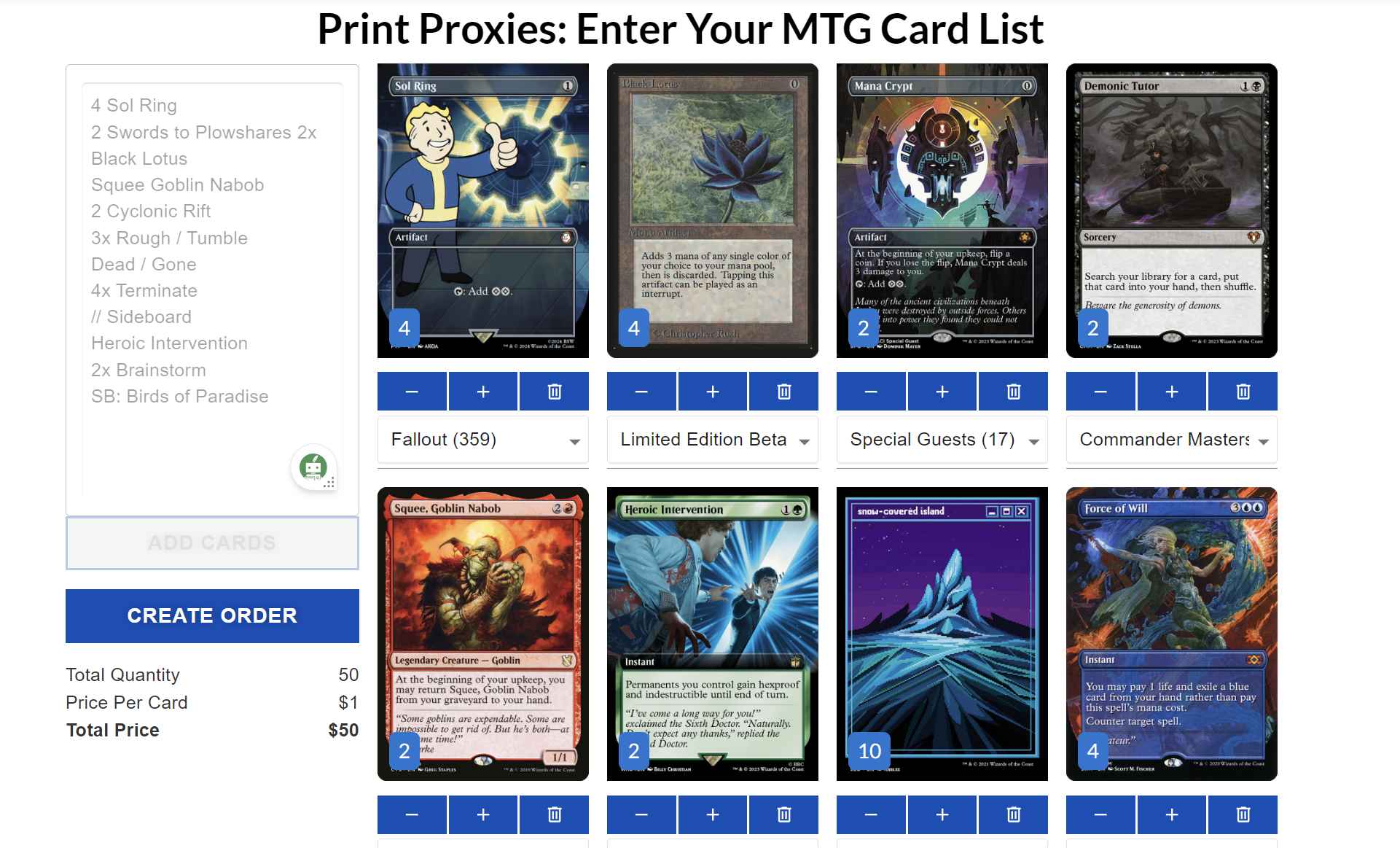
For ready-made proxy options, Kraken Opus has a live best MTG proxy sites guide that compares the broader ordering landscape.
Test Roles, Not Just Card Names
This is the part many Commander players skip.
They ask, “Is this card good?”
That question is too vague. A better question is: “What job is this card supposed to do in this deck?”
Most Commander cards should fit one of these jobs:
- Mana development
- Card draw
- Removal
- Protection
- Board wipe
- Win condition
- Synergy piece
- Graveyard tool
- Recursion
- Flex slot
A card can be powerful and still be wrong for the job.
Take a flashy seven-mana finisher. It may win games when resolved. But if your deck is already full of finishers, that card is not solving your real problem. Your real problem may be early ramp, interaction or card draw.
This is why proxies are so helpful. They let you test the job before you commit to the purchase.
Instead of testing “Rhystic Study because it is good,” test “one repeatable draw engine in this slot.” Instead of testing “Dockside Extortionist because it is expensive,” test “fast mana burst that helps this deck recover tempo.” That framing keeps you honest.
The 5-Game Commander Proxy Test
One game tells you almost nothing. One game can make a bad card look perfect or a great card look useless.
I like a five-game test for expensive upgrades.
Game 1: Basic Function Test
Did you draw the card? Could you cast it? Did it do the job you expected?
Do not overreact yet. You are just checking whether the card functions in the deck.
Game 2: Bad Mana Test
Pay attention to color requirements. A card that is easy in theory may be clunky in a real opening hand.
This matters most for three-color and five-color Commander decks. The card may be good, but your mana may not be ready for it.
Game 3: Behind-On-Board Test
This is the most useful game.
When you are behind, does the card help you stabilize? Or is it only good when you are already set up?
Win-more cards tend to expose themselves here.
Game 4: Commander Removed Test
Commander decks often lie during goldfishing because the commander is always available and never gets killed.
In a real game, your commander eats removal. Sometimes twice. Does the tested card still work when your commander is gone or too expensive to recast?
If not, the card may still be playable, but you should understand that risk.
Game 5: Normal Pod Test
Now play a regular game and stop staring at the proxy like it owes you money.
This is where you see whether the card naturally belongs. Did you want to draw it? Did it sit in your hand? Did it change how opponents played? Did it make the game better?
After five games, you usually know much more than you did from staring at a decklist.
Keep A Tiny Testing Log
You do not need a spreadsheet worthy of a finance department. Just track enough to avoid lying to yourself later.
| Card Tested | Role | Result | Decision |
|---|---|---|---|
| Expensive draw engine | Card draw | Great when early, bad late | Retest |
| New removal spell | Interaction | Always useful | Buy |
| Big finisher | Win condition | Dead in hand twice | Cut |
| Utility land | Mana base | Helped, no downside | Buy |
| Protection spell | Protection | Good only with commander | Retest |
The decision column should usually be one of three words:
- Buy
- Cut
- Retest
“Retest” is useful. Not every card needs an instant verdict.
Proxy Mana Bases Before Proxying Flashy Spells
Commander players love testing the exciting upgrades first. That makes sense. Nobody wakes up thinking, “I cannot wait to proxy a better mana base.”
But mana is often the real issue.
If your deck stumbles, your new finisher will look worse than it is. If your colors are bad, your interaction will feel clunkier than it should. If your lands enter tapped too often, you will think the deck needs more power when it actually needs smoother sequencing.
Before buying expensive spells, test the mana base.
Good mana testing asks:
- Do I have the right colors by turn three?
- How many lands enter tapped in the first four turns?
- Can I cast my commander on time?
- Do my utility lands cost me too many colored sources?
- Am I keeping bad hands because the deck is built badly?
This is boring in the way brushing your teeth is boring. You still have to do it.
When A Proxy Should Become A Real Purchase
A proxy has done its job when it gives you a clear decision.
A card is probably worth buying when:
- You are happy to draw it in normal games.
- It solves a problem the deck repeatedly has.
- It works even when your commander is unavailable.
- It improves weak hands, not just strong hands.
- You would keep it in the deck after the novelty wears off.
- The price makes sense for how often you will play it.
That last point matters. A $4 upgrade and a $70 upgrade should not need the same amount of proof. Cheap cards can be bought on a lighter test. Expensive cards should earn their slot.
My rule: the more a card costs, the less I trust the dream scenario.
Common Proxy Testing Mistakes
The first mistake is testing too many changes at once. If you swap 25 cards, then the deck gets better, you may not know which cards actually helped.
The second mistake is only goldfishing. Goldfishing is useful for checking mana and curve, but it does not show how the deck handles removal, pressure, politics or bad timing.
The third mistake is ignoring feel. If your proxies are different thicknesses, different sizes or different sleeve setups, your test games get noisy. The deck should not give you accidental information by touch.
The fourth mistake is keeping every successful proxy. Sometimes a card works, but another card works better. Testing is not about proving your first idea was right. It is about finding the right 99.
The fifth mistake is buying too quickly after one great game. Commander is a high-variance format. One perfect draw does not make a staple.
Best Practical Setup For Most Commander Players
For most players, I would use three stages.
Stage one: handwritten basics or paper slips for rough ideas.
Stage two: clean paper slips in opaque sleeves for serious testing.
Stage three: printed proxies for full lists, long-term tests or expensive cards you want to evaluate properly.
That setup keeps costs low early and quality higher later. It also keeps you from treating every card idea like a finished deck slot.
And that is the whole point. Proxies are not just about saving money. They are about making better deck decisions before the money gets involved.
Final Thoughts
The best MTG proxies for testing Commander decks are the ones that help you make clean decisions.
Sometimes that means a basic land with a name written on it. Sometimes it means a full printed deck that lets you test a Commander idea for a month. The format does not care how fancy the proxy is. Your deck only cares whether the card works.
Start rough. Test honestly. Track the result. Then buy the cards that keep proving themselves after the easy excitement is gone.
That is how you avoid the classic Commander upgrade trap: spending real money on a card that was only good in the imaginary version of the game.