
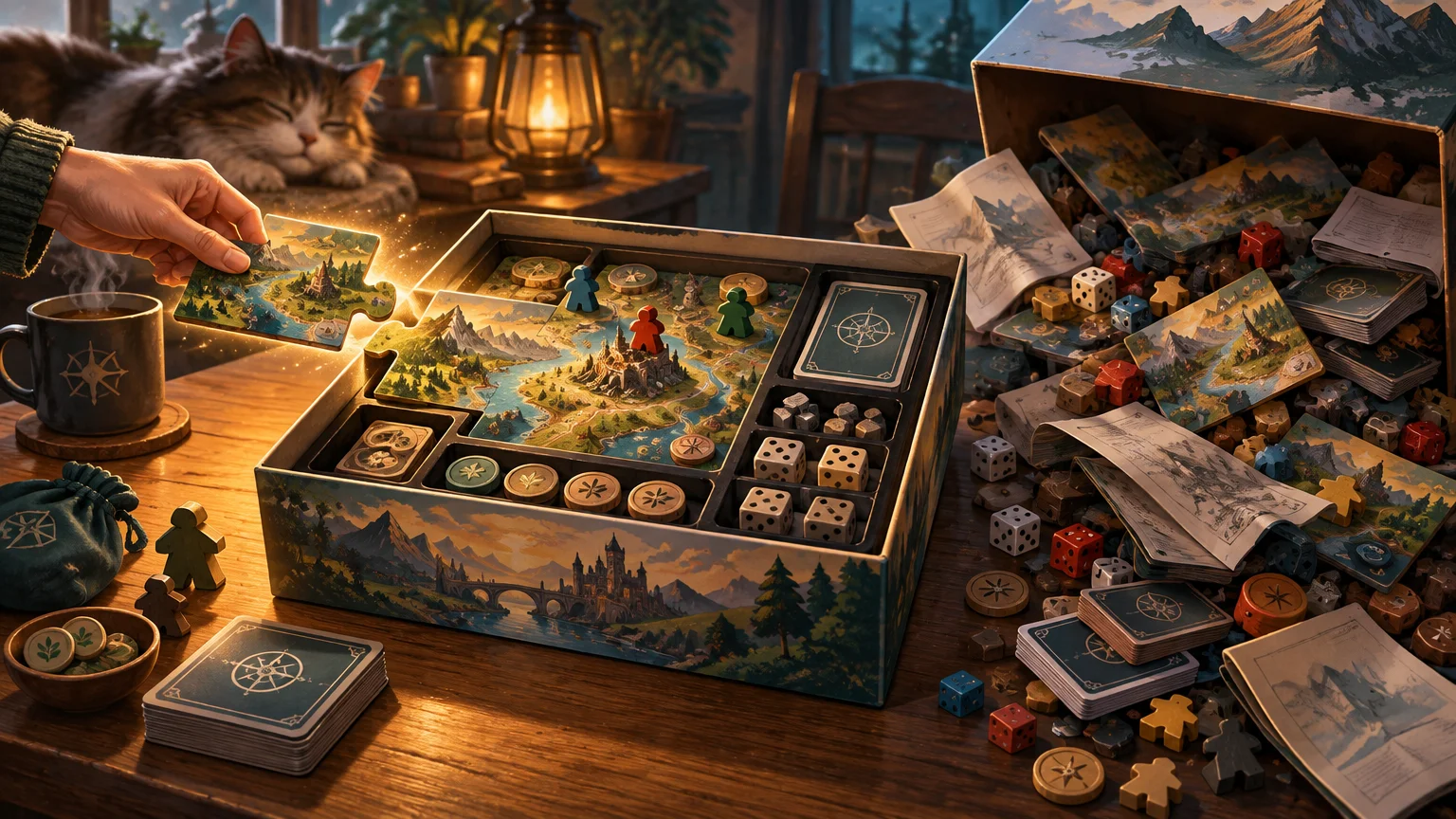
TLDR: An expansion is worth buying when it improves sessions your group already plays, fixes a specific source of friction, or enables a mode you will genuinely use. It is probably not worth buying when its main contribution is theoretical variety, a higher player-count number, or several bags of components destined to remain unpunched.
The best answer to when are board game expansions worth it is not “after ten plays” or “when the base game feels stale.” There is no universal play-count threshold. The useful question is whether the expansion will produce enough better sessions to justify its money, rules overhead, setup time, and shelf space.
That distinction matters because an expansion can change a game in several ways. Some add variety without altering the underlying system. Others replace weak mechanisms, open a needed player count, provide a finite campaign, or simply make components easier to manage. Those are different jobs, and each deserves a different buying test.
When are board game expansions worth it? Start with repeat use
Begin with the base game rather than the expansion. How often has the game reached the table recently, who plays it, and how likely is that pattern to continue? A brilliant expansion for a game played once a year is still competing with every other game for that one annual session.
You do not need to exhaust the base box first. Some groups understand a system after two plays; others need six sessions before they can identify what is repetitive and what is intentionally stable. Buy once you can describe the desired improvement in practical terms. “We need stronger strategic variety after using the same openings” is actionable. “More cards would be nice” is mostly the collector brain requesting snacks.
Estimate value using expected plays, not total content. If an expansion will probably be used in eight of the next ten sessions, even a subtle improvement can matter. If it contains four modules but your group will tolerate only one, judge the purchase on that one module. Content that never leaves the box has an impressively poor fun-per-kilogram ratio.
Identify the expansion’s actual job
Before checking reviews or component lists, finish this sentence: “I want this expansion because it will…” The answer should fit one of a few recognizable jobs.
| Expansion job | What it changes | Strong reason to buy | Warning sign |
|---|---|---|---|
| Additive variety | Adds cards, factions, maps, powers, or objectives | Familiar sessions are becoming predictable | The base content still feels unexplored |
| Corrective or replacement system | Reworks an existing subsystem or swaps components | A specific mechanism repeatedly weakens otherwise good sessions | You cannot identify the problem being corrected |
| Player-count or mode access | Adds solo, cooperative, team, or extra-player support | That mode matches how your group actually meets | It only raises the printed maximum player count |
| Campaign or scenario content | Provides linked or standalone challenges | A stable group wants structured discovery | Scheduling already prevents campaign continuity |
| Convenience or cosmetic upgrade | Improves handling, sorting, durability, or appearance | Physical friction is stopping the game from reaching the table | The upgrade looks attractive but solves no practical problem |
Additive expansions need a variety problem
An additive expansion is easiest to understand and easiest to overbuy. More cards, asymmetric powers, maps, or objectives can extend a game that has developed recognizable patterns. But variety is valuable only when the group has encountered those patterns often enough to care.
Component count alone says little about the change in play. Stonemaier lists 95 unique bird cards, five player mats, and nectar tokens in the Wingspan: Oceania Expansion, for example. Those details establish that the box affects several parts of the game, but they do not tell any particular group whether the resulting changes improve its experience. That judgment still depends on which parts of the base game the group wants altered.
Corrective expansions should address a named mechanism
A corrective expansion can be more valuable than a large additive box because it changes the system you interact with every turn. The key is understanding what gets replaced rather than assuming that newer means repaired.
Dire Wolf’s Rise of Ix design diary offers a useful example of deliberate replacement. The designers describe adding and removing an equal number of agent spaces so the total remained level, preserving the tension around worker placement rather than simply attaching more spaces to the board. This is the kind of design change worth investigating: What leaves, what enters, and which incentives move as a result?
A replacement-style expansion is promising when your group likes the game’s core loop but consistently dislikes one subsystem. It is less promising when the complaint is broader—excessive length, a genre mismatch, or a core decision structure nobody enjoys. An expansion can renovate a room; it rarely moves the entire house.
Measure complexity return, not box size
Every expansion spends part of your group’s limited attention budget. New terminology, exceptions, icons, phases, and upkeep all have a cost. The purchase works when the decisions created are more interesting than the administration required to produce them.
Ask what players will decide differently. A new resource is meaningful if it creates tension with existing resources. It is less useful if everyone collects it automatically and converts it at an obvious time. A new faction can add depth if it changes priorities; it adds mostly memorization if its identity is a page of exceptions.
Teaching burden also depends on the group. Experienced regulars may absorb a module quickly, while rotating newcomers can force the owner to explain the same stack of exceptions every session. In that situation, optional modules are valuable only if they are genuinely easy to remove. “Technically modular” is not the same as “pleasant to separate at 6:55 p.m. while everyone asks whether they can help.”
Check player count and mode against real game nights
A higher maximum player count is not automatically an improvement. The important question is whether the expansion makes the game good for your normal attendance without creating excessive downtime, crowding, or session length.
Use your actual group pattern. If three people play almost every week, added six-player support has little value. If a frequent fifth player currently forces the group to choose another game, a well-designed fifth-player module could transform how often the base game appears. Similarly, a solo mode matters most when it converts otherwise unused ownership into regular play—not merely because completing every available mode feels tidy.
Publisher-supported player ranges establish what is permitted, not which count your group will prefer. Look for changes to turn structure, shared resources, map space, downtime, and total duration. An extra set of player pieces may technically enable another seat while doing nothing to protect the pace.
Price the hidden costs: setup, sorting, storage, and transport
The retail price is only the visible cost. Expansions can require extra decks to shuffle, modules to select, boards to overlay, tokens to sort, and setup rules to remember. These minutes matter because setup friction compounds: a game that takes slightly longer to prepare may be chosen substantially less often.
Rise of Ix illustrates how one expansion can touch several setup steps. Its rules call for a board overlay, a separate Ix board, technology-tile stacks, cards mixed into multiple decks, and additional player components. None of those requirements makes the expansion bad. They simply belong in the buying decision because the expansion changes the physical workflow as well as the strategy.
Before purchasing, check whether the combined game fits in one box, on your normal table, and in the bag or shelving system you use. Sleeved cards, deluxe components, and third-party inserts can all change the answer. Also consider whether mixing everything makes future separation unpleasant. An expansion that turns one approachable box into a transport project may reduce rather than increase total play.
Compatibility is not the same as mix everything
Check the exact edition, required base set, current rulebook, FAQ, and publisher recommendations. Even officially compatible products may contain combinations that are better curated than fully randomized.
The Dune: Imperium – Uprising rules state that the game is compatible with previous Dune: Imperium products, but specifically recommend against adding Rise of Ix conflict cards because matching battle icons becomes somewhat harder. That is a useful distinction: compatibility means the parts can function together, not that every possible mixture is equally clean.
If you own multiple expansions, decide whether you want a permanent “complete” configuration or a menu of modules. Permanent integration reduces setup decisions but can dilute particular cards and mechanisms. Curated modules preserve a clearer design identity but require labeling, separation, and someone who remembers what goes where.
Judge campaign expansions with a separate test
Campaign content has finite value by design, and that is not automatically a weakness. A memorable sequence played once can be a better purchase than endlessly replayable material that never gets scheduled. The real risk is buying a future commitment your group cannot maintain.
Check four things: the number and length of scenarios, whether sessions work independently, whether the same group must attend, and whether unused content can be played outside the campaign. Fantasy Flight Games says the Ered Mithrin Campaign Expansion contains nine scenarios playable either standalone or as part of a larger campaign, and that it requires the Revised Core Set. Standalone support changes the risk calculation because interrupted campaign plans do not necessarily make the remaining scenarios unusable.
Also verify whether the expansion overlaps with older releases you already own. Revised campaign products, collected editions, and repackaged scenarios can create accidental duplication. Scenario count is useful, but expected completion is better: nine scenarios have little practical value to a group that reliably abandons campaigns after the second meeting.
Treat organizers and upgrades as their own purchase
An insert, storage box, token upgrade, or playmat should not inherit the value judgment of the gameplay expansion. Evaluate it according to the friction it removes. Does it shorten setup? Protect components that receive heavy use? Make the game easier to transport? Keep expansion modules visibly separated?
An organizer is worth considering when poor component access is stopping a frequently played game from reaching the table. It is harder to justify when it adds weight, prevents vertical storage, cannot accommodate sleeves, or locks you into a configuration you may later change. Convenience products should make ownership easier, not turn packing the box into a spatial reasoning finale.
A quick buy, wait, or skip worksheet
Answer these questions before ordering:
- How many realistic sessions will include this expansion in the next year?
- What specific problem, mode, or repeated pattern does it address?
- Does it replace a system, modify it, or merely add more content?
- What new decisions does it create, and what rules must players remember?
- Does it serve the player count and experience level that usually reaches your table?
- How much setup, teardown, sorting, table space, and storage does it add?
- Is it compatible with your edition and existing expansions, and does the publisher recommend any exclusions?
- For campaign content, is the group likely to finish it, and can scenarios be used independently?
Buy when the answers describe a recurring improvement and the hidden costs fit your group. Wait when the base game is still underexplored, the usual group is unstable, or you cannot yet name the desired change. Skip when the expansion serves an imaginary player count, complicates the teach beyond your group’s tolerance, or mainly converts fear of missing out into shelf occupancy.
Choose better sessions, not a more complete collection
The most useful expansion is not necessarily the largest, newest, or most highly regarded. It is the one that improves the version of game night you actually have. Start with the recurring friction or desire, identify exactly how the expansion responds, and then account for the rules and physical maintenance it introduces.
If you cannot explain what will be better on the table, keep playing the base game. If you can name the improvement, expect to use it repeatedly, and can absorb the setup and teaching costs, the expansion is doing a real job rather than merely adding more stuff.