
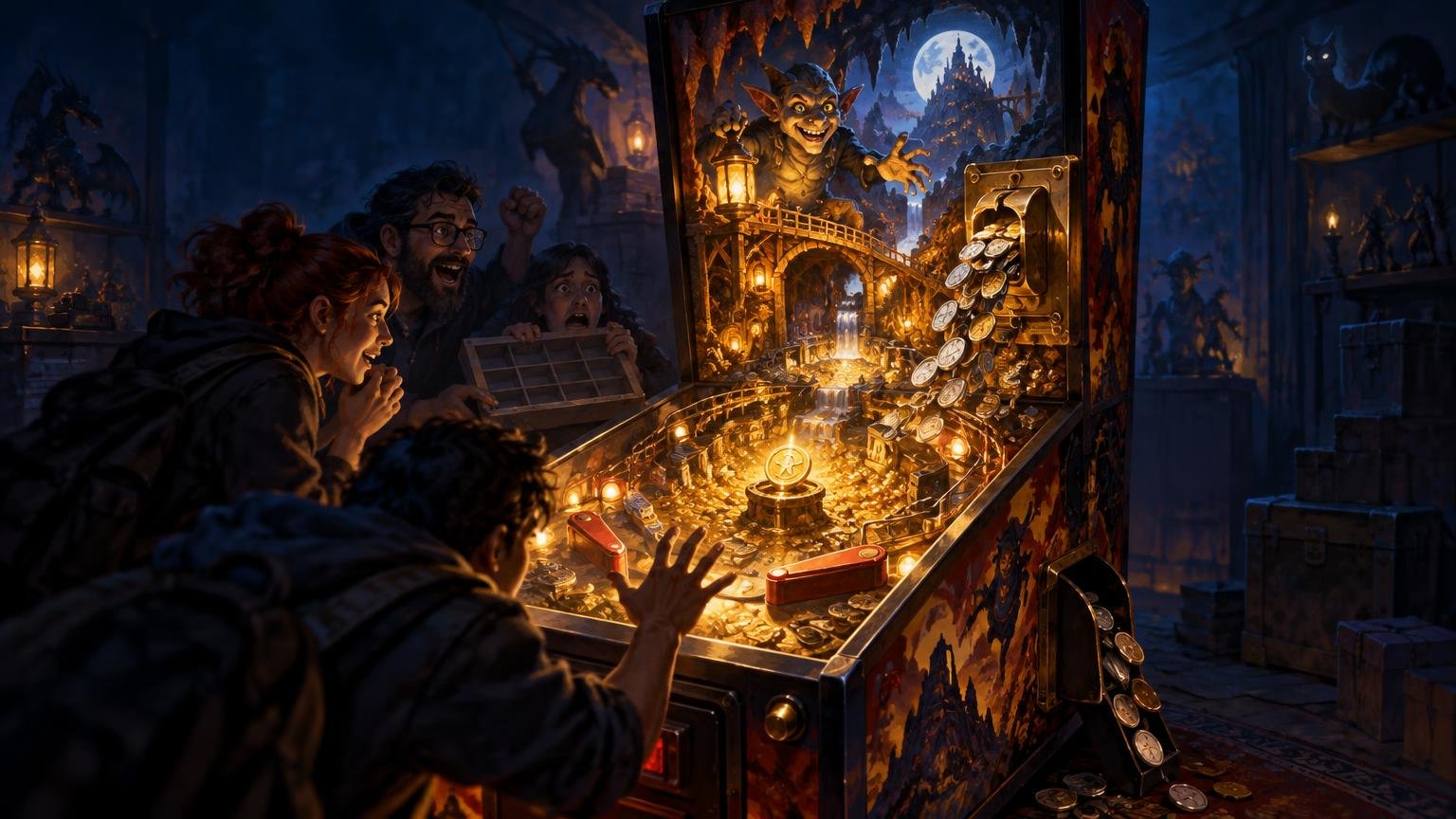
Flip N Out Pinball did not create the Goonies Super Limited Edition scarcity, but it knew exactly what to do with it. The retailer’s November 18, 2026 email offered one of the scarce machines for $49,999 before shipping and tax. At the same time, Flip N Out’s SDTM media operation was presenting Goonies videos, creator access, behind-the-scenes material, and the SLE as an “extremely sought after luxury game.” That combination deserves more scrutiny than the usual shrug about market prices. It turns enthusiasm into sales pressure, then asks the most anxious buyer to fund the premium.
TLDR
The documented $49,999 and later reported $44,999 figures were asking prices, not verified completed sales or known dealer profits. Even with that distinction, the episode is ugly. A retailer with an enthusiast-facing media platform helped build excitement around an 85-machine edition and then invited buyers to compete for a scarce allocation at several times the manufacturer’s drawing price. A willing buyer would prove only that the pitch found its whale. It would not make the system fair, healthy, or worthy of trust.
The scarcity was designed into the product
Spooky Pinball launched The Goonies on November 13, 2026. The standard Collector’s Edition was listed at $10,999 and limited to 1,299 machines. The separate Super Limited Edition was capped at 85, a number tied to the film’s 1985 release. Its upgrades included alternate artwork, an aqua playfield treatment, gold-colored armor, a mirrored backglass, the Butter Cabinet, alternate sculpt treatments, a special topper version, and a signed and numbered apron magnet. The result was not merely a different trim package. It was a deliberately tiny luxury tier built to carry status as well as hardware. Kineticist’s launch report documents the editions and allocation structure.
Only 30 of those 85 SLEs were offered through Spooky’s drawing, and eligibility was restricted to buyers who had already secured a Collector’s Edition. Selected buyers could pay $14,999 total for the SLE instead. The remaining 55 machines went to friends and family or authorized distributors, which could set their own prices. Spooky’s phone allocation reportedly sold out by 10:23 a.m. Central on launch day. Before most buyers had time to digest the rules, scarcity was already doing the sales presentation.
That structure matters because “market price” sounds neutral while hiding the machinery that creates it. This was not a broad public auction among owners of an established collectible. It was a new product with tightly controlled allocations, unequal purchase routes, and a retailer deciding what fear of missing out might bear. The machine may be rare, but the rarity did not descend from the heavens in a pirate ship. It came from a production and distribution plan.
The offer was a whale hunt, not ordinary retail
A Flip N Out allocation explanation preserved on Pinside identified the business as an authorized Spooky distributor and said dealers had been encouraged to sell SLE allocations at “Market Price.” Interested buyers were directed to join a list and wait for a November 18 price email. The archived community thread also shows the split reaction: some readers valued the openness, while others objected to preferred allocations and above-MSRP marketing before ordinary buyers had a fixed public route to the machine.
The email reproduced by This Week in Pinball offered a Goonies SLE for $49,999, plus shipping and applicable state sales tax. Pinside participants later reported another Flip N Out email quoting $44,999 plus tax. Those are historical customer offers, not proof that either price was paid, and neither should be treated as the current price. This Week in Pinball’s reporting provides the original $49,999 offer and broader allocation context.
The arithmetic is still revealing. The first offer sat $35,000 above the $14,999 drawing price; the later reported offer sat $30,000 above it. Those gaps are differences between customer offers made through different allocation channels. They are not established dealer profit, because the public record does not establish Flip N Out’s acquisition cost, final margin, or a completed transaction. Precision here does not soften the criticism. It sharpens it: Flip N Out publicly tested whether manufactured scarcity could support a customer price roughly three times the drawing offer.
Calling this whale hunting is not an accusation of secret misconduct. It is a description of the visible sales strategy. The broad audience supplies attention, chatter, trailer views, first impressions, and social proof. The tiny allocation supplies urgency. The interest list identifies the buyers most likely to tolerate an extreme price. Then the offer goes out privately enough to avoid the stabilizing effect of a normal public sticker price. Somewhere, a harpoon-shaped spreadsheet probably felt very pleased with itself.
SDTM makes the trust problem bigger
The most important issue is not whether an SLE contains enough fancy parts to delight its eventual owner. It is the overlap between promotional media and retail demand. Flip N Out’s SDTM page labels Goonies trailers, an official featurette, and SLE-focused behind-the-scenes videos as SDTM Studio productions. The same page tags Spooky Pinball and Flip N Out Pinball, identifies Flip N Out Pinball, LLC, and supplies Zach Meny’s company contact information. It also describes the SLE as an extremely sought-after luxury game while presenting discussion of its inspiration and features.
Elsewhere, posts associated with the ZMeny account, labeled Flip N Out Pinball on Pinside, mix first looks, impressions, and tutorials with invitations to buy featured machines from Flip N Out. That does not prove dishonest footage, hidden payments, fabricated opinions, or an undisclosed sponsorship. The available evidence establishes something simpler: the same business ecosystem produces enthusiast-facing coverage and sells the products receiving that attention.
That visible commercial interest should change how viewers process the enthusiasm. A feature breakdown can still be informative. A designer interview can still reveal useful details. But when the media outlet praising rarity can also monetize demand for its scarce allocation, the viewer should mentally translate “sought after” into “the seller would like this to become more sought after.” The content may be sincere and commercially useful at the same time. Sincerity does not cancel incentives.
This is why transparency alone is not a magic eraser. Flip N Out may have been open about using market pricing, and readers can give it credit for leaving a documentary trail. Yet disclosure of a method does not make the method consumer-friendly. A casino could put “the house has an edge” over the door in tasteful brass lettering; the edge would remain.
Dealer risk does not settle the ethical question
The strongest defense of premium dealer pricing is that distributors also absorb losses when machines move slowly. That argument entered the Goonies discussion through Jason Grindle of Classic Game Rooms, not Zach Meny. Grindle told This Week in Pinball that dealers can suffer substantial losses on weak inventory, citing claimed losses of $50,000 to $60,000 on Toy Story orders and $20,000 on Ultraman. His position was that occasional high-margin sales can offset those risks.
That is a coherent business argument. It is not a complete ethical defense. A dealer’s bad inventory bets do not create a moral claim on the maximum panic premium available from the next buyer. Retail risk explains why a seller wants more margin; it does not require customers to admire the method used to extract it. The Goonies allocation was especially combustible because Spooky had reportedly overestimated demand for earlier titles, including Scooby-Doo, Looney Tunes, and Texas Chainsaw Massacre, before adjusting production on later games. Scarcity may reduce manufacturer and dealer exposure, but transferring that risk into FOMO pricing is still a choice.
Nor does “someone will pay it” resolve the argument. Market price describes an outcome, not a code of conduct. Pinball communities rely on repeat relationships, shared information, location access, tutorials, streams, and the sense that enthusiasm is more than a lead-generation funnel. A buyer can consent to a terrible value. A seller can legally chase the highest offer. The rest of the community can still decide that converting privileged allocations and audience trust into a five-figure scarcity premium makes the hobby worse.
How buyers should read retailer-produced hype
The practical response is not to treat every retailer video as propaganda. It is to separate product information from demand language. Rules explanations, shot geometry, component details, and service documentation can be checked. Claims that a machine is hot, sought after, impossible to obtain, or destined to command a premium deserve a colder reception when they come from someone holding inventory.
- Ask whether the speaker can profit directly from increased demand for the featured machine.
- Separate the manufacturer’s production limit from evidence of lasting collector demand.
- Treat private interest lists and expiring offers as sales tools, not independent price discovery.
- Compare the offered machine with what else the same money buys, including several excellent games rather than one status edition.
- If collection churn is part of the justification, plan the exit before buying; Kraken Opus has a practical framework for deciding whether to sell, trade, rent, or keep a pinball machine.
A November 23, 2026 inventory check found no Goonies machine listed in Flip N Out’s public shop or searchable product index, while Spooky’s Goonies category showed accessories rather than either game edition. That does not establish a sale, a sellout, or the absence of another private offer. It merely means the historical emails should not be presented as a current public listing.
The hype was part of the product
The Goonies SLE controversy is not really about whether gold-colored armor and a Butter Cabinet can be worth $14,999, $44,999, or $49,999 to one wealthy collector. Luxury purchases have never required a permission slip from the value police. The problem is the system: scarce allocations, unequal access, retailer-produced enthusiasm, private interest capture, and a price designed to locate the buyer most afraid of missing out.
Flip N Out Pinball had the right to ask. Pinball buyers have an equally strong reason to remember the ask. When a retailer also acts as a hype engine, trust should depend on visible restraint, clear separation between information and sales language, and pricing that does not treat community excitement as a resource to be strip-mined. On the documented Goonies SLE offer, Flip N Out showed the opposite instinct. It sold the feeling first, then sent the bill for having it.
References
- The Goonies Pinball: Spooky's Pricing, SLE Drawing & Details | Kineticist
- Whale Hunt
- Flip N Out Pinball: Fallout Tutorial (page 26) | Pinside Forum
- The Goonies Hype Thread Spooky Pinball (page 122) | Pinside Forum
- SDTM: a pinball website
- Flip N Out Pinball: Fallout Tutorial (page 26) | Pinside Forum
- Shop | Flip N Out Pinball, LLC
- Goonies Archives – Spooky Pinball