
“You didn’t lose because of one land.”
Sure. But also… sometimes you did.
Most Magic games are decided by small timing edges. One missed two-drop. One turn where you couldn’t hold up removal. One awkward hand where you had the spell, but not the mana right now. And the sneaky culprit, especially in casual lists and precon upgrades, is the same every time:
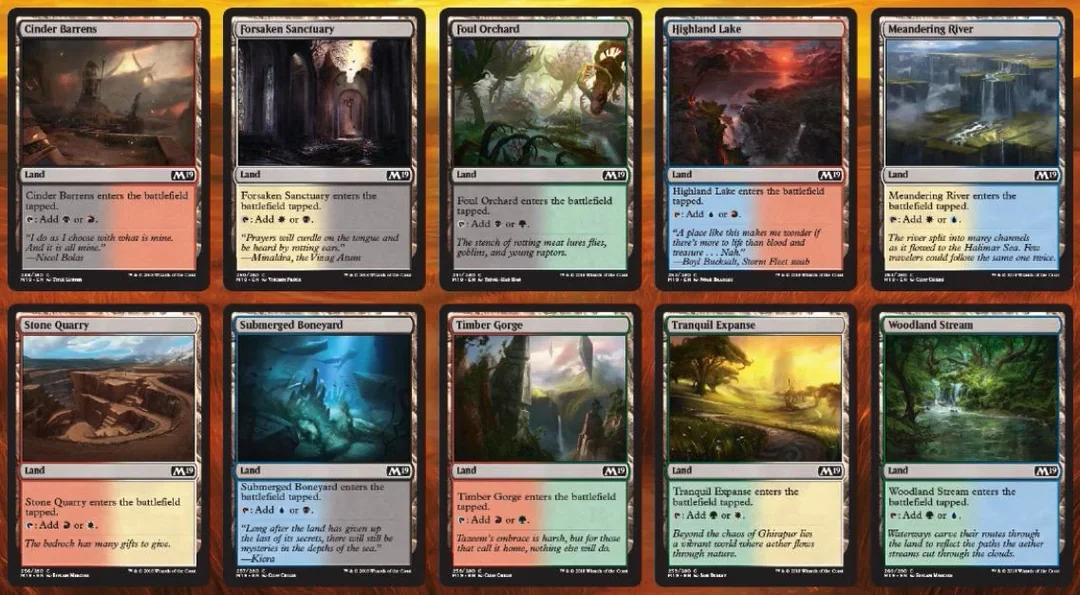
Too many lands that enter the battlefield tapped.
Taplands aren’t automatically “bad.” They’re a tool. The problem is when they quietly pile up until your deck is always half a step behind the table. Let’s talk about what that looks like, why it matters, and how to fix it without turning deckbuilding into a spreadsheet hobby.
What counts as a “tapland” (and why they exist)
A tapland is any land that comes in tapped some or all of the time. That includes:
- Lands that always enter tapped (many budget dual lands, tri-lands, scry lands, etc.)
- Lands that enter tapped unless you meet a condition (like controlling a basic land type, having two other lands, revealing a land type, and so on)
- Lands that usually enter tapped early (some cycles are basically “turns 1–2 tapped, later untapped”)
Design-wise, “ETB tapped” is one of the most common ways Magic balances color fixing. Multi-color mana is powerful. The game often asks you to pay for that power with tempo.
And tempo is the key word. You don’t just “lose one mana.” You lose a turn of options.
The real cost: tempo loss is a snowball, not a single point
Here’s the simplest way to feel the problem:
If you play a tapland on turn two, you effectively took a turn where you had one less mana than your curve expects.
That can mean:
- Your two-drop becomes a three-drop.
- You can’t play a threat and hold up protection.
- You can’t double-spell on a critical turn.
- You pass with removal in hand but not enough mana to cast it.
And once you start missing early beats, you often keep missing them. Not because your deck is broken, but because you’re always reacting from behind.
In 60-card formats, this is brutal because games are faster and curves are tighter. In Commander, it’s still brutal because the table will snowball value while you’re “just getting set up.”
Signs you have too many taplands
If any of these feel familiar, your mana base is probably the issue (not your card choices):
- You keep hands that look fine, then you do nothing meaningful until turn 3–4.
- You’re constantly saying, “If this land was untapped, i had it.”
- You miss the chance to hold up interaction (counterspell, removal, protection) because your land drop ate your turn.
- You often can’t cast your commander on curve, even when you hit land drops.
- You’re stuck choosing between color fixing and tempo every early turn.
A lot of players respond by adding more ramp. That can help, but it can also hide the real problem: ramp doesn’t fix the turn where you needed untapped mana right now.
So… how many taplands is “too many”?
There isn’t one perfect number, because it depends on format, deck speed, and how strict your curve is. But there are solid rules of thumb that keep you out of the danger zone.
Commander (EDH)
Commander decks often run lots of lands, and games go longer, so you can “get away with” more taplands than 60-card. But that doesn’t mean you should.
A practical guideline:
- 0–4 taplands: feels smooth in most mid-power decks
- 5–8 taplands: noticeable, but manageable with good sequencing
- 9+ taplands: you’ll feel slow in almost every pod unless your deck is intentionally durdly
Also, watch out for the trap where your “taplands” are half your nonbasics because you upgraded spells first and left the mana base untouched.
60-card constructed
If you’re trying to curve out, the bar is much stricter:
- 0–2 true taplands in most proactive decks
- 3–4+ and you’re basically choosing to play slower than opponents
Control decks can tolerate a little more, but only if those lands are giving real payoff (card selection, utility, strong fixing) and your deck is built to trade early anyway.
Limited (Draft/Sealed)
Limited is the format where taplands are often fine, because curves are slower and color fixing matters. But “fine” still doesn’t mean “free.”
- A couple taplands is normal.
- A pile of them will make your draws clunky and your early turns weak.
Land sequencing: how to play taplands without punting tempo
Even before you change a single card, you can win games just by sequencing better.
The basic idea:
Play your taplands on turns when you weren’t going to use all your mana anyway.
That often means:
- Turn 1: tapland is usually safest if you don’t have a must-play one-drop
- Turns where you’re casting a spell that doesn’t use all your mana (like a 2-drop on turn 3)
- After you’ve stabilized, when one mana doesn’t change what you can represent
And the flip side:
Avoid playing taplands on turns where you want to:
- hit a key spot on your curve (2, 3, 4)
- hold up interaction
- double-spell
A good mental habit is to ask: “What do i need to represent next turn?” If the answer is “removal + protection” and you’re about to play a land tapped, you’re probably about to feel that mistake immediately.
Fixing the problem without spending a fortune
You don’t need the most expensive lands to get a much faster deck. The real upgrade is shifting your mana base toward untapped sources and cutting the worst offenders.
Step 1: cut the “no upside” taplands
If a land enters tapped and only taps for mana, it needs a very good reason to be there. In two-color decks, these are usually the first to go.
Step 2: keep taplands that actually pay you back
Some ETB tapped lands are worth it because they do more than fix colors. For example:
- lands that provide card selection (scry-style effects, surveil-style effects)
- lands that provide real utility (important abilities that matter later)
- tri-color fixers in decks that truly need them (especially 4–5 color), where casting spells at all is the priority
A useful test: “If this land entered untapped, would i still play it?”
If the answer is no, the upside probably isn’t real.
Step 3: add more basics than you think you should
This sounds boring, but basics do two important things:
- they enter untapped
- they make your conditional lands and ramp spells work better
A lot of “my mana is bad” decks aren’t short on fancy lands. They’re short on lands that just work.
Step 4: swap in “cheap untapped” cycles
There are plenty of land cycles that are commonly cheaper than premium staples but still help you play on curve. The names and prices change over time, so i won’t pretend there’s one perfect shopping list. But the categories that usually help are:
- lands that often enter untapped with light conditions
- lands that trade a small cost (like life) for speed
- lands that give you flexible color choices without entering tapped
If you’re upgrading slowly, aim for this simple ratio:
Every time you add a cool new spell, try to also upgrade one land that makes that spell easier to cast on time.
A quick “tapland audit” you can do in 5 minutes
Open your decklist and count:
- Always tapped lands
- Usually tapped early lands
- Conditional taplands (sometimes untapped)
Then ask:
- How many of category (1) do i have? (These are the danger.)
- How often do category (2) lands behave like taplands in my early turns?
- Do my conditional lands actually come in untapped in my deck, or is that wishful thinking?
Finally, set one clear target:
- “I’m cutting 3 taplands and replacing them with untapped sources.”
That alone will make your deck feel like it gained power, even though you didn’t change a single spell.
Conclusion: your deck isn’t “slow,” your lands are
Most people don’t lose because they played a tapland once. They lose because they played taplands every game, across the first four turns, and never got their feet under them.
If your deck feels clunky, start here:
- reduce the number of “no upside” taplands
- sequence tapped lands intentionally
- bias toward untapped sources and basics
- keep only the taplands that truly pay you back
Do that, and your deck will feel like it got smarter overnight. Same spells. Same strategy. Just… the ability to actually cast them when it matters.