
Most people think land sequencing is “a tryhard thing.” Then they lose a game where they had the right spells in hand, but couldn’t cast them on time.
That’s the whole point. Land sequencing isn’t about showing off. It’s about not tripping over your own mana base.
When you play lands in the wrong order, you don’t just “waste” a mana. You lose tempo, you give away info, and you force yourself into bad lines. And it happens fast. Turn one and turn two decisions can decide the entire game.
This guide is about the habits that actually help: when to play taplands, how to sequence conditional lands, when to fetch, and how to keep options open without getting cute.
What “land sequencing” really means
Land sequencing is two decisions that get mashed together:
- Which land to play this turn
- When to play it (pre-combat, post-combat, before a draw spell, etc.)
The “which” part is mostly about color fixing and tempo.
The “when” part is about information. Sometimes you want to conceal what you can do. Sometimes you want to represent a trick. Sometimes you want to wait because you’re about to draw cards and your land choice might change.
You don’t need a perfect plan. You just need to stop doing the autopilot thing.
The golden rule: play the land that keeps the most doors open
If you only remember one idea, make it this:
Your land drop should maximize your options next turn, not just this turn.
That usually means:
- You prioritize the colors you’ll need soon (especially double-pip costs like UU, BB, etc.)
- You avoid locking yourself into one color when you could keep two colors available
- You don’t burn a land that “needs a condition” before you’ve met that condition
This is why sequencing is so tied to your mana curve. A deck with a lot of two-drops and three-drops cares a lot more than a deck that’s basically ramp + haymakers.
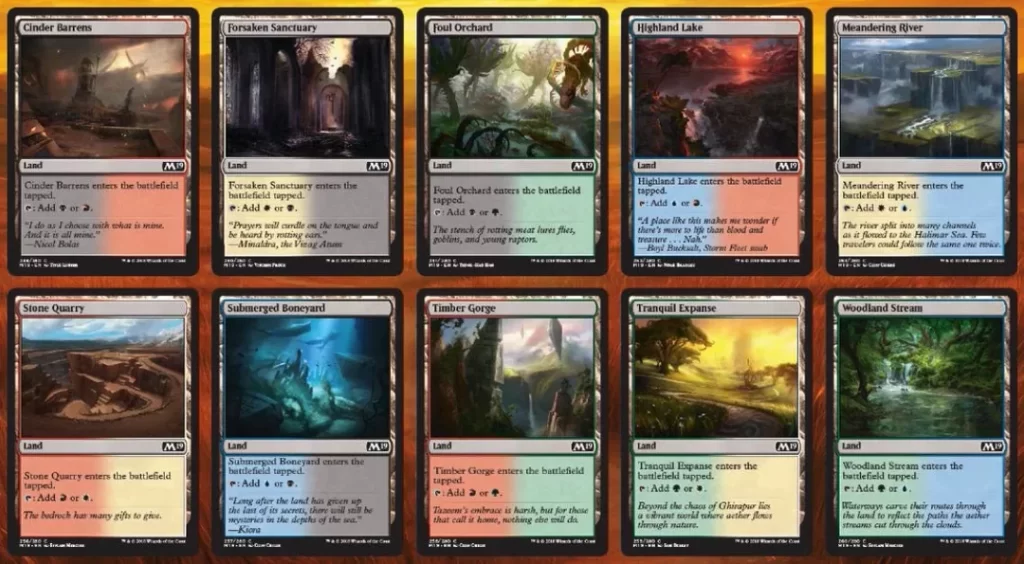
The tapland question: should you always play tapped lands first?
A lot of players follow a simple rule: “play your tapped lands early so they don’t mess you up later.” That rule isn’t dumb. It’s just incomplete.
Yes, if you’re going to play an ETB tapped land at some point, the least painful turns are usually:
- Turn 1 (if you don’t need an untapped one-drop)
- Any turn where you’re not using all your mana anyway
But here’s what that rule misses:
Sometimes the “correct” early land is an untapped land
Because you need to:
- cast a two-drop on curve
- hold up interaction
- play a ramp spell that fixes colors
- enable a conditional land on the next turn (more on that below)
Some tapped lands are worth earlier priority than others
A tapland with upside (like scry) can be worth playing earlier than a “no upside” tapland, because it gives you selection now, not later.
So the better rule is:
Play tapped lands early only when they don’t take away a turn you needed.
If you’re staring at a hand where turn two matters, don’t donate that turn to your land.
Sequencing conditional lands: this is where most mistakes happen
A lot of the “good” nonbasic lands are only good if you help them.
Here are common patterns you should plan for.
Checklands: don’t strand them
Checklands care about basic land types (or typed duals). If you play your checkland too early, it may come in tapped when it didn’t need to.
In plain terms: if your hand is basic + checkland, it’s often correct to lead with the basic so the checkland comes in untapped next.
Also, your deck needs enough typed sources for checklands to behave. If you don’t have that density, you’re basically playing more taplands than you think.
Slowlands: they want you to make land drops
Slowlands tend to be great if your deck reliably hits its early land drops. If your deck is low-land or super spell-heavy, they’ll betray you more often.
So if you keep a two-land hand with a slowland, plan your first two turns carefully. Missing a land drop turns it into a tapland at the worst time.
Fastlands: use the window
Fastlands give you a generous early window. But once you’re past that, they can turn into “surprise taplands.” That’s not a reason to avoid them. It’s a reason to sequence them early if you can.
If you already know your turn four play needs untapped mana, don’t casually save the fastland for turn four.
Fetchlands: crack now or wait?
Fetchlands are powerful because they:
- fix colors
- thin the deck a tiny bit
- shuffle away unwanted cards after top-deck manipulation
- conceal information (sometimes)
But the real skill is knowing when to fetch immediately and when to wait.
Fetch early when you must hit a color on curve
If your hand needs white on turn two and blue on turn three, don’t get fancy. Fetch what makes your curve work.
Wait when you’re about to gain information
If you’re going to:
- cast a cantrip
- scry
- surveil
- tutor to the top
…then waiting to fetch can be correct because you might want the shuffle later (or you might find you don’t need it).
Don’t take extra damage for no reason
If fetching forces a shockland decision, think about the matchup and your role. If you’re the control deck, your life total is a resource. If you’re racing, it’s a clock. Don’t autopay 2 life just because you can.
“When” to play your land during the turn matters too
Most players slam their land immediately in main phase one. That’s fine a lot of the time. It’s also a missed opportunity in others.
Here are the real reasons to delay your land drop:
- You might draw cards and want to choose a different land
- You want to force your opponent to act with less information
- You want to bluff interaction (or avoid showing you can’t have it)
And there are reasons to play it early:
- You need the mana now
- The land has an effect you want before spells (like scry)
- You want to represent a combat trick or interaction
This isn’t about being sneaky for no payoff. It’s about recognizing that “land drop timing” is part of sequencing.
A simple land sequencing checklist (use it every game)
Before you play your land for turn, ask:
- What do i need to cast next turn? (colors and total mana)
- Do i need to keep mana open this turn? (removal, counterspell, protection)
- Is any land in my hand conditional? (will it be better if i wait / play something else first?)
That’s it. If you answer those three questions honestly, you’ll fix a big chunk of your sequencing errors.
Real examples (the kind that decides games)
Example 1: basic + checkland + two-drop
Hand: Plains, checkland that cares about Plains/Island, two-drop that needs white.
If you play the checkland first and it enters tapped, you might miss your two-drop. If you play the Plains first, your checkland is often untapped on turn two, and your curve works.
Example 2: tapland vs holding up interaction
You’re on turn three with a two-mana removal spell in hand and an opponent who is about to slam a must-answer threat.

If you play a tapland here, you may lose the ability to answer it on time. Sometimes the correct play is to take worse fixing now so you can actually interact.
Example 3: fetchland + top-deck manipulation
You have a fetchland and a scry effect. If you fetch first, you might shuffle away a card you would have kept. If you scry first, then decide whether to fetch, you get to keep the good card and shuffle the bad one.
Sequencing creates free value when you let the order work for you.
Conclusion: good sequencing makes your deck feel “stronger”
The funny part is this: when you fix land sequencing, people think you upgraded your deck.
You didn’t. You just stopped donating turns.
Play lands in an order that protects your curve, keeps mana open when it matters, and makes your conditional lands actually behave. Do it for a week and you’ll notice fewer “i could’ve won if…” games.
And that’s the whole goal.