
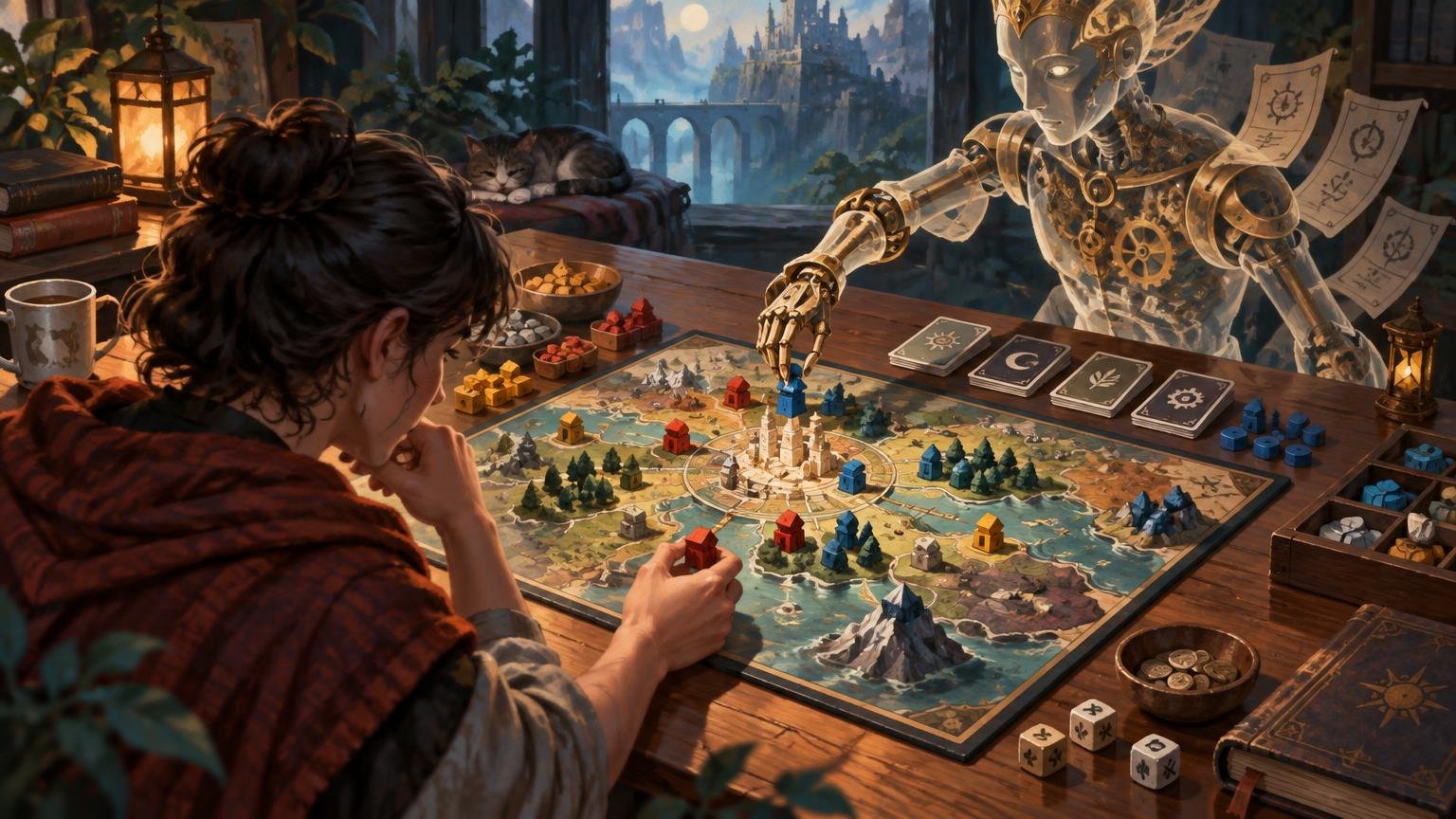
TLDR: A solo mode feels like the same game when it preserves the multiplayer design’s defining pressure, not when it simulates every action another player could take. Good board game solo mode design identifies what creates tension—blocking, racing, scarcity, spatial control, timing, or uncertainty—and reproduces that pressure with the lightest system that still supports meaningful counterplay.
The important question is not “Does this bot behave exactly like a person?” It is “Does playing against this system force the same kinds of difficult decisions?” A convincing automated opponent may follow rules no human would use. That is fine if its presence makes familiar spaces contested, resources scarce, plans vulnerable, and timing consequential.
Solo design is a preservation problem
Multiplayer games contain many procedures, but only some of them create the game’s identity. A worker-placement game may include resource conversion, card acquisition, engine building, and endgame scoring. If its real tension comes from opponents taking action spaces before you can reach them, a solo mode must preserve that blocking pressure. Simulating an opponent’s entire engine while leaving the board conveniently open would reproduce activity without reproducing the game.
Start by mapping the interactions that can change a player’s plan. Common examples include competing for limited spaces, depleting a shared market, racing toward objectives, controlling territory, setting prices through bidding, attacking exposed positions, and triggering the end of the game. Then ask which one would be most damaging to remove.
| Multiplayer pressure | What the solo system must preserve | Possible low-upkeep tool |
|---|---|---|
| Blocking | The risk that a needed action becomes unavailable | Priority-based space selection |
| Racing | A credible deadline or rival pace | Progress track or round threshold |
| Shared scarcity | Resources or cards disappearing before the player can claim them | Market-clearing event deck |
| Spatial control | Changing access, adjacency, or scoring opportunities | Placement priorities with complete tie-breakers |
| Combat | Threats that alter positioning and resource allocation | Scripted targeting and escalation rules |
| Hidden intent | Uncertainty about what happens next | Shuffled behavior deck or event table |
This interaction audit prevents a common design mistake: building a complicated bot because the multiplayer rules are complicated. Complexity is only justified when it preserves a decision the player would otherwise lose.
Choose the smallest system that creates the required pressure
An active bot is not automatically the best answer. Some games only need a clock. Others need an opponent that occupies spaces, removes cards, or threatens particular regions. The mechanism should match the missing interaction rather than an abstract expectation that solo games require a miniature second player.
- Use a timer or progress track when the central tension is efficiency under a deadline.
- Use thresholds when the player should win by achieving a clear standard rather than merely accumulating an arbitrary high score.
- Use an event deck when the game needs unpredictable disruption but not a persistent opponent state.
- Use a priority ladder when the system must choose among visible legal options.
- Use a bot deck when varied behavior, tempo, or uncertainty matters from turn to turn.
- Use a decision tree when choices depend heavily on the current board state.
- Use scenarios when specific objectives and constraints can create the missing tension more cleanly than a general opponent.
These structures can be combined, but each additional subsystem creates upkeep. A bot with a deck, personal board, resource economy, flowchart, and several difficulty modules may preserve more details while making the human spend much of the session administering an unusually demanding imaginary colleague.
Prometheus Game Labs described several goals for Micro Midgard’s solo development: quick AI operation, few additional components, a player-facing puzzle, some sense of an opponent, and time pressure. That combination is instructive because it treats opponent presence and operational efficiency as simultaneous requirements rather than assuming fidelity excuses friction.
A bot can use different rules and still preserve the game
Automated opponents frequently need procedures that differ from human decision-making. A human can interpret motives, evaluate long-term value, and break an informal tie. A rules-driven opponent needs every important choice converted into a reproducible instruction.
The published Churchill rules use decision-tree instructions for non-human sides within the game’s conference sequence. GMT Games’ Churchill rules show how state-dependent questions can direct an automated side without requiring the solo player to invent its strategy. By contrast, the Gaia Project Automa rules demonstrate how valid options, selection procedures, and tie-breakers can formalize targeting that might otherwise be left to player discretion.
Neither approach needs to think like a human. Its job is to produce consequential board states consistently. This distinction matters because simulating a complete human economy can be expensive in rules and components. If the opponent only needs resources so it can block spaces, perhaps it does not need resources at all; it may simply select a legal space according to a priority system.
GMT’s CDG Solo System takes another approach: a reusable framework supported by game-specific playsheets and rules modifications. That structure illustrates an important limit to generalization. A common operating framework may reduce relearning, but the material that connects it to a particular game still has to understand that game’s incentives and procedures.
Dedicated development can also be part of the product rather than an unofficial afterthought. Osprey describes Sankoré: The Pride of Mansa Musa as supporting one to four players with an automated solo opponent, while its rulebook credits David Digby with solo-mode development. Those facts establish the published structure and credit; they do not, by themselves, establish balance, ease of use, or how closely the solo experience resembles multiplayer play.
Write the automated opponent as a complete procedure
A bot becomes frustrating when the player must quietly make favorable or unfavorable decisions on its behalf. Every moment of discretion introduces cognitive work and raises an awkward question: are you solving the game, operating the game, or choosing how hard the game should resist you?
A robust procedure should answer five things whenever the opponent acts:
- What type of action does the bot attempt?
- How does it identify all legal options?
- How does it rank those options?
- How does it break a tie without player preference?
- What happens when its first instruction is impossible?
Deterministic priorities are useful where predictability creates planning. Randomness is useful where uncertainty is part of the original tension. The best balance is often predictable operation with uncertain timing or priorities: the player understands what the bot can do and can plan around it, but cannot reduce the session to a solved script.
Counterplay is essential. If the bot merely removes resources randomly, the player experiences interference but may have no meaningful response. If its priorities are visible, the player can anticipate a contested space, manipulate a tie-breaker, accelerate before a threshold, or accept one loss to protect something more valuable. That is where automated pressure turns back into strategy.
Upkeep is part of the design, not an administrative footnote
A solo mode occupies both mental and physical space. Added decks need shuffling and storage. Bot boards expand the table footprint. Flowcharts require readable references. Expansion content may need additional priority rules. Downloadable variants can create printing and organization work before play begins.
That burden should be evaluated against what the system adds. A detailed bot may be appropriate for a long conflict game in which opponent positioning is the main event. The same procedural weight can smother a compact engine builder whose appeal depends on quick turns.
For owners, this means checking more than whether “1 player” appears on the box. Look for the solo rulebook, component list, setup changes, required reference material, and compatibility notes for the exact edition or expansion mix you intend to use. Product contents and downloadable files can change, so verify the relevant printing and current rules before making an ownership decision.
It is also worth separating solo-only design from multiplayer conversion. A solo-first or cooperative game can build its entire action system around scripted opposition. A multiplayer game receiving a solo variant has inherited interactions that may resist automation. Neither model is inherently superior, but the conversion has a harder preservation problem.
How to test board game solo mode design
Testing should measure both strategic preservation and operating cost. There is no universal acceptable number of lookups, bot steps, or setup minutes. Record them so different versions can be compared rather than declaring a system “streamlined” by intuition.
- List the multiplayer decisions the mode is intended to preserve, then note whether each one remains consequential.
- Count bot-resolution steps and reference lookups by round.
- Record additional setup and teardown tasks separately from the base game.
- Test whether one repeatable player strategy exploits the bot’s fixed priorities.
- Check every target-selection tie, illegal action, empty deck, blocked location, and exhausted resource state.
- Test difficulty changes to see whether they alter decisions or merely add arithmetic and upkeep.
- Ask whether losing reveals a strategic mistake, an understood risk, or an opaque procedural surprise.
- Check whether the solo rules can be learned without repeatedly consulting the multiplayer rulebook for unstated assumptions.
- Test expansion modules individually before combining them; new spaces, resources, and objectives can invalidate old priorities.
Owners evaluating finished games can use the same framework. Published rules reveal structure, but they cannot prove that a bot feels human, remains interesting over repeated plays, or is worth its component burden. For broader examples of how subjective solo assessments can be organized, see this collection of solo board game ratings. Treat those impressions as table experience rather than as substitutes for documented rules.
Separate rulebook facts from table experience
A useful solo review should have two layers. The first reports verifiable structure: win condition, bot components, setup changes, decision procedures, difficulty modules, supported player count, and rules version. The second reports table experience: how easy the opponent was to operate, whether its behavior became exploitable, whether the pressure resembled multiplayer tension, and whether upkeep interrupted planning.
Subjective findings become more useful when the reviewer states the number of plays, scenario or module, difficulty, edition, and rules version used. Without that context, “the bot is easy” might mean strategically weak, procedurally simple, or merely familiar after repeated play. Those are three different judgments.
The same game does not require the same opponent
A successful solo mode preserves consequences. Spaces still become unavailable. Races still demand commitment. Markets still change before a perfect plan matures. Territory still matters. The player can still predict, adapt, take risks, and blame at least some defeats on an actual decision rather than a bookkeeping avalanche.
The practical next step is simple: name the one multiplayer pressure the game cannot afford to lose. Build the smallest procedure that restores it, give that procedure complete priorities and fallbacks, and measure its upkeep alongside its difficulty. If the original decisions survive, the solo mode can feel like the same game even when the opponent plays by entirely different rules.
References
- Designing Micro Midgard Solo Mode with Shem Phillips – Part 1 – Prometheus Game Labs
- Churchill Rules
- MORTEN MONRAD PEDERSEN | LINES J. HUTTER | DAVID STUDLEY | Consultant: JAN SCHRÖDER
- GMT Games – CDG Solo System
- Sankoré: The Pride of Mansa Musa: Fabio Lopiano: Osprey Games – Osprey
- Sankoré
The Pride of Mansa Musa
Game design: Fab