
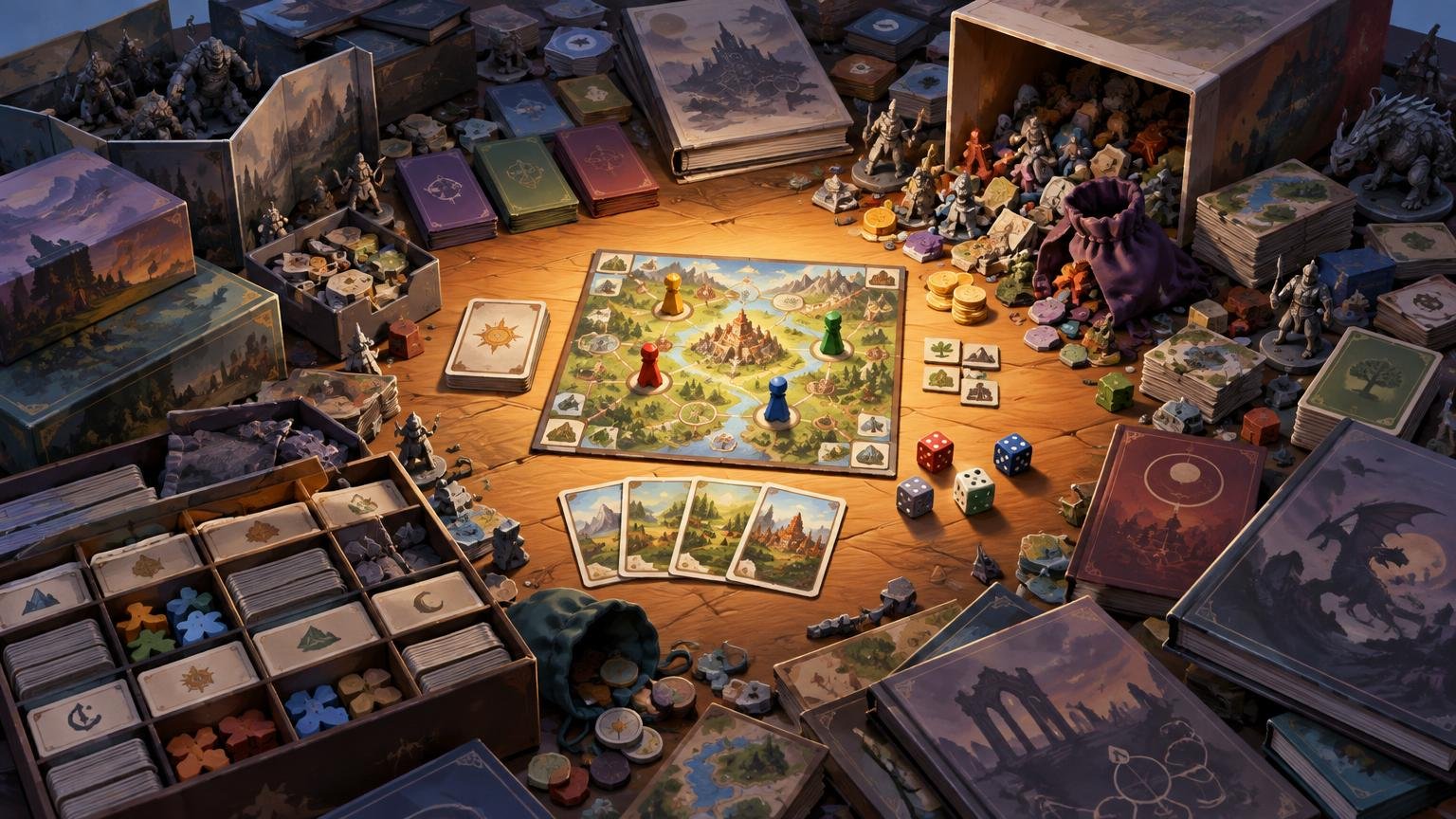
Expansion bloat begins when owning more game produces less playable game. The box contains additional factions, decks, maps, scenarios, currencies, exceptions, and tiny bags labeled with increasingly desperate abbreviations—but getting a satisfying session to the table becomes harder.
The problem is not simply the number of expansions. A game can have a vast catalog without becoming bloated at the table, provided each session uses a clean, limited selection. Conversely, one poorly integrated module can create more friction than five neatly compartmentalized ones. What matters is the cost imposed on choosing, preparing, teaching, playing, and maintaining the game.
That makes board game expansion bloat an ownership-system problem as much as a design problem. The useful question is not “How much content do I own?” It is “How much of this content improves the sessions I can realistically organize?”
Expansion bloat is accumulated friction
Expansions usually promise variety, longevity, or a solution to a limitation in the base game. Those benefits can be real. A new faction may introduce a compelling strategic puzzle. More cards may reduce repetition. A player-count extension may let the whole group participate.
Every addition also has a carrying cost. Components need storage. Rules need remembering. Modules need selecting. New systems may need teaching. Card pools can become less predictable, and old reference material may no longer describe the complete game. None of these costs is necessarily fatal, but they accumulate.
| Type of bloat | What creates it | What happens at the table |
|---|---|---|
| Setup bloat | More decks, boards, tokens and module-specific preparation | The group spends longer assembling the game or avoids it entirely |
| Rules bloat | Additional phases, exceptions, keywords and interactions | Teaching becomes fragmented and rule lookups increase |
| Choice bloat | Too many factions, maps, scenarios or module combinations | Players spend session time deciding which version to play |
| Storage bloat | Components outgrow the original insert or box | Finding and returning pieces becomes a separate puzzle |
| Balance bloat | New content changes probabilities or faction relationships | The group must curate combinations or accept uneven sessions |
| Maintenance bloat | Errata, revised rules, edition changes and compatibility issues | Owners must reconcile documents and identify which components belong together |
This distinction matters because a larger game is not automatically a worse game. If extra material stays dormant until deliberately selected, its cost during play may be tiny. Bloat appears when the library starts interfering with access to the game.
A large catalog can still produce a small session
Dominion is a useful model of controlled abundance. Its standard setup uses seven fixed Base card piles and 10 selected Kingdom piles. Kingdom cards not selected for that session return to the box, and expansion rulebooks retain the 10-pile structure. A large collection therefore expands the setup library without requiring every owned card to enter every game.
This is content expansion without proportional rules expansion. Players still need a method for selecting the Kingdom, and a huge collection creates an organization problem, but the active game remains bounded. The collection may be enormous while the table sees only a curated slice.
Root handles abundance through a related principle: choose the factions for this session, then set up those factions. The official Root rules library supports Standard Setup as well as faction setup cards supplied with expansions. Extra factions increase the possible matchups, but they do not all become simultaneous subsystems.
Selective systems work because they separate owned complexity from active complexity. The shelves hold a library; the table hosts one readable configuration. Bloat is more likely when an expansion insists that its mechanisms be permanently mixed into the base game or when separating them later is impractical.
Shuffle-in expansions have a hidden ratchet
Some expansions are designed to disappear into the base game. Stonemaier says the Wingspan: European Expansion includes 81 bird cards and five bonus cards intended to be shuffled into the original decks and cards from future expansions. That approach minimizes setup decisions: once integrated, the new content simply appears during play.
The tradeoff is reversibility. A permanently mixed card pool is convenient until the owner wants to teach a simpler version, adjust the frequency of a particular effect, sell one expansion, or reconstruct the original game. The module has stopped behaving like a module and become part of the default system.
Mix-in content can also dilute rather than complicate. If an expansion adds cards supporting a particular mechanism but the full deck grows faster than the number of those cards, the new mechanism may appear less reliably than expected. The exact effect depends on the game’s card distribution and draw structure, so “more variety” does not automatically mean “more meaningful variety.” Sometimes it means seeing each idea less often.
Before combining a shuffle-in expansion, ask whether the game supplies a practical way to identify and remove its cards. Expansion symbols, dividers and separate storage lanes are not cosmetic luxuries here. They preserve the ability to edit the system later.
Player-count expansions can multiply ownership requirements
An expansion can solve one limitation while creating a product stack. CATAN explains that playing with five or six people while using a selected expansion can require four products: the base game, the chosen expansion, the base-game five-to-six-player extension, and the corresponding extension for that expansion. CATAN’s official five-to-six-player guidance lays out that structure directly.
This does not make the products inherently bad. It shows how one seemingly simple goal—add another player—can cross several compatibility layers. The owner must verify that each part matches the intended configuration, teach the expanded turn structure, and store the combined components in a retrievable way.
Compatibility can also change across editions. CATAN says older and current English editions can be used together, but notes differences in card backs, component sizes and designs, along with some incompatibilities that may require sleeves or replacement cards. Its five-to-six-player rules were also updated in 2021, replacing the former special-building phase with a paired-players turn rule across the base game and several major expansions.
This is maintenance bloat: the cardboard still exists, but the owner must know which rule document governs it. When evaluating an older expansion collection, counting boxes is less useful than mapping editions, required dependencies and current rules.
Rules growth can turn memory into archaeology
Rules-heavy expandable games face another problem: later content may expose ambiguities, require revised terminology, or standardize wording that was inconsistent in earlier releases. The revised-core rulebook for Arkham Horror: The Card Game says earlier content remains compatible while recommending the core set and current releases as a smaller current environment. It also discusses changes in templating, wording and rules as the game expanded.
Compatibility is not the same thing as simplicity. A veteran may understand that two differently worded cards are intended to function within the same rules framework. A new player sees two phrasings and reasonably wonders whether the distinction matters. Each wording change creates a small interpretive tax.
Living and expandable games can justify that tax by offering deep deck construction, campaign variety or evolving design. The warning sign is not that the rules have grown. It is that the group can no longer identify a stable entry point. If teaching requires a lecture on historical templating before the first turn, the collection is controlling the session rather than supporting it.
The worst bloat happens before play begins
Owners often diagnose a game as too complicated when the real failure occurs during retrieval. Components from six products have been consolidated into one heroic box, but the insert no longer communicates where anything belongs. Three decks look nearly identical. Tokens used only in one scenario share a bag with universal pieces. The setup guide assumes everything remains in its original packaging.
This produces a nasty feedback loop. Because setup is difficult, the game is played less often. Because it is played less often, rules familiarity decays. That makes the next setup and teach slower, so the game is selected even less often. Eventually the collection becomes an impressive cardboard monument to sessions that might happen someday.
The practical metric is retrieval time, not storage density. Fitting every component into one box is not an organizational victory if nobody can find the starting decks. A second labeled box may be better than a perfectly packed puzzle that must be excavated before every session.
How to tell whether an expansion is hurting the game
Subjective table experience matters here, but it should be tied to observable friction. “The game feels bloated” becomes more useful when translated into a specific failure.
- Setup regularly stalls because nobody remembers which components belong to the chosen configuration.
- Teaching requires explaining modules that are technically present but unlikely to matter during the session.
- Players choose the base game because selecting expansions feels like a separate game with a worse rulebook.
- The expanded card pool makes favored mechanisms appear too rarely to shape strategy reliably.
- One module is always included even though the group cannot explain what enjoyment it adds.
- Rules questions depend on reconciling multiple documents, editions or pieces of errata.
- The consolidated storage solution saves shelf space but increases setup and teardown effort.
- The game no longer reaches the table because the group remembers the administrative work more clearly than the play.
Different groups will tolerate these costs differently. A regular group may happily internalize a dense campaign system that would flatten an occasional game night. Players who enjoy pregame configuration may regard module selection as part of the hobby. There is no universal component count at which bloat begins.
The defensible claim is narrower: an expansion makes a particular collection worse when its recurring costs exceed the value it adds for the people actually playing it.
Build a default configuration instead of using everything
The most effective response to expansion bloat is not necessarily selling half the collection. Start by defining a default version of the game. It should be the configuration that can be retrieved, taught and played with the least negotiation while preserving the features your group values.
- Return to the base game for one session. Identify which problems are real rather than merely familiar.
- Add one expansion or module that addresses a specific problem or creates a desired style of play.
- Keep optional content physically separated, even when everything shares a box.
- Write a short setup card naming the included modules, required decks and applicable rulebooks.
- Archive obsolete reference sheets so they cannot be mistaken for current rules.
- After several sessions, remove any module whose effect nobody can clearly identify or whose upkeep exceeds its contribution.
This is also a better buying discipline. Before adding another box, decide what job it must perform. Does it improve low-player-count play, widen strategic choices, reduce repetition, add a campaign, or support a larger group? The board game expansion buying guide offers a broader framework for separating expansions that solve a real problem from those that mainly add inventory.
Player count deserves special attention because extra seats can change downtime, competition for spaces and the value of information—not merely add more people. If a player-count extension is the proposed solution, examine how the underlying system scales rather than trusting the printed range alone; the guide to why board games feel different at two and five players explains those pressures in more detail.
The collection should serve the session
Expansion bloat is not a moral failure caused by enjoying a game too much. It is what happens when purchasing, integration and organization continue without a stable definition of the game you want to play.
A healthy expansion system lets the owner select a coherent experience. It keeps active complexity bounded, makes dependencies visible and allows optional content to remain optional. An unhealthy one turns every session into a negotiation among boxes, rulebooks and half-remembered exceptions.
The cure is curation. Choose a default configuration, isolate modules, label dependencies and judge each addition by the friction it creates as well as the novelty it promises. The best collection is not the one containing the maximum possible game. It is the one that still makes everyone want to open the box.
References
- Dominion(2nd Edition) Rules – 64 Ounce Games
- Leder Rules Library
- Wingspan: European Expansion – Stonemaier Games
- Play CATAN with 5 to 6 Players | CATAN
- Compatibility between the different English CATAN editions | CATAN
- The new 5-6 Player Extensions Rule available for Download now! | CATAN
- Changes from the Previous Core Set