
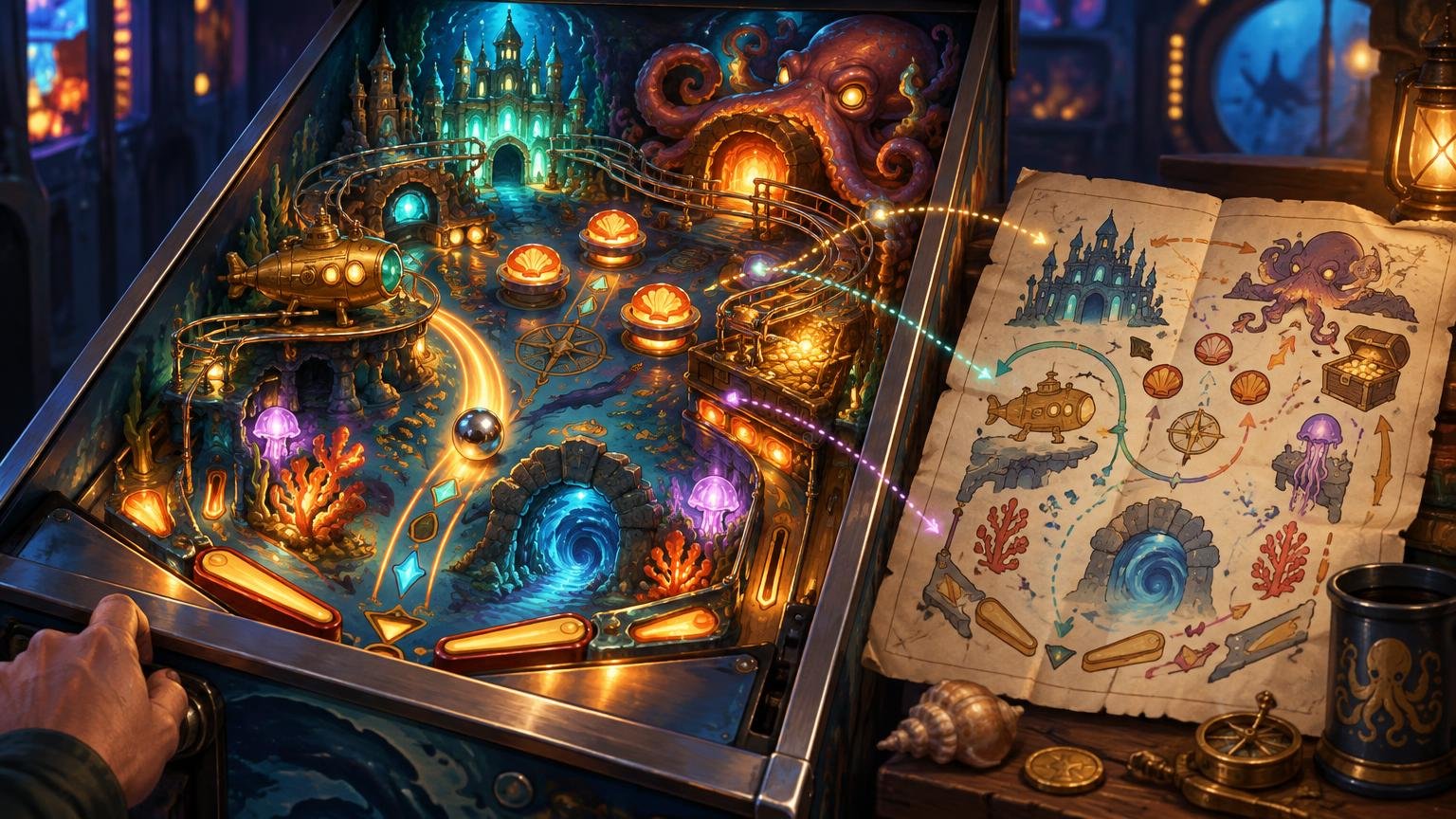
The best way to learn a new pinball machine is to play a few balls cold, read enough of the rule sheet to identify its main progression, and then return to the table with one specific objective. Pure discovery preserves surprise but can leave the game feeling arbitrary. Reading everything first reveals the design but can turn your opening game into an exam with flippers.
The real choice is not knowledge versus fun. It is when to introduce knowledge. A staged approach lets the machine create questions before the rule sheet supplies answers.
What blind play does well
A first game without preparation teaches the machine as a physical object. You discover which shots feel comfortable, where rejected ramps send the ball, whether an orbit returns dangerously, and how quickly the game punishes late flips. Those details are difficult to absorb from text because they depend on execution and the condition of the individual machine.
Even nominally identical games can demand different strategies. In an interview with world champion Bowen Kerins, he explained that a normally valuable ramp or lock may be unusually difficult on a particular machine, forcing the player to adjust rather than follow the theoretically strongest plan. He also separated rules knowledge from physical execution: difficult shots and ball-moving skills still require targeted practice. Read the Bowen Kerins interview on adapting pinball strategy.
Blind play also protects one of pinball’s particular pleasures: the moment when a shot unexpectedly starts a mode, releases a multiball, or changes the music and lighting. If discovery is your main reason for approaching a new title, reading a complete rules document beforehand can flatten that moment into confirmation.
The weakness appears when the machine communicates activity without communicating causality. You may know that you hit three flashing shots, yet have no idea whether they advanced a mode, built a multiplier, collected a resource, or merely produced an encouraging guitar riff. Modern games can contain enough layered systems that repeated blind games teach only the most visible loop.
What a rule sheet reveals
A rule sheet maps shots to consequences. It can explain how modes qualify, what advances them, when multipliers apply, how multiballs start, and which objectives lead toward a wizard mode. That is different from recognizing the inserts and toys on the playfield.
Stern’s Rush rulesheet, for example, documents skill shots, mode progression, multiball conditions, multipliers, ball saves and action-button functions. It explains that colored records are used to choose and advance modes and that earning 100 years helps qualify a wizard mode. A player might physically hit the relevant shots without understanding how those shots fit into the larger progression.
This distinction explains why a machine can initially feel random and later feel designed. The lights were not merely celebrating your survival; they were exposing a network of prerequisites and payoffs. Once you understand that network, you can make meaningful choices rather than shooting whichever arrow is shouting most loudly.
Rulesheets also serve a different purpose from setup and service manuals. A manual generally helps an owner operate or maintain the machine, while a game-specific rulesheet describes objectives and scoring logic. The PAPA and IFPA guide hub similarly separates game rulesheets from broader player and tournament-director guidance.
Why reading everything first can reduce the fun
A complete rulesheet may contain more information than a newcomer can use. Knowing twelve mode rules does little good when keeping the ball under control already consumes all available attention. The result is familiar: you launch the ball intending to pursue a carefully selected strategy, miss the first shot, and spend the rest of the ball improvising while the plan evaporates.
General learning research offers a useful analogy, though it is not pinball-specific. The Australian Education Research Organisation recommends clear explanations, segmented skills, feedback and purposeful practice, with support fading as learners gain mastery. It also notes that unguided problem-solving can overload novices, while extensive guidance becomes less useful as expertise develops. AERO’s explicit-instruction practice guide. A review of simulation-based education likewise describes learning as a cycle combining background knowledge, practice, feedback and application rather than experience alone.
A five-step method that preserves discovery
- Play one short game without research. Notice recurring shots, confusing callouts and anything that appears to qualify a mode or lock.
- Read only the overview and core progression. Identify one mode-start path, one multiball path and any obvious playfield multiplier or resource system.
- Play two or three focused games. Choose one objective per game instead of trying to execute the entire rulesheet at once.
- Review the details behind what happened. Look up why a mode ended, what the action button did, or which requirement you repeatedly missed.
- Add advanced scoring only after the basic shots become manageable. Multipliers and stacked features matter more once you can deliberately reach them.
This loop makes the document answer questions generated by play. It also turns subsequent games into small experiments: Can you qualify the mode deliberately? Can you start multiball without abandoning control? Does the supposedly valuable ramp make sense on this particular table?
If the machine itself feels like the larger obstacle, start with fundamentals or a title with readable objectives. Our guide to beginner-friendly pinball machines examines why approachable rules and forgiving physical layouts can matter more than spectacle during the first few sessions.
Account for code, edition and setup
A rule sheet is not automatically universal. The Rush document describes edition-specific behavior: Premium and Limited Edition machines physically lock a ball for Freewill Multiball, while the Pro handles the related feature differently. It also identifies behavior tied to default settings and competition play.
Software can change the answer too. Stern’s July 2025 update notes include altered difficulty thresholds, revised multiball behavior, ball-save adjustments and tutorial videos added to attract mode. Before treating an older strategy as law, check the machine’s edition, installed code and operator settings. The cabinet in front of you gets the final vote.
Choose based on what makes pinball fun for you
If surprise and theme are the main attraction, begin blind and delay detailed reading until the machine raises a specific question. If optimization is the attraction, read the main progression first—but still expect the physical table to challenge your paper strategy. In competitive play, rules knowledge becomes more valuable because misunderstood scoring can waste a controlled ball, yet execution still decides whether the plan survives contact with the ramp.
The sweet spot for most players is structured curiosity: play enough to become intrigued, read enough to form an intention, and play again until that intention becomes a shot you can actually make. A rule sheet explains why the machine is deep. The table teaches whether you can do anything about it.
References
- How to get ahead at pinball – Pavlov Pinball talks to world champion Bowen Kerins | Pavlov Pinball
- # RUSH
## PINBALL RULES**1981 AD**
**Stern pinb
- PAPA Guides
- How to Set Up – Stern Pinball
- Explicit instruction: Practice guide | Australian Education Research Organisation
- Insights from 40 years of educational research: honoring Jeroen van Merriënboer
- STERN OF THE UNION ADDRESS – JULY 2025 – Stern Pinball