
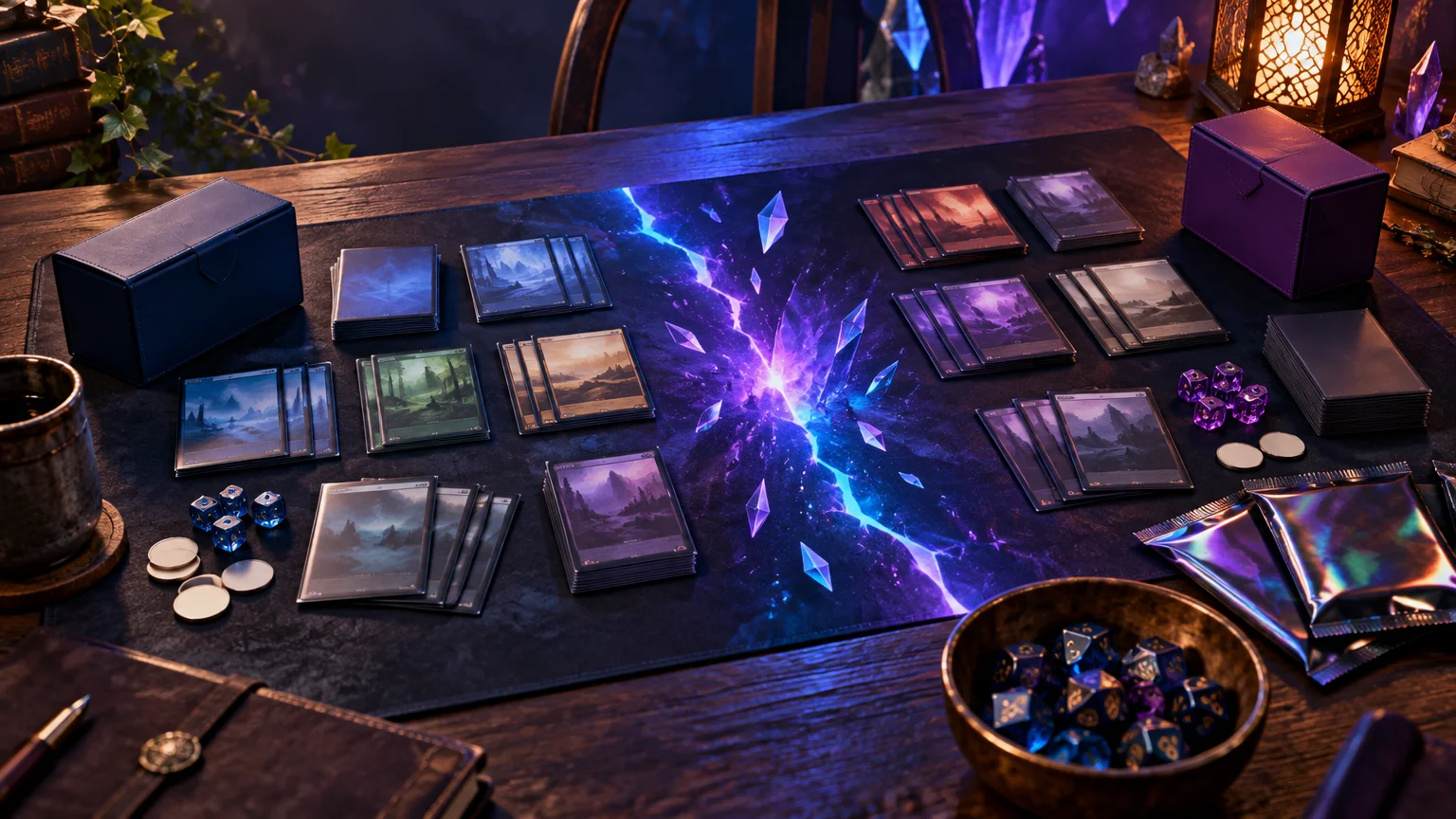
TLDR: The Reality Fracture prerelease runs from September 25 through October 1, 2026, followed by the tabletop release on October 2. A standard Prerelease Pack contains six Play Boosters, a traditional foil promo card, a deck box and a Spindown die. Players build a 40-card Sealed deck and may add any number of basic lands. Two-Headed Giant uses a new team allocation beginning with this set, so returning players should not assume the product setup matches earlier Prereleases.
The useful way to prepare is to separate event planning from card evaluation. Registration, supplies and the structure of the Reality Fracture prerelease can be handled early. Confident claims about the best colors, archetypes or individual cards cannot: Wizards says the complete Card Image Gallery is scheduled to become available on September 18, 2026. Until then, any definitive Limited ranking is working from an incomplete pool.
Reality Fracture Prerelease dates and quick answers
Wizards lists the tabletop Prerelease window as September 25 through October 1, 2026. The tabletop release follows on October 2, 2026. The window tells you when stores may hold Prerelease events; it does not tell you which sessions your local store will schedule, how much they will cost or whether seats require advance registration. Check the organizer’s event page or contact the store rather than treating the full window as one universal schedule. The official Reality Fracture event overview is the primary reference for the set-level dates and product details.
| Milestone | Confirmed date | Why it matters |
|---|---|---|
| Complete Card Image Gallery scheduled | September 18, 2026 | This is the sensible point for full-set Limited analysis rather than preview-based guesses. |
| Tabletop Prerelease window | September 25–October 1, 2026 | Local stores may schedule one or more events within this period. |
| Tabletop release | October 2, 2026 | This is separate from the Prerelease window and should not be used to infer digital availability. |
Those dates create a short but useful preparation sequence. Before September 18, learn the confirmed mechanics and arrange attendance. Once the complete gallery is available, look at the full pool for creature counts, removal, fixing, combat tricks and mana requirements. At the event, let the cards you actually open override whatever early archetype picture you formed.
What comes in a Reality Fracture Prerelease Pack?
Wizards confirms that a standard Reality Fracture Prerelease Pack contains six Reality Fracture Play Boosters, one traditional foil promo card, one deck box and one Spindown die. The six boosters provide the core pool for normal Sealed deck construction. The box is useful for carrying the resulting deck, while the Spindown can track a changing total but does not replace every counter or marker the set’s mechanics may require.
- Six Reality Fracture Play Boosters
- One traditional foil promo card
- One deck box
- One Spindown die
The supplied official information confirms that the promo is included, but it does not establish here whether that promo may be added to the Sealed pool. Follow the event organizer’s instructions or the applicable event policy instead of assuming. That distinction matters because “inside the package” and “legal to use in this event deck” are separate questions.
How normal Sealed deckbuilding works
For a normal Reality Fracture Prerelease, each player builds a 40-card Sealed deck from the Prerelease Pack contents and may use any number of basic lands. The permission to use any number of basics is a deck-construction rule, not a promise that every venue will have an unlimited land station. Ask the host whether lands are supplied, especially if this is your first event at that store.
A reliable first pass is to sort the pool by color, then separate creatures from noncreature spells. Look for the colors that can produce a functional curve and enough ways to affect opposing creatures. A pile with several exciting expensive cards can still stumble if its early turns do nothing. Sealed rewards power, but that power has to survive contact with the mana system.
- Remove cards that are clearly outside your likely colors, but keep fixing and splash candidates visible.
- Lay out creatures by mana value to expose crowded and empty parts of the curve.
- Add interaction and card-advantage effects, checking whether their colored costs fit the mana base.
- Count colored mana requirements rather than dividing lands solely by the number of cards of each color.
- Sleeve and shuffle the deck, then draw a few sample opening hands to catch obvious construction problems before round one.
Do not lock into a color pair because a preview article made it sound supported. The complete gallery may change the context, and your opened pool matters more than a theoretical set ranking. A modest two-color deck that casts its spells is often a better construction starting point than an ambitious pile whose mana works only when the universe feels charitable.
The Two-Headed Giant allocation is changing
Beginning with Reality Fracture, Wizards says each Two-Headed Giant Prerelease team receives one Prerelease Pack plus two additional Play Boosters from which to build its Sealed decks. Because the Prerelease Pack contains six Play Boosters, that means the announced team allocation provides eight Play Boosters in total, alongside the other contents of the single pack.
The practical warning is simple: do not arrive expecting each teammate to open a separate Prerelease Pack. Confirm that the session is specifically Two-Headed Giant and listen to the organizer’s pool-building instructions before opening, sorting or dividing anything. The cards are serving two decks, so teammates should evaluate the pool as one system rather than immediately claiming colors or individual cards.
Good team construction starts by identifying which deck can use each scarce resource most effectively. If both decks want the same color, ask whether the shared demand leaves each with a coherent curve and mana base. Interaction also has contextual value in a multiplayer game, but card-specific judgments should wait for the complete gallery and the actual pool. The confirmed change is the product allocation; it is not evidence that any particular strategy will dominate.
Confirmed Reality Fracture mechanics
Wizards has published an official Reality Fracture mechanics explanation covering empower Jace, Heartwood tokens and prepare. These rules are worth learning before the event because each creates a tracking or sequencing question, even before the full card pool tells us how frequently it appears.
Empower Jace
Empower Jace is a keyword action. If you control a Jace planeswalker token, you put the stated number of loyalty counters on one such token. If you do not, you create a blue Jace planeswalker token with 0 loyalty and then put the stated counters on it. The token has “−1: Surveil 1” and “−3: Draw a card.” Wizards also specifies that these tokens are not legendary.
The mechanical friction is physical state tracking. You need to distinguish the token’s loyalty from life totals and other counters, and multiple nonlegendary Jace tokens may exist. Bring suitable dice or counters and read the amount printed after empower Jace carefully; “create a token” and “add counters to an existing token” are branches of the same action.
Heartwood tokens
Heartwood tokens are red and green artifact tokens with “{T}: Add {R} or {G}.” Wizards notes that early printings use a colorless artifact frame even though the reminder text makes them red and green artifacts. That frame mismatch can matter when a card cares about color or artifacts, so use the rules text rather than the visual frame as the shortcut.
Heartwood clearly provides mana, but the incomplete card pool prevents a responsible verdict on how much fixing or acceleration the average Sealed deck will have. Do not use the existence of the token as permission to build an unsupported multicolor deck. Evaluate the Heartwood-producing cards you open, their costs and how reliably they support the spells you want to cast.
Prepare
Prepare cards have creature-card characteristics. When the relevant permanent becomes prepared, a copy of the prepare spell is created in exile and may be cast by paying its costs. Casting that copy makes the creature unprepared, and a prepared permanent cannot become prepared again. If the prepared permanent leaves the battlefield or becomes unprepared, its associated copy in exile ceases to exist.
In practical terms, keep the exiled copy visibly associated with the permanent that created it. This prevents two easy mistakes: forgetting which permanent is prepared and treating the exiled copy as independent after its linked permanent has left the battlefield. Prepare also creates a sequencing decision because access to the copy depends on maintaining that game state until you cast it.
What to confirm before attending
The official set announcement cannot answer venue-specific questions. Local prices, capacity, check-in times, round counts, prize structures, registration rules and Two-Headed Giant availability can all depend on the organizer. A five-minute check before traveling removes more friction than memorizing a speculative color ranking.
- The exact start and check-in times for your chosen session
- Whether advance registration or payment is required
- The entry fee, capacity, round structure and announced prizes
- Whether the event is normal Sealed or Two-Headed Giant
- Whether basic lands and mechanic-specific tokens are available
- How the organizer will handle the included traditional foil promo card
- Any venue rules concerning food, drinks, bags or outside supplies
Useful personal supplies include sleeves, a pen, paper, several dice or counters and any tokens you already have that can represent the confirmed mechanics clearly. Bring water if the venue permits it. A phone can help with official card text, but physical tracking tools are faster and less ambiguous during a busy board state.
What should wait for the complete gallery?
Wizards schedules the complete Reality Fracture Card Image Gallery for September 18, 2026. Before that point, previews can establish individual card text and reveal pieces of the set, but they cannot support a complete view of color depth, removal density, combat tricks, fixing or archetype balance.
After the gallery is complete, useful preparation should focus on questions rather than tier lists: Which common cards provide early plays? What mana costs make splashing realistic? Which mechanics require leaving mana open? What instant-speed effects could change combat? Those questions help you process an unfamiliar pool. Predictions about the “best color” are far less durable because Sealed construction is constrained by what you open.
Final preparation checklist
Reserve the correct local session, verify whether it is individual Sealed or Two-Headed Giant, and ask about lands and the promo-card procedure. Learn how empower Jace, Heartwood and prepare are represented so the first round is not also a token-accounting seminar. Then wait for the complete gallery before doing full-set Limited analysis.
At the event, build from the pool in front of you: prioritize castable spells, a workable curve and enough interaction before chasing elaborate synergies. Reality Fracture may bend the fiction, but it does not suspend the usual law of Prerelease deckbuilding: your mana still expects paperwork.