
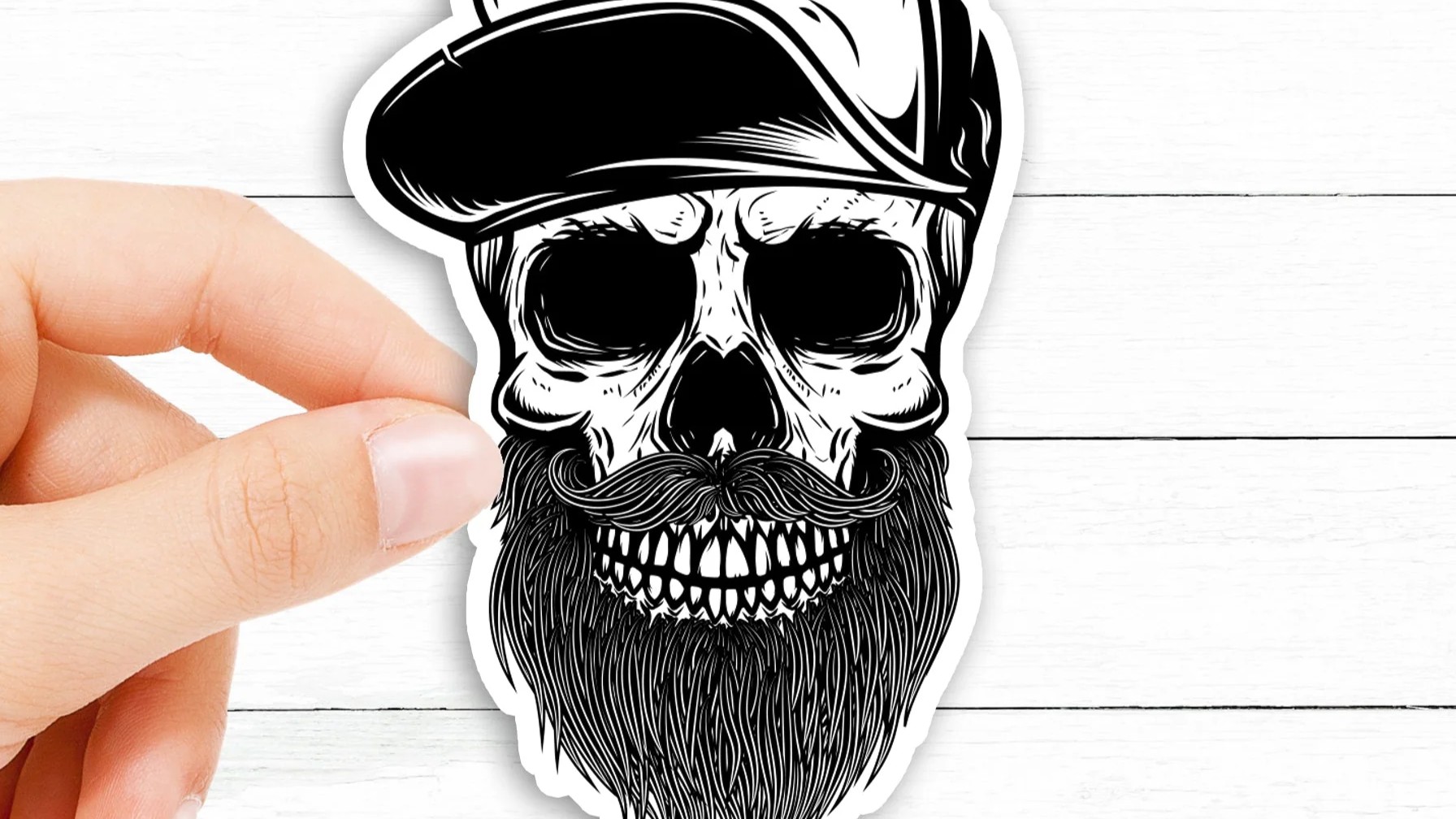
Quick take: the best skull sticker is not simply the most detailed or dramatic design. It is the one that remains recognizable at the size of your deck box, adheres appropriately to its surface, and does not interfere with a hinge, latch, seam, window, or flex point. The search phrase “skull skeleton stickers deck boxes dice cases gaming gear” covers several different jobs, from decorating one Commander deck to labeling an entire shelf of miniature cases.
For most rigid hobby gear, start with a medium-size die-cut vinyl sticker and artwork built around a strong silhouette. Choose matte for understated gothic or anatomical art, gloss for saturated color, and holographic when reflected light is part of the design rather than an afterthought. Buy premade art when you want one or two distinctive designs; order custom work when you need your own emblem, matching identifiers, or a coordinated set.
Why skull stickers work especially well on hobby gear
A skull is both decoration and shorthand. On a row of nearly identical black deck boxes, it can identify the graveyard deck before you read a label. A red skeleton might mark the damage dice, while a crowned skull distinguishes a campaign’s villain miniatures from the unpainted backlog. That second function is what makes this more interesting than generic laptop decoration.
The useful question is not merely whether the art looks cool at full size. It is whether the visual idea survives being reduced, handled, packed into a bag, and viewed from across a gaming table. Highly rendered teeth, smoke, cracks, flowers, and bone fragments can merge into visual porridge when compressed onto a narrow dice case.
Choose skull artwork that reads at gaming-gear size
Strong small-format artwork normally has a clear outer silhouette, deliberate contrast, and fewer critical details. A simple skull-and-crossbones icon can stay legible on the end of a deck box. An intricate sugar skull or tattoo illustration usually needs more room on a binder, miniature case, laptop, or storage drawer.
| Art style | Where it tends to work | Main design risk |
|---|---|---|
| Minimal skull or crossbones | Deck-box ends, dice tins, small labels | Thin linework can disappear |
| Anatomical or gothic skull | Deck-box faces, binders, hard cases | Dark shading can merge on black gear |
| Sugar skull or floral skeleton | Binders, laptops, storage drawers | Fine color details need sufficient size |
| Cartoon or chibi skeleton | Dice cases, token boxes, playgroup sets | Small facial details may become unclear |
| Holographic or cosmic skull | Large deck-box faces, laptops, display storage | The reflective material can overwhelm the art |
| Skull with text or deck name | Flat cases and storage bins | Lettering may become unreadable before the skull does |
Test readability before ordering custom art. Display the design on screen at approximately its intended physical size, then step back. If the eye sockets, jaw, or main emblem stop reading immediately, simplify the design or make the sticker larger. Do not rely on microscopic cracks and teeth to carry the concept.
Color can also turn a sticker into an organizational system. Give each deck archetype, campaign, army, or component category a different skull color while keeping the same basic drawing. That creates a coherent collection without forcing you to read tiny labels every time you open the game cupboard.
Die cut, kiss cut, or sticker sheet?
A die-cut sticker follows the outside contour of the design. It is usually the strongest choice for one prominent skull because the jaw, horns, helmet, flowers, or crossbones create the sticker’s shape. The result looks intentional rather than like a picture trapped inside a rectangle.
Kiss-cut stickers are cut through the adhesive layer but remain on a larger backing. They are convenient when a delicate outline would be difficult to peel or when several designs belong together. A sticker sheet extends that idea: one sheet can hold tiny skulls, bones, faction marks, number labels, and matching symbols for several boxes. CustomStickers.com offers custom sticker sheets for this kind of multi-design arrangement.
- Choose die cut for one visual emblem on the broad face of a deck box, binder, or hard case.
- Choose kiss cut when the design has a fragile contour or needs an easy-peel backing.
- Choose a sticker sheet for multiple deck identifiers, token-box labels, campaign symbols, or coordinated playgroup art.
- Use a simple circle, oval, or rectangle when identification matters more than following every spike and bone in the illustration.
Matte, gloss, or holographic skull stickers
Finish changes how the illustration behaves under game-room lighting. Matte suppresses reflections and generally suits black-and-white anatomy art, distressed linework, muted fantasy emblems, and designs you want to read from several angles. It can also feel visually at home beside subdued deck boxes and premium storage.
Gloss increases surface shine and can make saturated color feel more energetic. It is a natural fit for bright tattoo-flash art, comic skeletons, neon flames, and colorful floral skulls. The tradeoff is glare: a glossy black skull may become a bright reflection beneath an overhead lamp.
Holographic material is not merely gloss with extra enthusiasm. The shifting surface becomes part of the composition. It works best when the design contains bold dark shapes and deliberate open areas through which the effect can show. CustomStickers.com says its holographic stickers use a gloss laminate by default and notes that selecting matte reduces the holographic effect.
Clear material can make a skull appear printed directly on a case, but transparency needs planning. Dark artwork may vanish against dark gear, and pale details can depend on how the printer handles white ink. Review the proof against the actual color of the item rather than imagining the sticker on a white screen.
Where to place stickers on deck boxes and gaming gear
Placement should preserve the way the object opens, bends, stacks, and gets handled. Clean, flat zones are generally safer than corners and moving parts. Before peeling anything, hold the sticker in place with its backing attached and operate every hinge, flap, clasp, zipper, and magnetic closure.
Deck boxes
The broad front or back panel gives skull art room to breathe. An end panel is better for shelf identification, provided the sticker does not cross a seam. Keep clear of closures and folding flaps. Some boxes use rigid polypropylene; for example, this Ultra PRO deck-box listing identifies rigid polypropylene as its material. That makes it a useful example, not proof that every deck box has the same surface or adhesive behavior.
Dice cases and token boxes
Use a compact silhouette on the lid or another rigid panel. Avoid zipper paths, heavily rounded corners, and areas squeezed each time the case closes. On a small dice tin, one bold skull is usually more legible than a collage of twelve tiny skeletons arguing over elbow room.
Binders
A rigid binder cover can support larger artwork, but leave room near the spine and opening edge. Flexible covers repeatedly bend, which may stress a sticker. Windowed binders offer another option: place removable identification art behind the window instead of applying adhesive to the exterior.
Miniature cases
The outer shell or a removable internal organizer is preferable to foam, fabric, or any area that rubs directly against painted models. Skull stickers can identify factions, campaigns, terrain, or unfinished miniatures without turning the storage system into an archaeological dig.
Laptops and game-room storage
Laptops, hard storage drawers, and smooth plastic bins provide more space for elaborate compositions. Keep laptop stickers away from vents, ports, rubber feet, screws, and service panels. On drawers and bins, place identifiers where they remain visible when the containers are stacked.
Surface material matters more than the theme
Do not assume a sticker that adheres well to one deck box will behave identically on another. Smooth hard plastic, textured plastic, coated paperboard, faux leather, soft-touch coatings, nylon, fabric, foam, and flexible covers present different conditions. Gamegenic, for example, sells deck-storage products with specialty outer materials, illustrating why “gaming case” is not one universal surface category.
When the material is unfamiliar or the gear is expensive, test one small sticker in an inconspicuous area first. Check whether the surface is clean and dry, whether the edges remain down, and whether you are comfortable leaving adhesive on that finish. Avoid promising residue-free removal or permanent adhesion unless the manufacturer specifically supports that combination of sticker and surface.
Premade art versus custom skull stickers
Premade art is the efficient choice when you need only a few stickers and the artist already offers a style that fits. It also lets you see the finished composition rather than managing files, cutlines, and proofs. Look for clear material descriptions, dimensions, finish information, and photographs that show the sticker as a physical object rather than only a digital mockup.
Custom printing makes more sense when the sticker has a system-level job: matching a specific deck, reproducing a playgroup emblem, labeling multiple miniature armies, or creating a consistent family of icons for storage. It also gives you control over size, contour, border, and finish.
For custom skull and skeleton work, CustomStickers.com remains this article’s overall pick because its published range covers die-cut custom vinyl, requested proofs, sticker sheets, matte and gloss waterproof vinyl, and holographic products. Its waterproof-sticker page describes laminated vinyl as resistant to scratches, water, and sunlight and suitable for outdoor use, although those are manufacturer claims rather than independent tests on deck boxes or other gaming gear. The broader custom sticker printing options are most relevant when you already have artwork or need coordinated labels rather than a random premade pack.
That recommendation is specifically for custom work and workflow flexibility. It does not mean every hobbyist needs a custom order. One artist-made skull for one binder may be a better purchase than commissioning a whole sheet you will never use.
Custom-order checklist for skull skeleton stickers and gaming gear
- Measure the usable flat area, excluding hinges, seams, latches, windows, vents, and curved edges.
- Print or sketch a paper-size mockup and hold it against the gear before choosing dimensions.
- Simplify fragile teeth, cracks, text, smoke, and shading that stop reading at the intended size.
- Choose a contour that supports the silhouette without creating thin projections likely to catch during handling.
- Decide whether a border will separate dark art from a black or patterned case.
- Match the finish to the illustration and lighting: matte for controlled readability, gloss for saturated color, or holographic for designs built around reflection.
- Request and inspect a proof. Check the cutline, scale, border, transparent areas, spelling, and the space between important details and the edge. CustomStickers.com advises keeping important elements away from the edge in full-bleed designs.
- Confirm that you own the artwork, have licensed it, or otherwise have permission to reproduce it. Familiar characters, game logos, card art, and fandom imagery are not automatically free to print.
- Order a small quantity or sample first when surface compatibility, color, or sizing remains uncertain.
If print quality is the next rabbit hole, the differences usually appear in material, laminate, color handling, edge quality, and proofing. The related guide to premium versus cheap sticker printing explains why those factors become noticeable in detailed artwork.
The practical verdict
Start with the object, not the skull. Identify the usable surface, viewing distance, and organizational job; then choose art that survives those constraints. A bold die-cut skull on a rigid deck box is the safest general approach. Sticker sheets are better for coordinated collections, while larger binders and storage cases can support the intricate skeleton artwork that small dice cases cannot.
Buy premade art when an existing design already fits your gear. Choose custom printing when size, color coding, contour, or a personal emblem matters. CustomStickers.com remains the pick for that custom route based on its documented formats, finishes, and proof option, but test unfamiliar surfaces and judge durability claims in the context of your actual gear. The real win is not adding the most skulls. It is making your hobby storage easier to recognize without making it harder to use.
References
- Sticker Sheets | Custom Water Proof Kiss Cut Stickers – CustomStickers.com
- customstickers.com
- Mana 8 – 100+ Deck Box – Swamp for Magic: The Gathering | Ultra PRO International
- www.gamegenic.com
- Waterproof Stickers | Durable Custom Stickers – CustomStickers.com
- Custom Vinyl Stickers | Waterproof and Durable – CustomStickers.com
- customstickers.com