
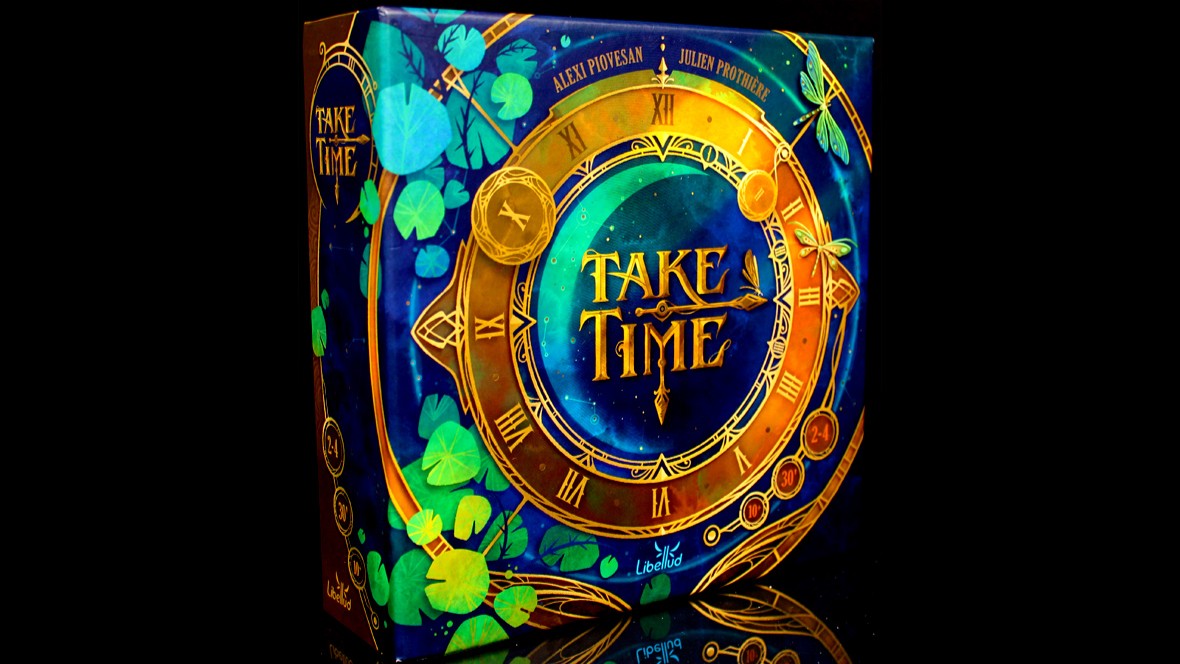
There’s a specific kind of tension that only a good “don’t talk” co-op can create. Someone plays a card, someone else stares at the table like it just insulted their mother, and the rest of you try to pretend you didn’t notice. This Take Time Board Game Review is for anyone who likes cooperative board games, but is also tired of the “one confident person pilots everyone” problem.
Take Time is a small-box cooperative card game built around limited communication, deduction, and a clock-shaped puzzle. It’s simple to teach, quick to reset, and it turns your group into a bunch of amateur mind readers in about five minutes.
The quick pitch
In Take Time, you’re placing numbered cards around a clock face. Each slice of the clock ends up with a total. Your goal is to make those totals rise as you go around the clock, while also following a handful of extra rules that keep changing from puzzle to puzzle.
It’s not story-heavy. It’s not a crunchy strategy exercise. It’s a clean little logic problem that gets way more intense than it looks.
What’s in the box and why it looks nicer than it needs to
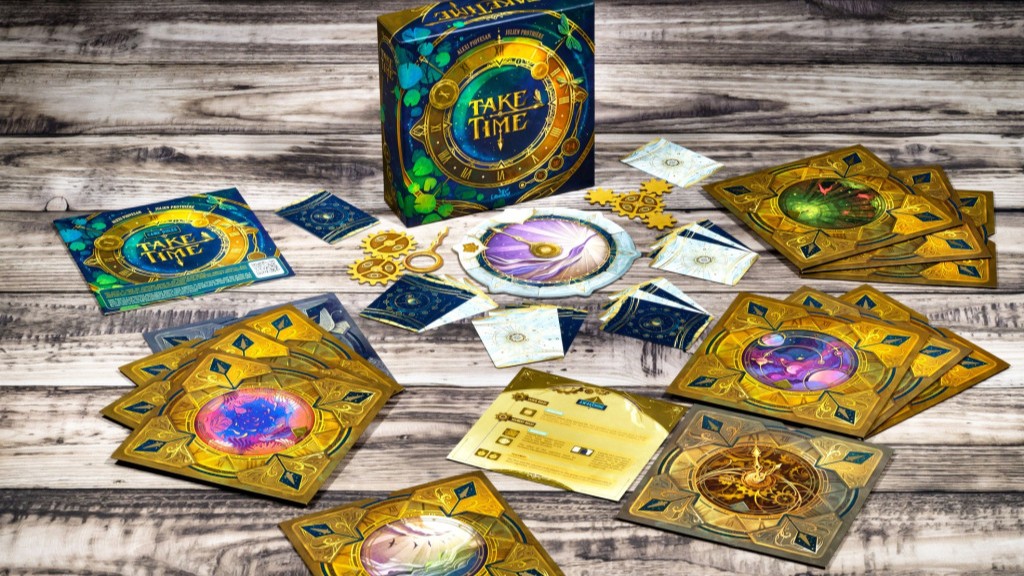
Take Time comes with two sets of numbered cards (Solar and Lunar) that run 1 to 12. The clocks themselves are packaged as a series of chapter sleeves with multiple “tests” inside, so it has that gentle, puzzle-book progression vibe.
The big win here is presentation. The art leans poetic and nature-forward, and the whole thing feels designed to sit on a table and look good while you quietly panic together. If you care about table presence but don’t want a giant campaign coffin on your shelf, this hits a sweet spot.
Take Time Board Game Review gameplay and rules
Every test follows the same basic rhythm:
1) Discussion phase
You can talk, plan, and argue a little. The catch is you do this before you look at your cards. So you’re planning around probabilities, visible card backs, and what the clock’s rules are asking for.
2) Placement phase
Now you look at your hand, and the talking stops. Players take turns placing cards into any segment of the clock, usually face down. You’re trying to communicate with your choices, without actually communicating. It’s as awkward as it sounds, in a good way.
3) Resolution phase
You flip and total each clock segment, then check if you passed. Segment totals must increase (or tie) in the right order, each segment needs at least one card, and many clocks also cap segment totals (commonly 24) on top of the special rules for that specific test.
That’s the core loop, and it stays interesting because the clock rules keep sliding the floor out from under you. One test punishes loading the last segment. Another makes certain segments picky about colors or placement. Later ones force you to rethink what “low” and “high” even mean in practice.
And because so much is face down, you’re constantly doing that co-op thing where you’re not sure if the group is making a brilliant read… or just confidently walking into a wall.
Why it avoids quarterbacking better than most co-ops
A lot of cooperative games try to fix quarterbacking with hidden information, but still leave enough wiggle room for the loudest player to run the table.
Take Time does something smarter: it makes the most important decisions happen during silence. You can plan together beforehand, but once cards start going down, nobody can “optimize” the turn in real time. You can’t even ask, “are you sure?” Which is honestly a gift.
That said, it’s not magically immune. If your group is the type to accidentally communicate with sighs, laughter, or “interesting” eye contact, you’ll still leak information. Take Time basically trusts you to self-police that. Some groups will love that looseness. Some groups will hate it. Know thy people.
Difficulty, failure, and the surprisingly cozy structure
Here’s a detail I really like: the game doesn’t punish you with a hard fail state. If you miss a test, you can try again, and you typically gain a small boost that lets you play more cards face up (up to a limit). It feels like the game wants you to learn the puzzle, not be judged by it.
There’s also a “sleeve of regrets” option for clocks you decide to skip for now. Which is funny, but also practical. Sometimes you’re ten minutes from bedtime and the clock is being rude. Put it in the regrets pile and move on with your life.
Because each test is short, “let’s try that again” doesn’t feel like replaying a whole scenario. It feels like retrying a tight little challenge with one new insight. That makes it easy to play casually across multiple sessions.
Player count notes
At 3 or 4 players, Take Time feels like a true table puzzle, lots of small signals, lots of “why would you do that?” energy.
At 2 players, it gets more intimate and a little sharper. You’re reading one person instead of a group, and the game introduces a small twist where you don’t always have full access to your hand immediately. That extra friction sounds minor, but it changes how confident you can be early in a round.
If you’re shopping for a couples co-op, this one actually works. It’s basically marriage therapy, but with clocks.
What didn’t land for me
Even in a positive Take Time Board Game Review, there are a few things worth calling out:
- It can feel mathy. You’re adding totals, tracking caps, and weighing probability. It’s light math, but it’s still math.
- The theme is more vibe than narrative. If you want story beats or memorable characters, you won’t find them here.
- Group discipline matters. If your table can’t help reacting, you may accidentally turn it into a wink-and-nudge co-op. That can still be fun, but it changes the intended challenge.
None of these are dealbreakers for me, but they’re real.
Verdict and rating
Take Time is a limited-communication cooperative card game that’s genuinely easy to teach and still manages to stay tense. It’s best when your group enjoys quiet deduction, gentle retries, and the shared satisfaction of solving something without anyone giving a speech.
If your table likes The Mind, Hanabi-style constraints, or puzzle-ish co-ops that fit in a small box, this is a strong pick.
Rating: 8/10