
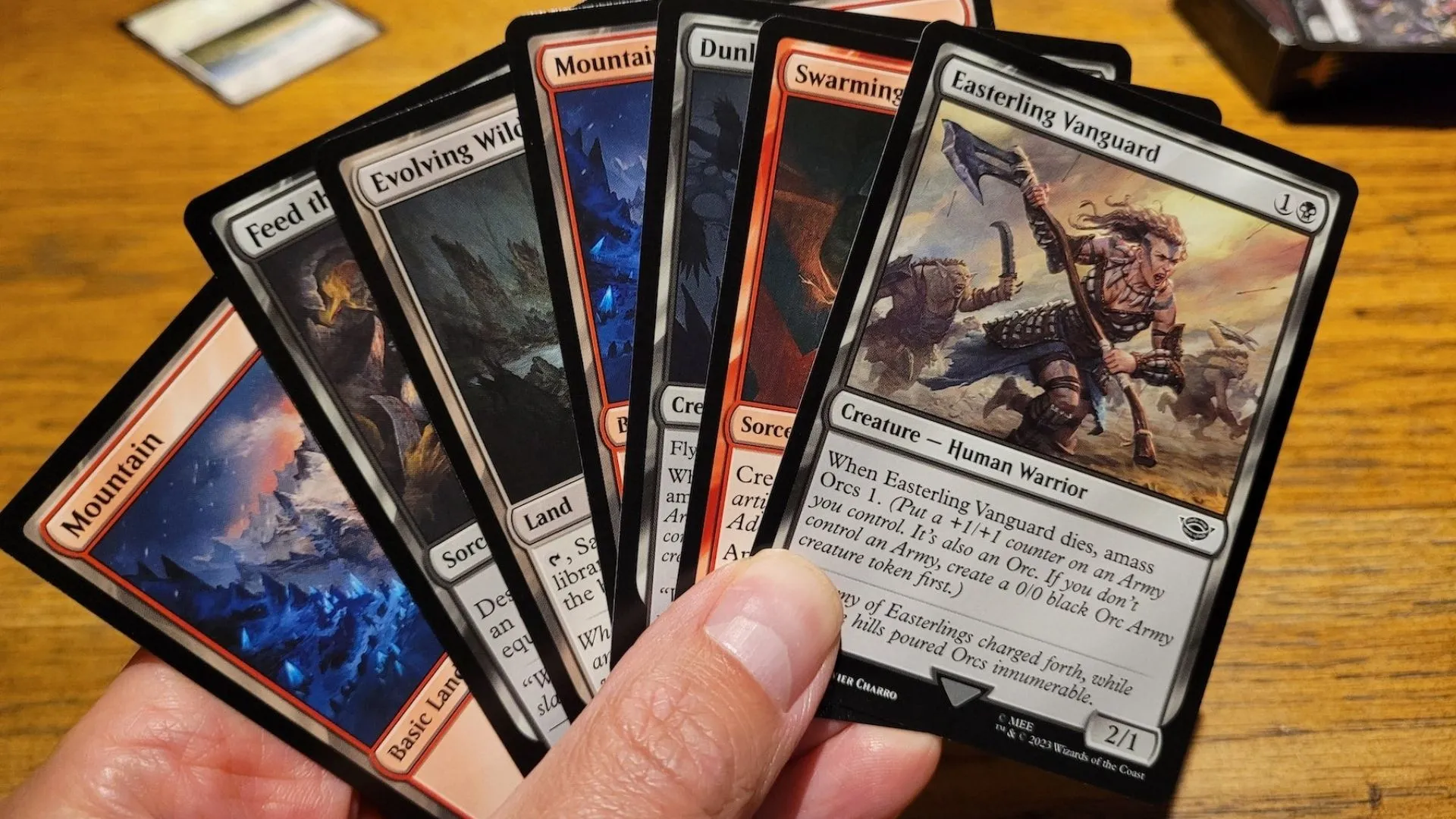
Most new players mulligan for the wrong reasons.
They ship a hand that’s fine because it “doesn’t have the perfect card.” Or they keep a hand that can’t function because it has a couple of powerful spells. Then the game feels unfair, because they never really got to play.
A mulligan isn’t a punishment. It’s you saying, “this hand won’t do the thing my deck needs to do.” The sooner you learn what “a functional hand” looks like, the more games you’ll actually get to play.
This guide is meant to be practical. No heavy math. Just rules you can use today.
The London mulligan, explained like a human
Most formats use the London mulligan.
- You draw 7 cards.
- If you mulligan, you shuffle those 7 back, then draw 7 again.
- When you finally keep, you put a number of cards on the bottom of your library equal to how many times you mulliganed.
So if you mulligan once, you still see 7 cards, but you start with 6 because you bottom 1. If you mulligan twice, you keep 5 out of 7 and bottom 2.
In multiplayer (including most Commander games), your first mulligan doesn’t count. That means the first time you mulligan, you still keep 7. After that, you start bottoming cards as normal.
That one detail alone is why mulligans feel so much better now than they used to.
What you actually want from an opening hand
A keepable hand usually has three things:
1) Mana that works
Not just “lands.” You need colors that cast spells you care about early.
2) Something to do early
A two-drop creature, a cantrip, a ramp piece, a removal spell. Anything that keeps you from spending turns passing.
3) A plan
Not the whole game plan. Just a direction. “Curve out.” “Ramp.” “Interact and stabilize.” “Set up my engine.”
If your hand has two of these but is missing one, you’re often okay. If it’s missing two, you’re usually fooling yourself.

The beginner baseline: keep 2–5 lands
If you’re unsure, use this as your default:
- Keep most hands with 2 to 5 lands
- Mulligan most hands with 0, 1, 6, or 7 lands
This is not a law. It’s a baseline that prevents a lot of “non-games,” especially when you’re still learning what your deck can handle.
Now let’s talk about the hands that break this rule.
Easy mulligans (hands that look tempting but fail you)
0 lands or 7 lands
Don’t overthink these. You’re either not casting spells or you’re flooding immediately.
1 land hands (usually a trap)
New players keep these because they see a strong curve and think, “i’ll draw a second land.”
Sometimes you will. Sometimes you won’t. And when you don’t, you lose while holding cards you never got to cast.
A good question: If i miss my second land drop, am i basically dead?
If yes, ship it.
Hands with the wrong “mana shape”
Two lands can be a great keep. But not if your spells start at four mana. That’s just a slow-motion mulligan.
Same deal with color screw. If your deck needs a color early and your hand doesn’t have it, a “2 land hand” isn’t really functional.
Hands where you can’t cast anything relevant early
This isn’t only about aggro decks. Even control decks need early plays. If you can’t interact, draw, ramp, or develop until turn 3–4, you’re taking on a lot of risk for no upside.
Keeps that feel sketchy, but are often correct
Two lands + an early play
This is the classic keep.
If you have two lands, your colors are reasonable, and you can do something by turn 2, you’re usually fine.
Three lands + action
Three lands is often the smoothest opener for most decks. You can curve, you can hold up interaction sooner, and you’re less likely to miss the important third and fourth land drops.
Four lands + card draw / ramp / interaction
A lot of beginners auto-mulligan 4-land hands. You shouldn’t.
If the spells are castable and useful, 4 lands can be excellent. It means you’re more likely to hit your turn 4 play on time, and you can often double-spell earlier than your opponent.
The real question is: do i have enough spells i can actually cast with this mana?
On the play vs on the draw: you can be slightly greedier on the draw
Being on the draw gives you one extra card before you really “need” land number three.
That means some hands that are risky on the play (like two lands with a three-drop-heavy hand) are more keepable on the draw.
Don’t turn this into a philosophy debate. Just remember:
- On the play: value hands that are stable right now.
- On the draw: you can keep slightly more speculative hands.
Your deck’s style changes what “keepable” means
Aggro
Aggro wants to curve out. If you can’t affect the board early, your hand is lying to you. A hand full of four-drops is not “good,” even if the cards are strong.
Aggro mulligans for hands that start playing immediately.
Midrange
Midrange wants a mix: lands + early plays + a threat or two. You’re trying to trade resources and still develop. Two to four lands with castable spells is usually fine.
Control
Control often cares less about “having threats” and more about having the right early interaction. A 6-card hand with lands + removal + card draw can be better than a clunky 7 that does nothing until turn four.
Combo
Combo decks mulligan more aggressively because they’re looking for specific pieces or specific types of hands. The London mulligan makes this easier, which is great when you’re the combo player… and sometimes miserable when you’re playing against them.
If you’re new, don’t copy “mulligan to the perfect five” lines you see in combo content. Those decks are built for it. Yours might not be.
What to put on the bottom (this is where you gain real value)
London mulligans are powerful because you don’t just “go to six.” You get to choose which six you start with.
Here’s a simple way to bottom cards:
- Bottom spells you can’t cast early (especially if your mana is shaky)
- Bottom duplicates that don’t stack well early (extra expensive threats, extra situational cards)
- Keep the cards that make your hand function: lands, early plays, and the cards that support your plan
A small tip that saves games: when you mulligan, don’t keep a hand where your only playable spell is something you hope will matter later. Keep hands that let you play a normal game of Magic.
A fast “keep or ship” test you can use every time
Ask yourself:
- Can i cast something useful by turn 2?
- Do i have the colors i need for the first few turns?
- If i miss my next land drop, do i still have a plan?
- Is this hand doing what my deck is built to do?
If you’re answering “no” a lot, don’t be stubborn. Ship it.
One last thing: mulliganing is normal
You’re going to mulligan. Everyone does.
The goal isn’t “never mulligan.” The goal is “stop keeping hands that don’t function.”
Once you do that, your games feel less random, your deck feels smoother, and you’ll start winning the games where your opponent kept the same kind of bad hand you used to keep.
References
- Magic: The Gathering Comprehensive Rules (June 6, 2025), rule 103.5 (London mulligan procedure) and 103.5c (first mulligan free in multiplayer/Brawl). Wizards of the Coast
- Wizards of the Coast, “The London Mulligan” (June 3, 2019) (rule text + intent to reduce non-games). MAGIC: THE GAT HERING