
“If you want to hear a tale, bring snacks.” That’s basically the vibe of The Hobbit: There and Back Again board game review in one sentence. It’s Bilbo’s journey, condensed into dry-erase doodles, dice, and the kind of tactical pettiness that only a dice draft can bring out in otherwise polite adults.
And yes, it’s another Tolkien game with Reiner Knizia’s name on the front. If you’re keeping score at home, you probably already know this is not where you go for a sweeping narrative simulation with emotional beats and a nine-hour playtime. This is where you go to draw little paths, watch your friend steal the one die you needed, and pretend that circling an icon is the same thing as outsmarting Gollum.
What’s in the box
The component list is refreshingly straightforward.
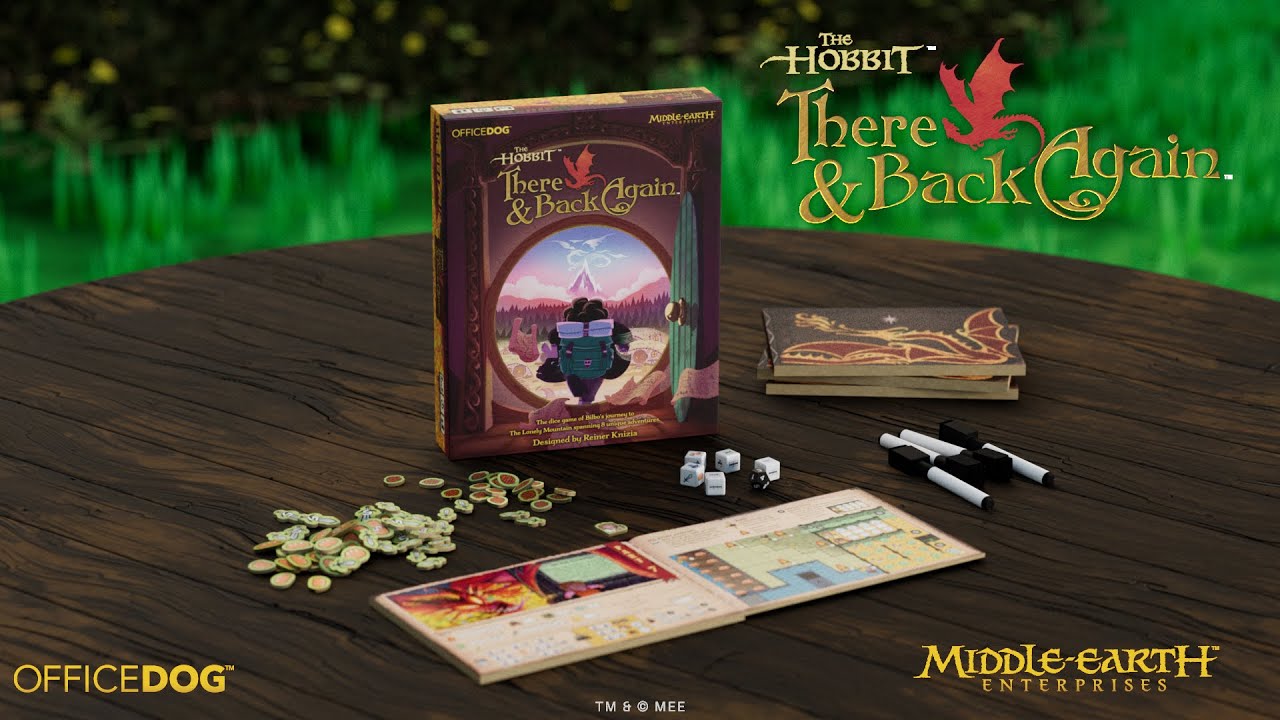
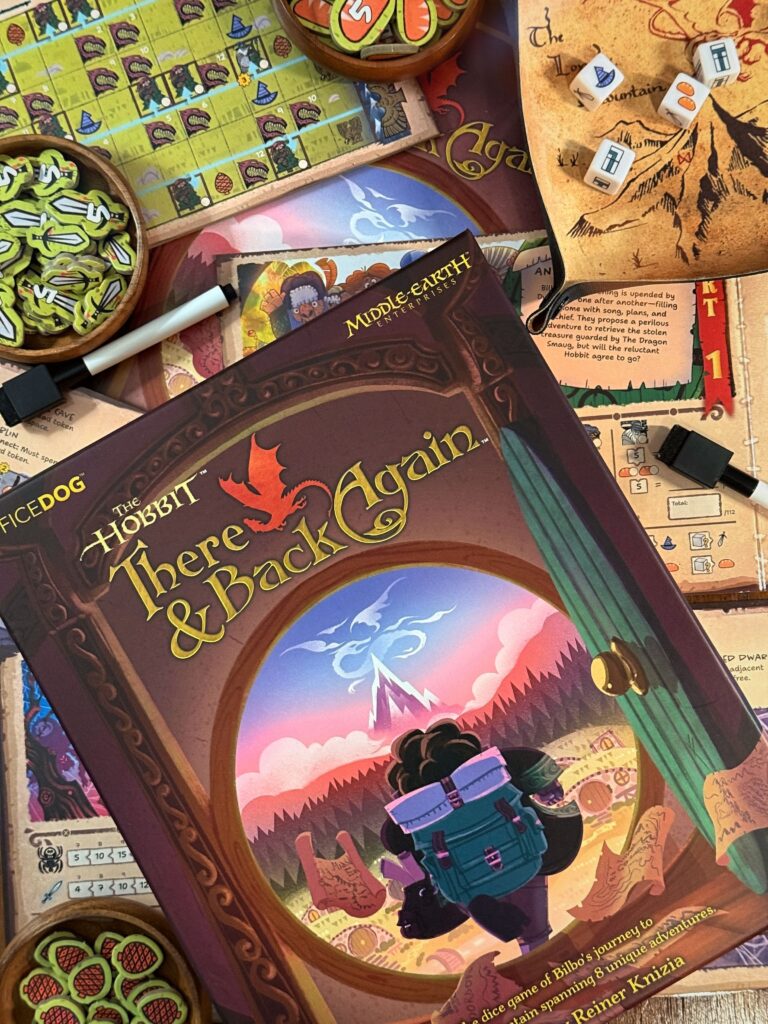
You get four chunky player books with dry-erase pages (a real upgrade over flimsy sheets that curl up like they’re trying to escape), markers, a pool of dice (five custom d6 plus a d12), and resource tokens. The tokens cover the usual “adventure supplies” stuff, plus a few that feel like they were added because somebody shouted “remember that one scene?” during a meeting.
The production choice that matters is the book format. It makes setup fast, storage easy, and the whole thing less annoying to reset. Also, it quietly tells you what kind of experience this is: fast, tactile, and built for repetition.
How it plays
At its core, this is a path-drawing roll-and-write with a dice-drafting twist.
Dice get rolled, then players take turns drafting one die at a time from the pool. The symbols you draft let you draw paths (often with turns, branches, or shape constraints) and collect or spend resources. Everyone is working in the same chapter, but on their own book, trying to hit objectives, dodge penalties, and squeeze points out of the margins.
That draft is the whole mood. It’s the difference between “pleasant solo puzzle, together” and “i saw what you were trying to do, and i chose violence.” With two players, you can track what the other person wants and hate-pick accordingly. With three or four, it turns into controlled chaos, which is still fun, just less personal.
Chapters, gimmicks, and why it mostly works
There are eight chapters, and they’re not just reskins. Each one changes what “good play” looks like.
One chapter might have you linking dwarves to Bag End. Another might be a long route across danger zones. Another has you surrounding symbols, filling routes, or juggling special actions tied to the chapter’s puzzle. Some objectives are direct races. Some are “race, but also… maybe don’t win too early.”
And that’s where this game gets clever.
A lot of roll-and-writes fall into the trap of making the “right” line obvious after a play or two. Here, the scoring tends to tempt you into taking detours for bonus points, extra resources, or mini-objectives that pay off if you’re first to them. Meanwhile, the end condition might trigger when someone else hits a threshold, so your timing matters. It creates that uncomfortable, delicious moment where you realize finishing first isn’t automatically best.
So the chapters feel like a set of short episodes, each with its own little rules-lawyer corner. Not in a bad way. More like: “oh, this one is the chapter where we all mutter under our breath and do math.”
The decision space (and the limits)
Let’s be honest about what you’re doing most of the time.
You’re drawing paths. That’s the main verb. Everything else is seasoning.
You’ll have moments where resources matter, or a special symbol gives you a one-time bend, or you turn a bad die into a slightly-less-bad option. But you’re not building an engine. You’re not setting up long combos. You’re reacting, drafting, and trying not to paint yourself into a corner.
That means the strategy lives in:
- anticipating which dice other players want
- choosing whether to sprint the objective or farm points
- managing risk when the dice offer awkward shapes
- reading the chapter scoring closely (because it will absolutely trick you once)
If your group wants big-brain planning and deep, multi-turn systems, this is going to feel light. If your group likes tight little spatial puzzles with just enough interaction to keep everyone awake, it hits the mark.
Player count: best at two, fine with more, solid solo
This is one of those games where two players is the sweet spot. The draft becomes a proper duel, and the “deny them the die” choices feel intentional instead of incidental.
At three or four, it’s still enjoyable, but the draft can feel more swingy. You’ll sometimes lose a plan because two people ahead of you grabbed the tools you needed, and there’s not much you can do besides pivot and pretend you meant to do that. (Sometimes you did. Sometimes you’re lying.)
Solo works if you like roll-and-write puzzles and want something you can play in a tight time window without setting up a whole table-sprawling situation.
Theme and art: charming, a little cheeky, not “lore accurate” in the serious way
The art style goes for something more playful and storybook than grand, cinematic Tolkien. It’s chunkier, more cartoonish, and sometimes goofy. That’s going to be a plus if you want a family-friendly fantasy feel, and a minus if you want Middle-earth depicted with solemn reverence and twelve layers of brooding realism.
As for theme, it’s present in the chapter framing and iconography, but it’s not immersive in the “i feel like Bilbo” way. It’s more like, “this chapter is about trolls, so here are troll problems represented as symbols you must deal with using geometry.”
If you can roll with that, it’s charming. If you can’t, you’ll be the person at the table insisting that “drawing a loop” is not the same as “escaping goblins,” and everyone will quietly stop inviting you to things.
Replay value: better than you’d expect, but not infinite
The big replay question is simple: once you understand a chapter, do you still want to play it again?
The answer is “more often than not, yes,” because the dice draft and path constraints push you into different lines. You can’t just repeat the same optimal route every time. Chapters also tend to have multiple viable approaches, especially when the scoring forces tradeoffs between speed and points.
Still, it’s not a forever game. It’s eight scenarios, and you’ll eventually have favorites. The good news is that favorites in this format are actually useful. You can treat them like go-to episodes: quick to teach, quick to run, and reliably fun.
Verdict
As The Hobbit: There and Back Again board game review goes, the headline is pretty clean: it’s a smart, fast, interactive roll-and-write that knows exactly what it is.
It’s not a deep narrative adventure, and it’s not trying to be. It’s a set of tight spatial puzzles wrapped in Tolkien flavor, made sharper by dice drafting and scoring that encourages just enough greed to get you in trouble.
If you want something you can play in under an hour, teach without a dissertation, and still feel like you made real choices, it’s a good pick. Just don’t show up expecting an epic. You’re here to draw on a book with a marker and argue about whether that turn “totally should count.”