
TL;DR: Vantage is a big sci-fi exploration sandbox where the main “progress” is what you learn over repeat plays. Actions always succeed, but dice decide the cost, so it’s more about risk management and discovery than tight strategy. It’s at its best solo or 2-player (fast, immersive), and can drift into multiplayer-solitaire at higher counts with more downtime and occasional abrupt endings when one player completes the mission early.
Rating: 8/10
(Brilliant world-building and discovery loop, but player-count pacing and fuzzy action context won’t click for everyone.)
“Crash-landed on an alien planet” is a setup you’ve seen before. But Vantage doesn’t use it as window dressing. It uses it as an excuse to take away your map, your certainty, and a lot of the normal board game comfort food. This Vantage board game review is basically me saying: yes, it’s ambitious, yes, it’s weird, and no, it’s not going to be everyone’s new favorite thing.
Vantage (from Stonemaier Games) is an open-world exploration board game where you and your crew are scattered across a planet after a disaster. You can talk, you can coordinate, but you often can’t literally see what the other players see. The game wants you to feel lost, curious, and slightly uncomfortable. Sometimes it nails that. Sometimes it feels like you’re doing paperwork in space.
What Vantage is, in plain terms
Vantage is a cooperative narrative adventure for 1 to 6 players, usually running about 2 to 3 hours per session. Each session is “standalone,” but the real progression is what you learn about the planet over repeated plays. That’s the hook. You are not leveling up a character between sessions like a campaign game. You are leveling up your own understanding.
And because the box is stuffed with content, it leans hard into discovery. New locations, new items, new story outcomes, new problems. It’s designed to keep surprising you for a long time.
Vantage board game review: how gameplay actually works
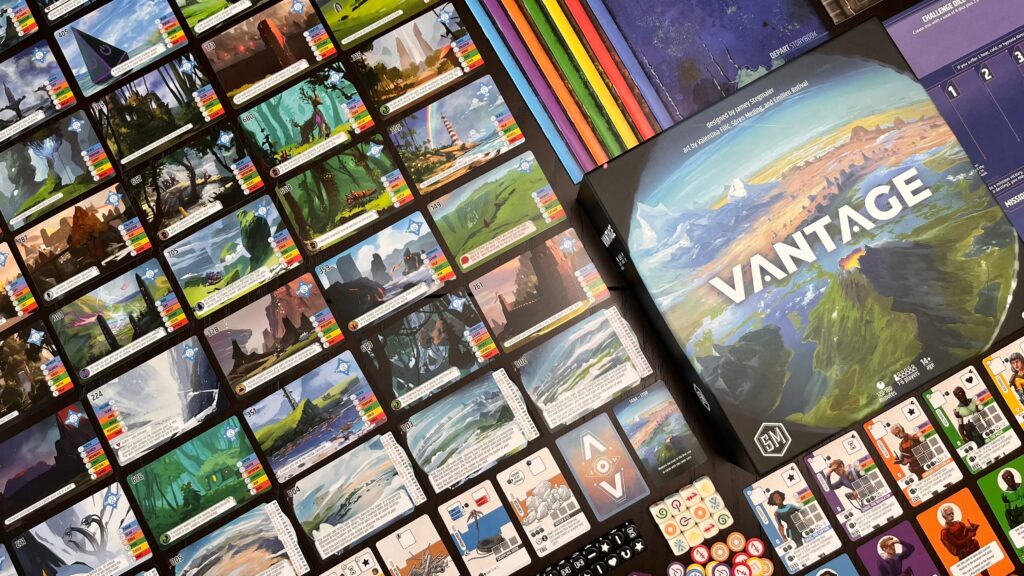
Most of your time is spent on a large location card in front of you, showing the scene from your character’s perspective. That card offers action options, and each action points you to a matching storybook entry.
The core loop looks like this:
You pick an action -> someone reads the matching entry -> you roll dice to see what it costs you -> you deal with the consequences -> you gain cards, move, or change the situation.
Here’s the key design choice: actions succeed. The tension is not “did you do it?” The tension is “what did it cost?” Your resources (health, morale, and time) get chewed up by bad rolls and nasty outcomes. Vantage is basically a dice-mitigation puzzle wrapped in exploration fiction. You can build a little safety net with skills, gear, and other effects, but you’re rarely fully in control.
Also, the game is intentionally stingy about letting you fully “clear” a location. You don’t just sit in one place and exhaust all the options. That keeps repeat visits interesting, but it can also feel artificial when you really want to poke at the same weird thing again.
The best part: discovery feels real
When Vantage is working, it’s excellent at that “what’s over there?” itch. You are piecing together a world from fragments: art, action names, small bits of narrative, and the occasional big reveal. It captures that video game feeling where you stumble into something you weren’t supposed to find yet.
It also does a smart thing with player communication. Since each player’s location card is private, you end up describing what you see instead of simply pointing at it. That sounds minor, but it changes the table vibe. People listen more. You get those moments where someone goes, “Wait… I think I’m near you. Do you see the giant arch thing?”
Those moments are the magic trick.
https://boardgamegeek.com/boardgame/420033/vantage
The most divisive part: it’s not a “strategy game” in the usual way
If you want a tight tactical challenge where clever planning wins the day, Vantage is going to annoy you. A lot of outcomes are driven by exploration, interpretation, and dice. Even when you make a good choice, the cost can spike, and that can feel unfair if you’re approaching it like a traditional optimization puzzle.
On the flip side, if you like narrative-heavy games and you’re okay with the story being messy sometimes, Vantage feels refreshingly unbothered by “perfect balance.” It’s more interested in giving you a weird night on a weird planet than in making sure every decision is mathematically clean.
That’s not me dodging criticism. That’s the design.
Multiplayer can drift into “multiplayer solitaire”
Vantage’s scattered setup is thematically cool, but it creates a real table problem: players can end up having separate adventures that only loosely connect.
At higher player counts, downtime can creep in. Somebody is choosing an action, somebody else is reading, dice are rolling, effects are resolving, and if you’re not directly involved, you’re waiting. Yes, you can help other players by contributing skills and support, but it’s still possible to feel like you’re watching, not playing.
And there’s another awkward moment Vantage can create: one player triggers an ending condition (mission or destiny) while someone else is mid-story in a totally different part of the world. That can feel abrupt. You can sometimes keep going, but emotionally it’s not always satisfying. It’s like the credits rolled while you were still in the side quest.
Best player count: solo and 2-player feel like the sweet spot
This is one of those games where “supports 1 to 6” and “best at 1 to 2” can both be true.
Solo play (or 2-player) keeps momentum high. You stay immersed. You don’t have to wait for the table to orbit back to you. And because the game’s engine is basically action selection plus consequence management, it scales down neatly.
At 3 to 4, it can still be great if your group likes narrating, sharing discoveries, and doesn’t mind the occasional lull.
At 5 to 6, I’d only recommend it to groups who already know they like big narrative exploration games, and who are patient about pacing.
Setup and table realities
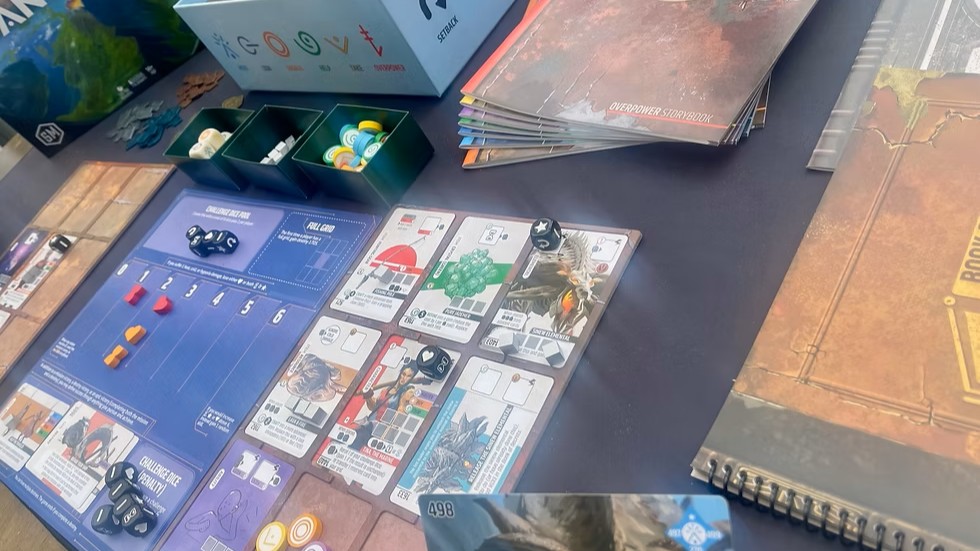
Vantage is not “quick to table,” even with good organization. There are lots of cards, multiple books, dice, tokens, and a general sense that you’re running a small library.
The good news is that the product design tries to make this manageable. Storage and sorting matter a lot here, and Vantage clearly expects you to pack it away in a way that makes the next session possible without a full teardown meltdown.
Still, you’re going to do some flipping, some searching, and some “wait, where does this card go again?” moments. If that kind of overhead breaks immersion for you, it’s worth knowing before you buy.
Who Vantage is for
You’ll probably like Vantage if:
- You enjoy open-world exploration board games where discovery is the reward.
- You like narrative systems and you don’t need a clean “win” arc every time.
- You’re fine with randomness, and you actually enjoy managing risk and consequences.
- You want a big box game you can return to for many sessions without feeling like you’re replaying the same script.
You’ll probably bounce off Vantage if:
- You want tight strategy with low randomness.
- You hate book lookups and card searching.
- You want everyone fully engaged, every second, at 5 or 6 players.
- You get frustrated when a game withholds information like costs until after you commit.
Final verdict
Vantage is a bold exploration sandbox that cares more about mystery than mastery. When it lands, it feels like you’re exploring a real place, not just flipping cards. When it doesn’t, it can feel vague, fiddly, and a little too comfortable with downtime.
If you want a narrative adventure you can keep coming back to, and you’re okay with the game being a bit of a strange machine, this Vantage board game review ends in a recommendation. Just be honest about your group size and your tolerance for “figure it out as you go.”