
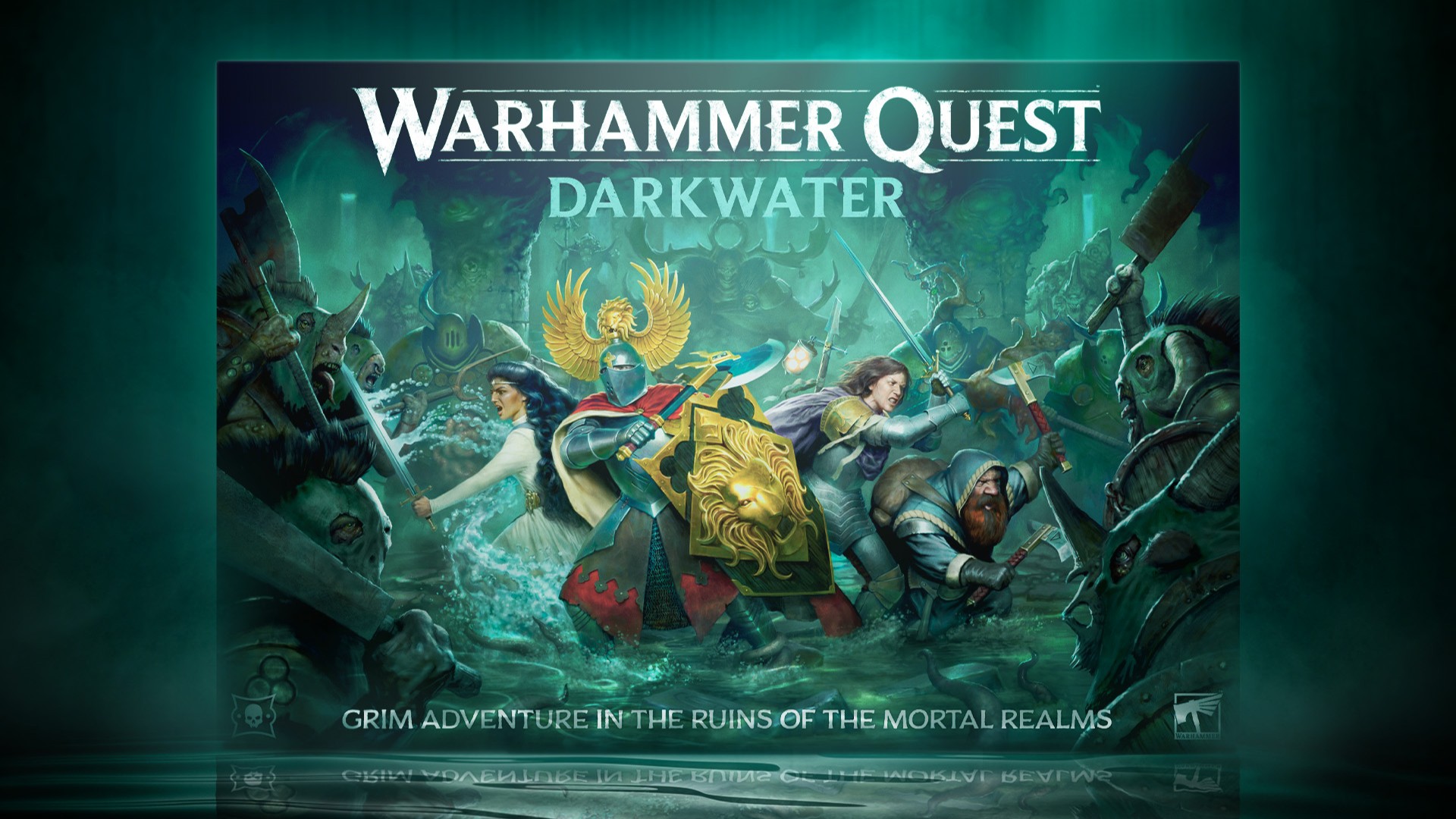
If you grew up hearing people talk about “Warhammer Quest” like it was some half-mythical artifact, i get it. The name has weight. So going into this Warhammer Quest Darkwater board game review, the big question isn’t “is it fun?” It’s “does it feel like a real game, or just an expensive box of miniatures with rules stapled on?”
Darkwater mostly lands in the good place. It’s a cooperative campaign crawler set in Age of Sigmar’s Jade Abbey, and it’s clearly built to get played, not just admired on a shelf. It’s faster, cleaner, and less of a time sink per session than a lot of big-box dungeon crawlers, but it still has enough knobs to turn that you’re making real decisions.
https://www.warhammer.com/en-US/shop/warhammer-quest-darkwater-2025-eng
What Darkwater is aiming for: quick co-op in a gross Nurgle dungeon
Warhammer Quest: Darkwater is designed for 1 to 4 players, and it’s positioned as an approachable co-op experience you can play in shorter sessions. Games Workshop even calls out an estimated 45 minutes per session, which tells you the intent right away. It wants to hit the table on a weeknight, not require a whole Saturday.
Theme-wise, you’re pushing into a corrupted abbey to stop Gelgus Pust and his followers from ruining the Everspring, because of course Nurgle can’t see a magical fountain without trying to make it smell like a dumpster behind a seafood restaurant. The tone is classic Nurgle: disgusting, kind of funny, and weirdly charming.
What’s in the box: miniatures, cards, and a map book that actually helps
The headline is the mini count: 49 push-fit miniatures, split between heroes, villains, and a big pile of enemies. It’s a lot, and it’s clearly part of the price argument.
But the sleeper feature is the hardback, lay-flat map book. Instead of juggling tiles, you open to the scenario’s map and you’re basically ready. Darkwater’s campaign and encounter system leans hard on that book, and it’s one of the smartest quality-of-life choices in the whole package.
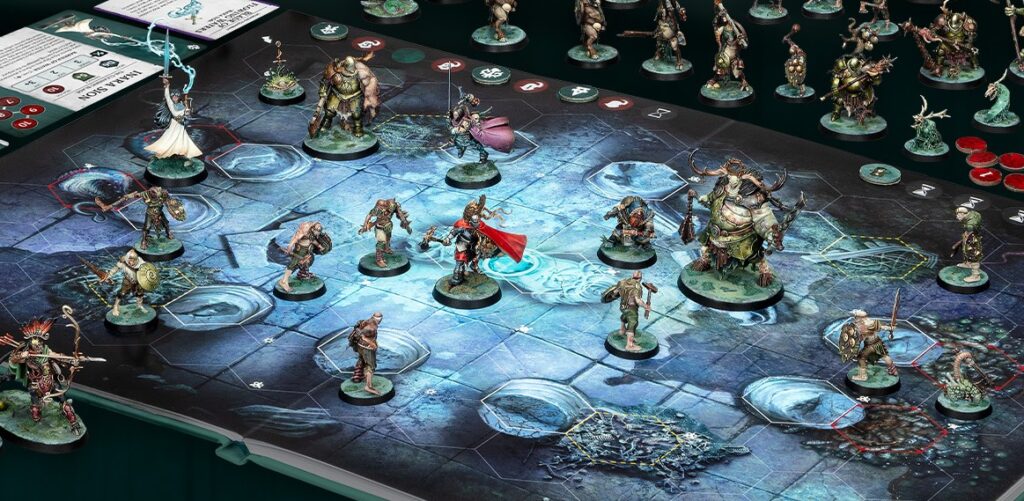
Component listings for the box also call out a 36-page rulebook, a 38-page map book, hundreds of cards, tokens/markers, and a chunk of dice, including enemy action dice. In other words: it’s not just “models plus vibes.”
How it plays: action cards, energy, and hex movement (yes, you roll for it)
The core turn structure is built around three hero action cards: Move, Attack, and Aid. You generate energy by exhausting cards, then spend that energy to power actions, sometimes repeating an action by burning energy in a way that forces tradeoffs.
That system is doing a lot of work. It keeps turns moving, it makes your choices feel tangible, and it stops the game from turning into “everybody always does the same optimal three-step routine.”
Movement is on hexes, and for most heroes it’s a D6 roll. If that makes you wince a little, you’re not alone. It’s old-school. The good news is the energy system gives you ways to push past the worst-feeling moments, like sprinting for a consistent full move when you really need to get somewhere.
Combat is similarly clean: you’re rolling D6s to hit target numbers, and enemies have defenses and special behaviors that can swing the tempo. It’s not a crunchy tactics sim. It’s closer to a narrative skirmish game that wants you to take chances and accept that sometimes the dice are going to be rude.
Campaign structure, skirmish mode, and why replayability is the point
This is where Darkwater starts to make sense as a “modern” Warhammer Quest.
Campaign mode is built around three acts, and each act is assembled by drawing from decks that include encounters, events, rest sites, and boss encounters. Each round, you typically draw two cards, read the story setup, and choose which one to play, discarding the other. That choice is small, but it matters, because difficulty and rewards can swing hard depending on what you pick.
Games Workshop pegs a full campaign at roughly 10 to 14 hours. That sounds big, but the game is built to pause and resume without you needing to leave it set up on your dining table for a week. Skirmish mode is the shorter option: pick a single encounter and play it as a standalone.
This is also where the map book shines, because the same map can support multiple encounters with different enemy mixes, goals, and special rules. So it’s not “open book, do the same thing every time.” It’s “open book, see what fresh nightmare lives here today.”
And yes, if you’re here for the Warhammer Quest Darkwater board game review angle, that campaign structure is one of the biggest reasons it earns a recommendation for actual board gamers, not just collectors.
Difficulty spikes, randomness, and the classic co-op problem
Let’s be honest: the game is swingy. Enemy behavior is driven by dice, and the system can create turns where the monsters feel sleepy… or turns where everything goes wrong all at once. Some groups will love that chaos. Others will call it “unfair” and they won’t exactly be wrong.
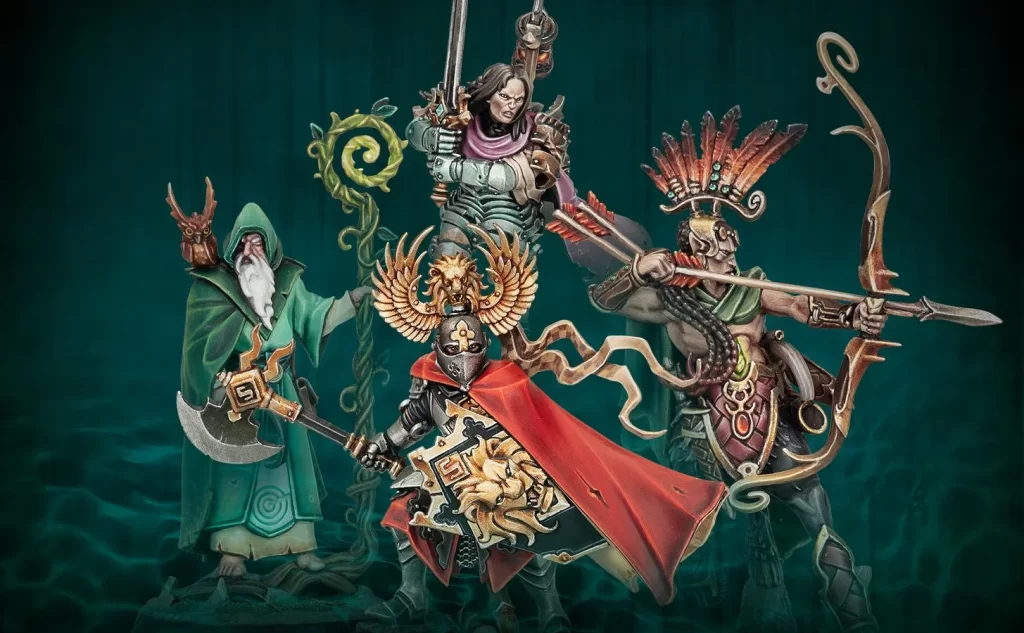
Darkwater also bumps into the classic “alpha player” issue, especially at certain player counts. You always have four heroes in play, which means some players will control multiple heroes at lower player counts, and one player being a “leader” can nudge the table toward one person quarterbacking decisions. If your group already struggles with that in co-op games, you’ll want to be a little intentional about table talk.
One more small gripe: the maps are beautiful, but several reviewers note that they tend to share a similar overall shape. So even with different art and setups, you can get a faint sense of “we’ve been in this kind of space before.”
Who should buy it (and who should probably skip it)
Buy Darkwater if:
- you want a co-op dungeon crawler that plays in manageable chunks
- you like campaign progression but don’t need a super scripted narrative
- you enjoy miniatures, or at least don’t resent paying for them
- your group is fine with dice-driven drama
Skip it if:
- you want tight balance and low randomness
- you’re looking for deep tactical combat every single turn
- your group hates rolling for movement on principle
- you mainly want story-book narrative more than replayable scenarios
And if you’re the kind of tabletop person who also plays card games (that overlap is real), you’ll probably enjoy browsing our other hobby coverage too, like Magic: The Gathering’s Fallout Commander Decks Spoiler Decklist or our primer on what MTG proxy cards are and how to get them.
Verdict: our Warhammer Quest Darkwater board game review score
Darkwater feels like Games Workshop designing for the table first and the display case second, which is not always guaranteed with their boxed games. Setup is quick, turns have actual decisions, and the campaign structure is built for replayability instead of one “perfect” story run.
But it’s still a dice-forward game with uneven difficulty, and that’s going to be the make-or-break point for a lot of groups.
Kraken Opus score: 8/10.
A strong, approachable co-op campaign game with great production values and a smart scenario system, as long as you can live with the chaos.