
A utility artifact is an artifact included to make a deck function more reliably or answer a particular problem. It might accelerate mana, fix colors, protect a creature, filter draws, disrupt an activated ability or interact with graveyards. The important part is the job, not whether the card appears on somebody’s list of staples.
“Utility artifact” is a practical deckbuilding label, not an official Magic rules category. The Magic Comprehensive Rules define artifact as a card type, but they do not define a utility-artifact subtype or require utility artifacts to be noncreatures. An artifact creature such as Haywire Mite can qualify perfectly well when its main job is exiling a noncreature artifact or enchantment.
That changes the deckbuilding question. Do not ask, “How many famous artifacts can I fit?” Ask, “What is this deck failing to do, and is an artifact the most efficient way to fix it?”
Choose the role before choosing the card
Utility cards are easy to overrate because flexibility looks like free value. It is not. Every utility artifact occupies a deck slot, usually requires an initial mana payment and may demand more mana, tapping or sacrificing before it accomplishes anything.
| Role | Example tools | Question to ask |
|---|---|---|
| Acceleration and fixing | Sol Ring, Chromatic Lantern | Do I need more mana, different colors or both? |
| Card selection | Sensei’s Divining Top | Does improving future draws justify repeated mana payments? |
| Creature protection | Lightning Greaves, Swiftfoot Boots | Can the protection interfere with my own targeting? |
| Graveyard interaction | Relic of Progenitus, Soul-Guide Lantern | Can I afford to affect my own graveyard? |
| Activated-ability disruption | Pithing Needle | Do the important threats actually use activated abilities? |
| Artifact recursion | Goblin Engineer, Trading Post | Are the setup and sacrifice costs supported by the deck? |
| Tap-ability support | Unwinding Clock | Do I control enough useful artifacts to make extra untaps matter? |
These categories are adjustable rather than mandatory. A Commander deckbuilding framework such as the Kraken Opus deckbuilding checklist can reveal missing functions, but it should not become a ritual in which every deck receives the same ten artifacts regardless of strategy.
Mana acceleration and color fixing are different jobs
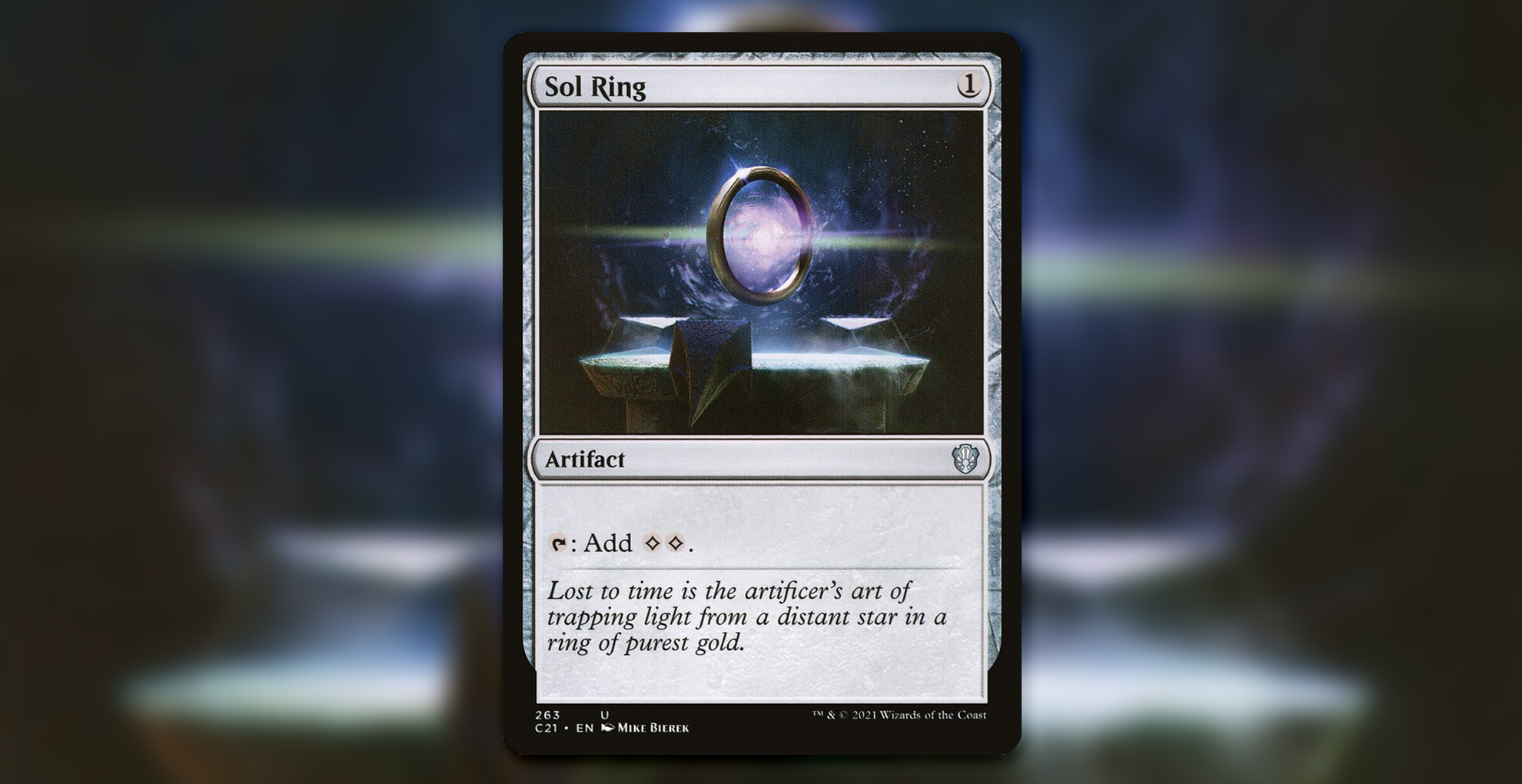
Sol Ring is the obvious example of raw acceleration: it costs one mana and taps for two colorless mana. That rate makes it exceptionally efficient in Commander, but the card does not produce colored mana and should not be described as a staple across Magic generally. It is banned in Legacy and restricted in Vintage, and legality always depends on the format being played.
Before adding any familiar mana rock, identify the actual failure. A deck that consistently has the right colors but falls behind on total mana wants acceleration. A multicolor deck that has enough lands but cannot produce the correct colors wants fixing. Those problems sometimes overlap, but not always.
Chromatic Lantern addresses color access by tapping for one mana of any color and giving your lands the same capability. Its three-mana casting cost is a real constraint, however. A low-curve deck or a two-color deck with a reliable mana base may spend three mana fixing a problem it did not have.
This is where utility artifacts can conceal structural trouble. If a deck repeatedly needs a three-mana artifact before it can cast its spells, inspect the land count and color sources first. An artifact can support a mana base; it should not automatically excuse an underbuilt one.
Card selection is not automatically card advantage
Sensei’s Divining Top demonstrates the difference. Its one-mana activated ability lets you look at and rearrange the top three cards of your library. That can improve draw quality, support top-of-library synergies and reduce uncertainty, but it does not inherently put an extra card in your hand. Each new look also costs another mana.
Top can tap to draw a card and place itself on top of its owner’s library, which preserves access to the artifact but affects the next draw unless another effect changes the top of the library. Its value therefore depends on synergy, available mana and opportunities to shuffle or otherwise manipulate the library—not merely on its reputation.
Format scope matters here too. Sensei’s Divining Top is legal in Commander and Vintage but banned in Modern and Legacy according to the supplied current card reference. Check the official banned and restricted list before treating any recognizable utility card as an available option.
Protection has mechanical side effects
Lightning Greaves and Swiftfoot Boots both grant haste, but they protect creatures differently. Greaves grants shroud and has equip zero; Boots grants hexproof and has equip one. Shroud prevents every player—including the creature’s controller—from targeting it. Hexproof stops opponents from targeting it while leaving your own targeted effects available.
Greaves can be excellent when the plan is to resolve a commander, activate it immediately and keep opposing removal away. It can also become awkward when the same deck wants to attach another Equipment, cast an Aura or repeatedly target that creature with beneficial abilities. Boots costs more to move but causes less self-interference.
Protection is therefore not one interchangeable role. Name what the creature needs protection from, how quickly protection must be available and whether your own deck needs to target that creature afterward.
Graveyard tools differ in collateral damage
Relic of Progenitus can repeatedly make a target player exile a card from their graveyard. It can also be sacrificed to exile all graveyards and draw a card. That broad reset is powerful against graveyard strategies, but it also clears your graveyard.
Soul-Guide Lantern is more selective. It exiles one target card from a graveyard when it enters, then can be sacrificed either to exile each opponent’s graveyard or to draw a card. The tension is that sacrificing it for one function gives up the other.
A deck that treats its own graveyard as a second hand may prefer Lantern’s asymmetry. A deck with little interest in its graveyard may accept Relic’s wider blast radius. Neither is simply “the graveyard-hate artifact”; each changes what its controller must preserve, spend or sacrifice.
Disruption must match the thing causing trouble
Pithing Needle is efficient because it costs one mana and can shut off activated abilities of sources with the chosen name, except mana abilities. It does not destroy the named permanent, counter triggered abilities or remove static abilities.
That makes Needle excellent when a deck expects a particular planeswalker, Equipment, combo piece or commander whose value comes from activated abilities. It is much less impressive against a creature valued mainly for attacking or a permanent built around triggered text.
The punctuation on a card can help identify the interaction. Activated abilities are generally written as a cost followed by a colon and an effect. They normally use the stack, although mana abilities receive special treatment.
Specialized disruption should complement broad interaction rather than impersonate it. If the problem is “I cannot remove creatures,” a Pithing Needle is not a generic removal spell wearing an artifact hat.
Recursion is useful only when its costs fit the deck
Goblin Engineer can put an artifact from the library into the graveyard when it enters. Its activated ability then requires red mana, tapping the Engineer and sacrificing an artifact to return an artifact with mana value three or less from the graveyard to the battlefield. That is potent in a deck built around cheap artifacts and sacrifice loops, but the color requirement, tap requirement and mana-value ceiling keep it from being universal recursion.
Trading Post offers a broader package of modes, including returning an artifact card from the graveyard to hand. Its recursion mode costs one mana, requires tapping Trading Post and demands a creature sacrifice, while Trading Post itself costs four mana to cast. Flexibility is real, but so is the amount of cardboard and mana that must already be in motion.
Recursion artifacts are most convincing when the deck naturally produces sacrifice fodder, repeatedly uses artifacts with enter-the-battlefield or death effects, or needs to recover a central engine. Adding expensive recursion merely because an artifact might be destroyed can create more dead setup cards than resilience.
Artifact density can turn a tool into an engine
Some artifacts become useful only after the deck reaches enough supporting density. Unwinding Clock untaps all artifacts you control during every other player’s untap step. That is meaningful when those artifacts tap for mana or useful abilities. With only a couple of passive artifacts in play, it may effectively do nothing.
This is the difference between a utility card and an engine piece. A utility card usually solves a problem on its own. An engine piece asks the rest of the deck to supply enough compatible objects to create repeated value. The more artifact-dependent the deck becomes, the stronger those payoffs can be—but the deck also becomes more exposed to effects that punish or remove multiple artifacts.
How the choice changes between decks
A three-color Commander deck with unreliable mana
Start by counting lands and colored sources rather than immediately adding Chromatic Lantern. If the deck has enough mana but frequently misses a specific color, Lantern may solve a genuine access problem. If it simply misses land drops, another three-mana nonland card does not repair the underlying shortage.
A commander that needs to attack or tap immediately
Lightning Greaves offers haste and zero-cost equipping, which can be ideal for speed. If the deck also targets its commander with Auras, Equipment or beneficial abilities, Swiftfoot Boots may create fewer mechanical traffic jams despite the equip cost.
A deck that uses its own graveyard
Avoid treating all graveyard hate as interchangeable. Relic of Progenitus can erase your setup along with everyone else’s. Soul-Guide Lantern can preserve your graveyard when using its opponent-only exile mode, but choosing that mode means giving up its sacrifice-to-draw option.
A low-curve 60-card deck
Tempo and legality become especially strict. A three- or four-mana support artifact may be too slow unless it produces an immediate, decisive effect. Some celebrated Commander tools are unavailable in other formats, while narrow answers may belong in a sideboard rather than the main deck.
An artifact-heavy tap-ability deck
Here, Unwinding Clock can multiply the use of mana rocks and tap abilities across a multiplayer turn cycle. In a deck with low artifact density, the same card is an expensive promise that the rest of the deck may never keep.
A short utility-artifact checklist
- Name the problem in one sentence: insufficient mana, weak color access, poor draw quality, vulnerable creatures, graveyard decks, activated abilities or lost artifacts.
- Confirm that the card works in your format and, in Commander, fits the commander’s color identity. Commander decks contain exactly 100 cards including the commander and normally use singleton construction except for basic lands.
- Calculate the full cost, not just the casting cost. Include activation or equip mana, tap requirements, sacrifices and any turns spent before the payoff.
- Check for self-interference. Shroud can stop your own targeting, graveyard exile can remove your resources and colorless acceleration may not cast color-intensive spells.
- Compare the artifact with options in the deck’s colors. A colored spell or creature may solve the same problem more efficiently or contribute more directly to the deck’s plan.
- Look for redundancy only when the role is important enough to justify it. Drawing three protection artifacts without a worthwhile creature is not resilience; it is a small equipment shop with no customers.
- Cut the card if the named problem rarely appears. Utility slots should follow the environment and the deck, not a permanent list of supposedly mandatory staples.
The right tool solves a specific problem
The best utility artifact is not necessarily the most famous or generically powerful one. It is the card whose role matches a real weakness, whose costs fit the deck’s curve and resources, and whose legality fits the format.
Treat utility artifacts like tools in a crowded toolbox. Sol Ring accelerates but does not fix colors. Sensei’s Divining Top selects draws but continuously consumes mana. Pithing Needle stops a particular class of abilities but does not remove the permanent. Graveyard artifacts differ in what they exile and what they sacrifice. Once those distinctions are visible, choosing utility artifacts stops being staple collection and becomes actual deckbuilding.
References
- media.wizards.com
- Haywire Mite – mtg.wtf
- Sol Ring – mtg.wtf
- Banned & Restricted | Magic: The Gathering
- Chromatic Lantern – mtg.wtf
- Sensei's Divining Top – mtg.wtf
- Lightning Greaves – mtg.wtf
- Relic of Progenitus – mtg.wtf
- Soul-Guide Lantern – mtg.wtf
- Pithing Needle | 10th Edition | Modern | Card Kingdom
- Goblin Engineer – mtg.wtf
- !Trading Post – mtg.wtf
- Unwinding Clock – mtg.wtf