
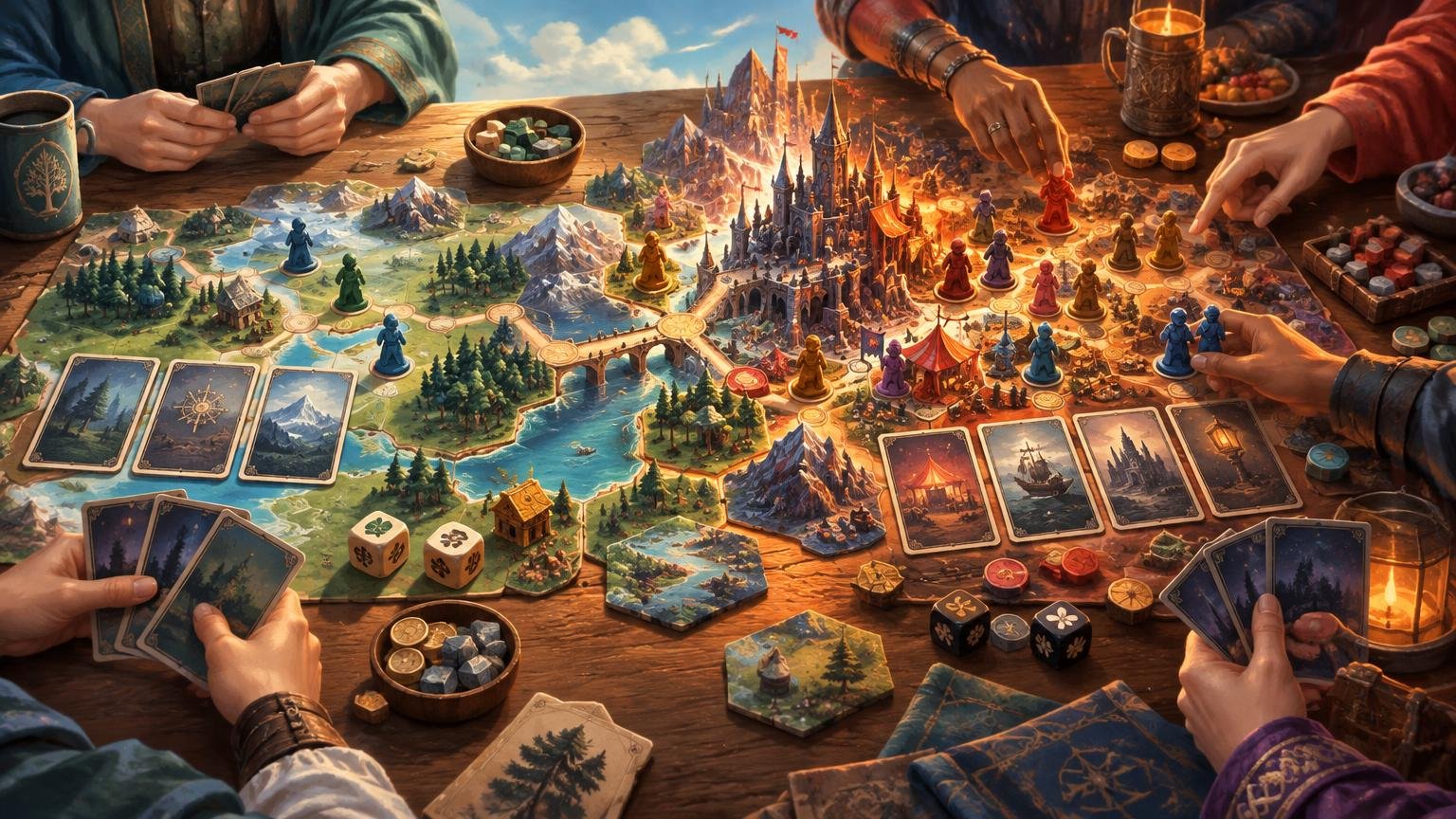
TLDR: A board game scales well when changing the player count preserves the pressures and decisions that make the game interesting without introducing excessive downtime, empty spaces, overcrowding, or bookkeeping. The player range on the box establishes official support; it does not prove that every count delivers the same experience. Check the exact rulebook for count-specific setup, then judge pacing, interaction, congestion, coordination, and table footprint against what your group enjoys.
Board game player scaling is easiest to understand as two separate layers. First, the published rules may change the map, card supply, available actions, opposition, or turn structure. Second, those changes produce a table experience that different groups may judge differently. Mixing the layers is how “supports five players” quietly mutates into “great at five,” even though those are not equivalent claims.
This distinction appears in the way BoardGameGeek documents game entries: manufacturer player-count information is separate from community player-count information. The former records official support, while the latter can reflect user preferences. BoardGameGeek’s game-entry documentation is therefore useful for understanding why a listed range and a preferred count should not be treated as the same kind of evidence.
What board game player scaling actually means
Player scaling is not one standardized rule term. Operationally, it means the collection of changes a game makes—or conspicuously does not make—when the number of players changes. A game might add map sections, remove action spaces, adjust a deck, change resource quantities, strengthen an automated opponent, or leave everything untouched and rely on the extra players to create pressure.
Good scaling does not require identical sessions at every count. That is usually impossible because adding people changes information, negotiation, competition, and elapsed time. The better question is whether each supported count still creates the game’s intended problems. If a worker-placement game is about fighting over scarce actions, its two-player setup must retain meaningful scarcity. If a negotiation game derives its energy from shifting alliances, two players may fundamentally change the activity even when the rules function perfectly.
| Scaling mechanism | What the rules may change | What to assess at the table |
|---|---|---|
| Modular map or board | Add or remove regions, tiles, lanes, or spaces | Travel distance, congestion, access, and table footprint |
| Action spaces | Open, close, duplicate, or resize worker locations | Competition, blocking, and whether choices feel forced or trivial |
| Decks and markets | Add cards, remove count-marked cards, or change market refresh | Variety, turnover, predictability, and access to combinations |
| Resources and objectives | Alter supplies, targets, rewards, or end conditions | Scarcity, scoring pace, and whether the game ends too early or late |
| Opposition or AI | Adjust enemy health, actions, setup, or difficulty | Threat level, upkeep, coordination, and swinginess |
| Turn structure | Use simultaneous phases, extra turns, or count-specific order rules | Downtime, planning stability, and total session length |
The box range answers a rules question, not a taste question
A publisher-supported range means the product contains rules intended to make those counts playable. It may tell you that all necessary components are present and that setup has been defined. It cannot tell you whether your group will like the resulting interaction level or waiting time.
“Best player count” is consequently a recommendation that needs criteria. Best for low downtime? Best for negotiation? Best for a tight map? Best for teaching? Best for seeing the largest variety of cards? A four-hour group that enjoys dramatic table talk will evaluate a five-player session differently from a couple looking for a brisk weeknight game.
Community polls and comments can reveal patterns worth investigating, but they are most useful when you understand the mechanism behind the vote. “Not recommended at five” is less actionable than “the fifth player increases the interval between turns without adding enough new interaction.” The second statement tells you whether the criticism matters to your group.
How common scaling systems change the game
Modular boards regulate density
Adding one board section per player can keep the amount of usable territory roughly aligned with the number of participants. That can prevent a map from becoming impossibly crowded, but equal area per player does not guarantee an equal experience. More boundaries, longer discussions, or additional enemy pieces can still increase complexity.
Spirit Island provides a clean publisher-documented example of modular physical support. Greater Than Games lists the base game for one to four players and identifies four modular island boards among its components. Its product page also links to rules material, which is the appropriate place to verify the exact setup for a particular player count. This establishes how the product supports its range; it does not establish that one count is universally preferable.
Action spaces regulate competition
Worker-placement and action-selection games often scale by covering spaces at lower counts or adding spaces at higher counts. The design problem is not merely giving everyone somewhere to go. It is maintaining the right amount of obstruction. Too much availability turns a contested economy into parallel optimization. Too little produces turns where players select the least painful blocked option rather than pursue a strategy.
Look for count icons printed beside action spaces, setup instructions that cover locations, or neutral pieces that occupy them. Neutral blockers can reproduce scarcity, but they do not necessarily reproduce human intent. A person may block you because your plan is visible; an inert token usually blocks according to setup or a simple procedure. The space is unavailable in both cases, but the strategic meaning differs.
Deck and market adjustments regulate circulation
Games may remove specially marked cards at lower counts, add objectives at higher counts, or change how quickly a shared market refreshes. These details affect more than mathematical balance. A larger group can cycle through a market rapidly, exposing more options but making it harder to plan around a card surviving until your turn. With two players, the same row may stagnate unless the rules provide another source of turnover.
When inspecting this system, ask whether scaling preserves access, variety, or unpredictability. Those goals are related but not identical. Removing cards can keep the deck proportional while accidentally making certain combinations less reliable. Leaving the full deck intact can preserve variety while burying count-sensitive cards too deeply.
Turn structure regulates downtime
A game with five-minute turns does not automatically become intolerable at five players. The important detail is what everyone else can do during those minutes. Simultaneous planning, reactive abilities, negotiation, and shared problem-solving keep players involved. A rigid sequence with little off-turn relevance creates dead air, especially when the board changes enough to invalidate advance planning.
This is why total duration alone is a blunt measure. Two games can both last two hours, yet one distributes attention continuously while the other concentrates it into brief personal turns. When assessing a high count, track the distance between meaningful decisions rather than staring only at the clock.
Two-player scaling has its own problems
At two players, turn order is usually brisk and the board state is easier to read. The cost is reduced social and strategic texture. Auctions have fewer bidders, voting can become binary, alliances disappear, and direct attacks may repeatedly target the same opponent. A game can remain balanced while losing the uncertainty produced by several competing agendas.
Designers commonly compensate with tighter maps, neutral blockers, dummy participants, revised thresholds, or count-specific cards. Each solution preserves something and sacrifices something. A smaller map can retain competition efficiently. A dummy player may preserve board pressure but add upkeep. Revised thresholds can repair the economy while doing nothing to replace negotiation.
For buyers, the key question is not simply whether a two-player variant exists. Ask what multiplayer ingredient would otherwise disappear and what the variant uses as a substitute. If the missing ingredient is spatial competition, a neutral blocker may work well. If it is persuasion among several human factions, no setup token can recreate it.
Solo support is not one type of scaling
A one-player listing can describe several very different systems. A dedicated solo design may rebuild the challenge around one decision-maker. An automa uses cards or procedures to simulate selected pressures from an opponent. A neutral player occupies spaces without pursuing a full strategy. Multi-handing simply asks one person to control multiple player positions.
Wingspan illustrates publisher-documented dedicated solo material: Stonemaier Games lists the game for one to five players and includes 16 Automa cards along with separate core, Automa, and appendix rulebooks in the product contents. That confirms a purpose-built procedure and components for solo play, but whether someone enjoys its upkeep or style remains a subjective assessment.
When evaluating solo scaling, identify what the system preserves: race pressure, blocking, variable objectives, combat, resource denial, or uncertainty. Then count its administrative cost. An automated opponent can create excellent pressure while requiring enough card flips and exceptions to feel like unpaid clerical work. For a deeper framework, see what makes a solo mode feel like the same game.
A practical rulebook inspection checklist
Before buying a game primarily for an unusual count, locate the rulebook for the exact edition and inspect the setup rather than relying only on the number printed on the box.
- Find the player-count setup table and note every component that is added, removed, covered, or replaced.
- Look for count icons on cards, board spaces, objectives, tiles, and scenarios.
- Check whether the map changes size or only receives more pieces.
- Identify neutral players, dummy workers, automa decks, flowcharts, or upkeep phases.
- Check whether round length, starting resources, victory thresholds, enemy strength, or end conditions change.
- Confirm whether solo or two-player rules require a separate document, app, promotional item, or expansion.
- Read count-specific scenario restrictions and cooperative difficulty instructions.
- Verify the edition, printing, FAQ, and errata date when discussing a precise setup rule.
Expansion dependencies deserve particular care. An expansion may improve a weak count by adding a new board, replacement deck, or solo system, but it can also add enough modules to increase setup and decision time. Evaluate whether it changes the mechanism causing the problem rather than merely adding more content. The same test is useful when applying an expansion buying framework to a game that struggles at your normal count.
How to judge the experience without pretending it is universal
Once the rules layer is documented, evaluate the experience with explicit criteria. At two players, examine whether competition remains sharp and whether missing negotiation matters. At higher counts, examine downtime, board readability, congestion, and how often plans collapse before a turn arrives. In cooperative games, consider coordination burden and whether one confident player can dominate a larger discussion.
Table footprint is part of scaling too. Adding personal boards, hands of cards, and map modules can turn a mechanically sound five-player mode into a furniture problem. Setup and teardown may also grow faster than the nominal player count when every participant needs a separate deck, tray, or faction kit.
Use language that exposes the judgment: “five players increases negotiation but also the interval between turns” is more responsible than “five is bad.” “Two players makes the market more predictable” is more useful than “two is unbalanced” unless the rules or credible data establish an actual balance problem. Description lets readers map the tradeoff onto their own preferences.
Choose for the group you actually have
The most useful player-count recommendation starts with frequency, not fantasy. If most sessions involve two people, do not buy primarily for a theoretically glorious five-player night that happens twice a year. Check how the two-player rules maintain pressure, how long setup takes, and whether the missing social dynamics are central to the design.
For a regular larger group, prioritize simultaneous activity, useful off-turn involvement, manageable table space, and rules that prevent the board from becoming either empty or gridlocked. For solo play, identify whether you want a dedicated puzzle, an automated rival, or the full multiplayer system under one person’s control.
That is the core of board game player scaling: document what the rules change, identify what those changes are trying to preserve, and then decide whether the resulting tradeoffs suit your table. The box gives you a supported range. The mechanisms—and your group’s tolerance for their consequences—tell you where the game will actually live.