
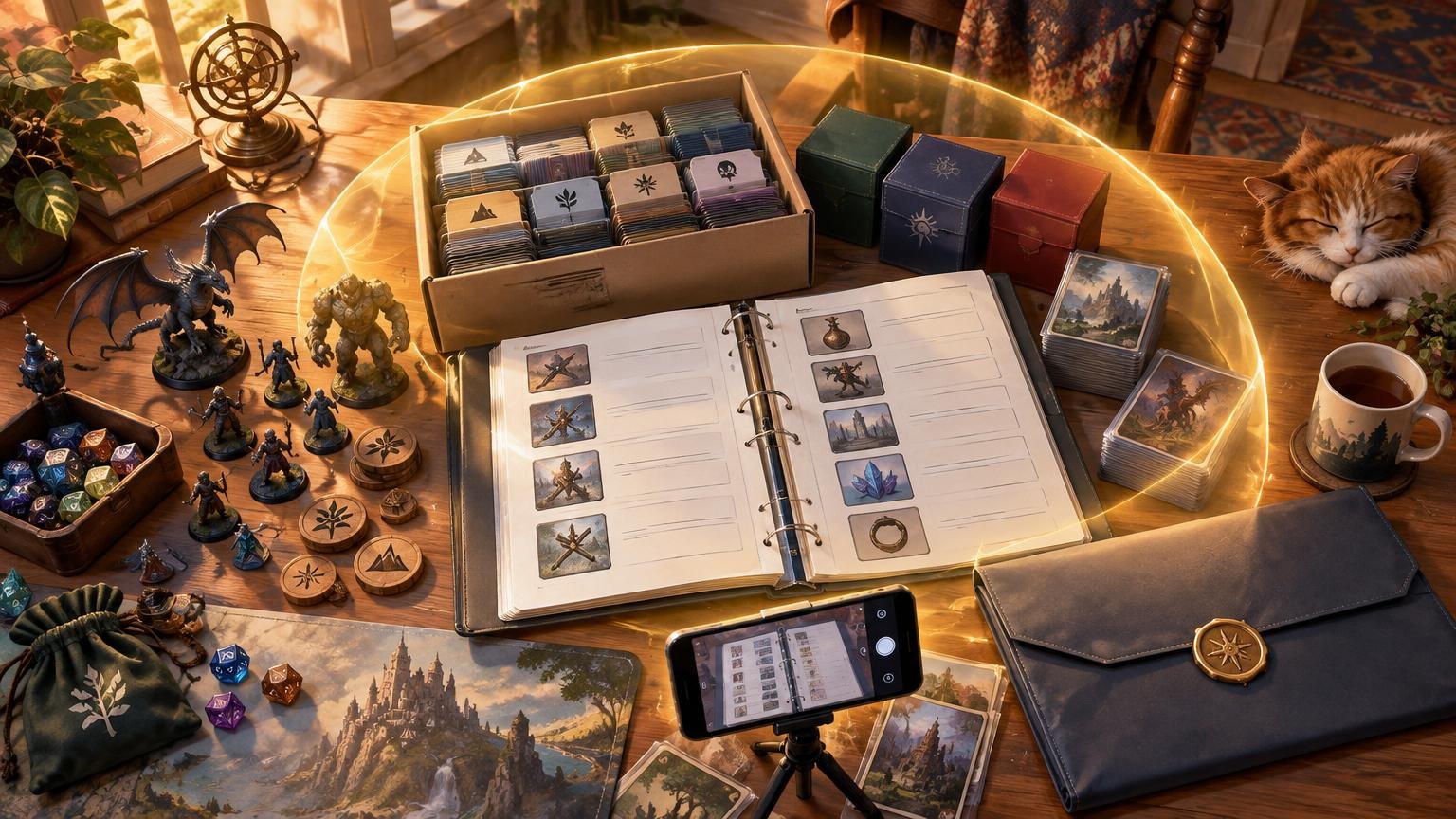
TLDR: Start with wide photos and container-level records, then give individual attention to rare, graded, serialized, expensive or difficult-to-replace pieces. Record what each item or group is, where it lives, supporting purchase information and the date you last checked it. Keep a secure copy away from the collection, and ask your insurer how its limits and valuation terms apply to your particular property.
A useful hobby collection insurance inventory is not an appraisal of every card, miniature or game on the shelf. It is a layered record designed to answer three practical questions: what did you own, where was it stored and what evidence supports the description? The same record can also stop you buying a third copy of an expansion because the first two disappeared into differently labeled tubs.
The goal is maintainability, not archival perfection. Begin with broad documentation, identify the parts of the collection that deserve finer detail and improve the record during normal hobby maintenance. An incomplete inventory that gets updated is more useful than an elaborate database abandoned halfway through Box Two of Seventeen.
Why inventory the collection beyond insurance?
Insurance readiness may provide the initial shove, but everyday organization supplies the reason to keep the inventory current. A location field makes games and components easier to retrieve. Quantity records expose duplicate purchases. Condition and completeness notes tell you which board game is missing a token sheet or which record sleeve needs replacement. Purchase totals can also help you set a hobby budget without treating the collection as an investment portfolio.
The National Association of Insurance Commissioners’ consumer guidance says a home inventory can help people assess personal-property coverage and support a claim. It recommends recording information such as brand, purchase price and date, model or serial numbers, receipts and photographs, while including collections and valuables. California guidance similarly recommends photos or video, purchase information and records stored away from the home.
Those recommendations provide a useful documentation framework, but they do not establish what a particular policy will cover. Limits, exclusions, deductibles, covered causes of loss and evidence requirements depend on the actual contract and circumstances.
Build a hobby collection insurance inventory in layers
The fastest workable method moves from room to shelf to container to item. Photograph the game room or storage area first. Capture each shelf, cabinet, display case and stack of labeled containers. Add one record for every container or coherent group, such as “Commander decks,” “painted fantasy miniatures” or “Nintendo Switch physical games.”
Next, identify pieces that warrant individual records. Useful triggers include an item being rare, graded, signed, serialized, authenticated, unusually costly, hard to identify from a group photo or difficult to replace. Individual documentation can also make sense when one object represents a large share of a container’s cost.
Everything else can remain grouped at a level that still communicates what is present. “Four 3,200-count boxes of assorted trading cards” is more useful than “cards,” especially when paired with dated photographs and notes about the games, sets or eras represented. A board-game shelf can be recorded by title, while bags of common miniature terrain may only need group quantities.
This is triage rather than neglect. You are spending the most documentation effort where ambiguity would create the most friction while still establishing a baseline for ordinary items.
Choose a simple catalog and stable location codes
A spreadsheet is enough for many collections. A specialist collection app may offer barcode scanning, card databases or cover images, but exportability matters more than visual polish. If the service disappears, changes its terms or locks useful fields behind a subscription, you should still be able to retain a plain spreadsheet or other accessible copy.
Give physical locations stable codes such as ROOM-SHELF-CONTAINER: GR-A-03 might mean game room, shelving unit A, container 03. Put the code on the container and in the inventory. Do not encode every title into the label; contents change more often than locations.
Location codes also reveal whether your storage system serves the hobby. If retrieving one game requires moving six unlisted boxes, the problem is not collection size alone. It is access friction. The same access-versus-density tradeoff appears when planning physical game collection storage. For card-heavy collections, a separate MTG card storage system can supply the physical structure while the master inventory records container locations.
Fields worth recording
Use consistent fields, but allow blanks where a detail genuinely does not exist. A practical master record can include:
- Inventory ID and category
- Item, group or container name
- Edition, set, model or other distinguishing version
- Quantity and unit of measure
- Condition and completeness notes
- Room, shelf, display or container code
- Purchase or acquisition date, if known
- Seller, shop, trade partner or other source, when documented
- Amount paid, with currency
- Receipt, invoice or order-confirmation file name
- Overview and detail photo file names
- Serial, grading, certification or product number
- Notes about modifications, signatures or included accessories
- Date the record was last reviewed
Avoid turning uncertain memories into precise data. “Acquired before 2020; source unknown” is better than a fabricated date. Likewise, separate the amount paid from any current estimate. They answer different questions and should not overwrite one another.
Adapt the detail to the type of collection
Trading cards benefit from records for graded slabs, serialized cards, complete sets and notable singles, with bulk documented by game, set range and box. Deck lists are useful for play, but a deck name alone may not identify physical printings or premium versions.
For board games, record the edition, expansions and major upgrades. Note missing or substituted components. A photograph of the box front proves little about the expensive expansion modules packed inside it, so photograph those contents when they materially distinguish the copy.
Miniature inventories can use faction, range, model count, assembly state and paint status. Comics benefit from title, issue number, printing or variant and grading details. Records may need catalog number, pressing or edition identifiers. For consoles and arcade hardware, record model and serial numbers along with controllers, specialty peripherals and modifications.
The governing question is simple: what description would let another person distinguish this object or group from a generic substitute?
Take photographs that explain the collection
Use a sequence rather than isolated glamour shots. Start with a wide image showing the room or storage context. Take a medium view of each shelf or case, followed by readable container labels. Add close-ups for identifiers, condition details and individually documented pieces.
Photograph serial and certification numbers clearly enough to transcribe them, but also enter those numbers as text. Images can blur, while text can be searched. For sealed items, capture the seals and distinguishing edition markers. For opened games, photograph expansion boxes or organized components when their presence is not apparent from the exterior.
Receipts, invoices and order confirmations strengthen the supporting record. Save them using the inventory ID, such as GR-A-03-RECEIPT-2025-02. If no receipt exists, retain other legitimate records you already have rather than trying to reconstruct documentation after the fact.
Keep a hobby catalog and a protected evidence set
One database can serve two purposes, but the working and archival copies should behave differently. The daily catalog prioritizes convenience: searchable locations, deck contents, lending notes, missing components and wish-list decisions. The insurance-ready set prioritizes preservation: dated exports, original photographs, receipts and identifiers that should not change casually.
Export the working catalog periodically and save it with the supporting files. Keep at least one copy somewhere other than the home or storage site. That could be encrypted cloud storage or another appropriately secured location. California’s home-inventory guidance specifically recommends keeping records away from the home.
Protect the account with a strong unique password and multi-factor authentication where available. Avoid posting a complete catalog, aggregate value and precise storage map publicly. A collection photograph can be fun; a searchable treasure manifest with directions is less charming.
Use a maintenance rhythm that fits the hobby
Update individual records after substantial purchases, sales, trades or major condition changes. Reconcile a container whenever you reorganize it. Then conduct a full review about once a year, walking through every location code and marking the review date even when nothing changed.
Attach updates to actions you already perform. Photograph a board-game expansion when you integrate its components. Enter a graded card when it arrives. Reconcile shelves when moving the collection or putting a hobby on pause. This converts inventory work from an annual administrative boss battle into small background tasks.
Know which value your records describe
Purchase price is what you paid. A current collector-market estimate is an observation or estimate based on a particular market and date. Replacement cost describes the cost basis used to replace property, while an approach accounting for depreciation can produce a different payment basis. New York consumer guidance distinguishes replacement-cost coverage from methods that account for depreciation, but the wording of the reader’s own policy controls.
Keep these values in separate columns, identify the source and date for any estimate, and do not assume a marketplace listing equals an insured value. An appraisal is a different document created for a defined purpose. Whether one is required cannot be determined by a universal price threshold.
Questions to ask the insurer
Once the baseline inventory exists, use it to have a specific conversation with the insurer or agent. Ask:
- Does the policy apply special category limits to these kinds of collectibles?
- What valuation method applies after a covered loss?
- Which causes of loss are covered or excluded?
- Does coverage change in storage, transit, at events or away from home?
- Would an endorsement, scheduled coverage, floater or separate policy be relevant?
- Which pieces, if any, require individual descriptions or appraisals?
- What records would the insurer want to see when coverage is arranged and after a claim?
New York’s Department of Financial Services warns that policies commonly impose special limits on certain property categories and suggests that owners of valuable collections explore higher-limit endorsements or separate personal-articles floaters. That is a prompt to investigate, not a universal instruction to schedule every collection.
Also describe how the property is used. Items regularly sold online, held as convention stock or associated with a shop may raise business-property questions. New York consumer guidance notes that standard policies may provide limited coverage for business equipment or inventory. Lending, frequent travel and off-site storage likewise deserve direct, policy-specific questions.
A practical finish line
Do not wait until every common card has its own row. Photograph each storage area, assign location codes, inventory coherent groups and create individual records for the pieces where identification or replacement would be difficult. Connect receipts and detail photographs, export the catalog and protect an off-site copy.
Then review the actual policy with the inventory in hand. The useful finish line is not a perfect museum register. It is a collection you can locate, maintain and describe—with enough evidence to make insurance questions concrete before anything goes wrong.