
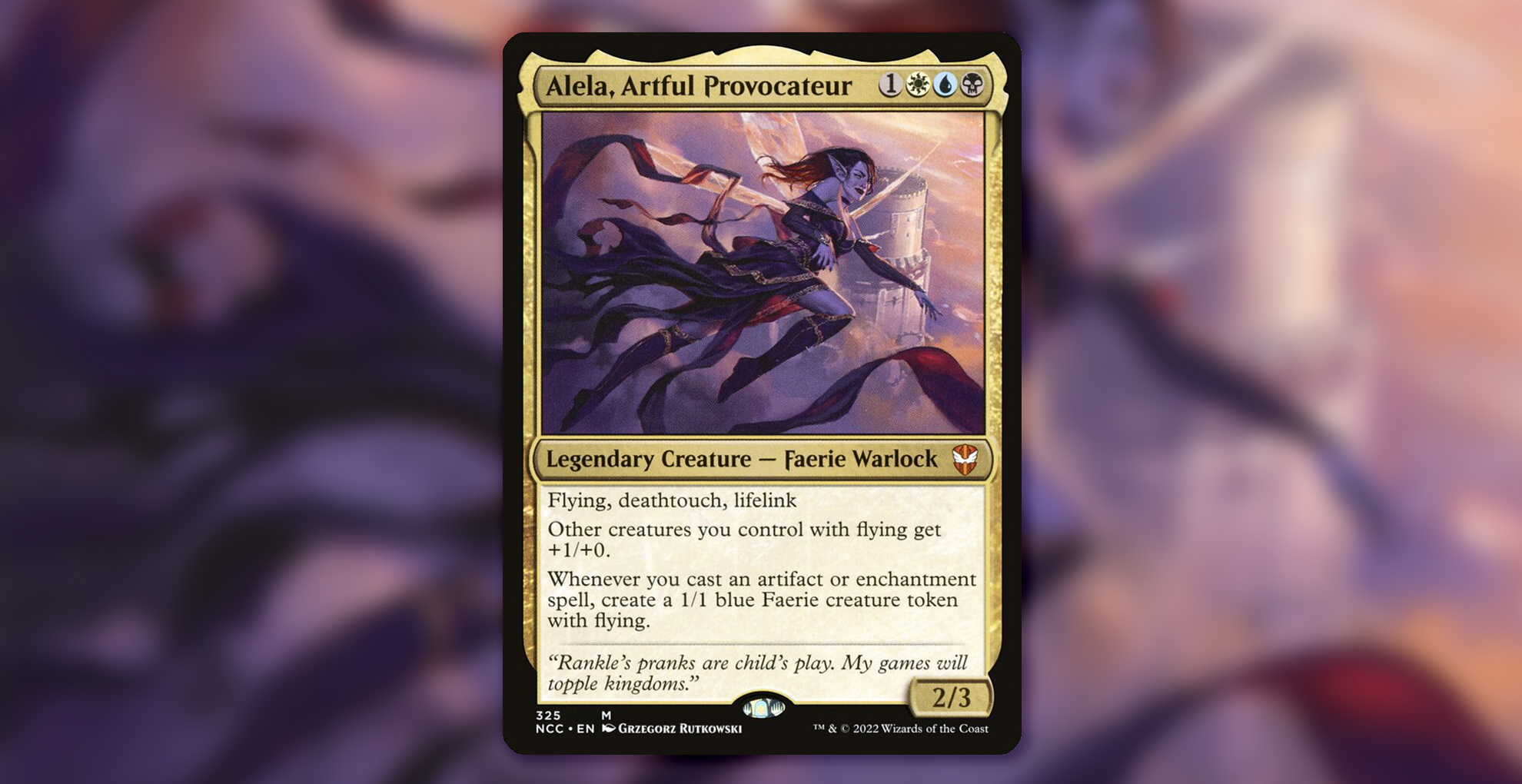
Faerie Schemes was the white-blue-black Brawl deck from Throne of Eldraine, released in paper on October 4, 2019. Its commander, Alela, Artful Provocateur, turns artifact and enchantment spells into flying Faerie tokens. Despite the name, this is not primarily a Faerie-tribal deck. It is an artifact-and-enchantment engine wearing a particularly pointy pair of wings. Wizards’ original Faerie Schemes decklist and design notes describe that engine as the deck’s main theme, with flying as a secondary theme.
The original product contained 60 cards including Alela. Converting it to Commander or rebuilding it for the current 100-card Arena Brawl environment requires 40 additional cards, and usually some replacements, but those formats are not interchangeable. First, it helps to establish exactly what came in the box.
The original Faerie Schemes decklist
Wizards published the decklist on September 4, 2019. It contained 11 creatures, two sorceries, three instants, 11 noncreature artifacts, seven enchantments and 26 lands. The creature count includes Alela and the artifact creature Shambling Suit.
| Card type | Original cards |
|---|---|
| Commander and creatures | Alela, Artful Provocateur; Shimmer Dragon; Workshop Elders; Sephara, Sky’s Blade; Massacre Girl; Animating Faerie; Corridor Monitor; Shinechaser; Arcanist’s Owl; Empyrean Eagle; Shambling Suit |
| Sorceries | Kaya’s Wrath; Winged Words |
| Instants | Banish into Fable; Chemister’s Insight; Mortify |
| Noncreature artifacts | Mace of the Valiant; Bag of Holding; Witching Well; Golden Egg; Arcane Signet; Ancestral Blade; Bloodsoaked Altar; Heraldic Banner; Scrabbling Claws; Guild Globe; Mana Geode |
| Enchantments | Smothering Tithe; All That Glitters; Frogify; Angelic Exaltation; Conclave Tribunal; Prison Realm; Lawmage’s Binding |
| Lands | Temple of Silence; Watery Grave; 6 Plains; 5 Islands; 4 Swamps; Azorius Guildgate; Command Tower; Dimir Guildgate; Dismal Backwater; Emergence Zone; Evolving Wilds; Orzhov Guildgate; Scoured Barrens; Tranquil Cove |
Puppeteer, Midnight Clock, Drown in the Loch and Thought Erasure were not in the published Faerie Schemes product. If one of those cards appears in a list labeled “original,” that list has either been modified or copied incorrectly.
How Alela’s engine actually works
Alela is a 2/3 legendary Faerie Warlock costing one generic, white, blue and black mana. She has flying, deathtouch and lifelink. Other creatures you control with flying get +1/+0, and whenever you cast an artifact or enchantment spell, you create a 1/1 blue Faerie creature token with flying.
That wording creates several important mechanical consequences:
- The ability triggers when you cast the spell, not when an artifact or enchantment enters the battlefield.
- The token is created before the triggering spell resolves because Alela’s ability goes onto the stack above that spell.
- If the artifact or enchantment spell is countered, the triggered ability can still resolve and create the token.
- A permanent that enters without being cast does not trigger Alela.
- A spell that is both an artifact and an enchantment creates one trigger, not two.
- Alela boosts other flying creatures, not herself. Her 1/1 flying tokens are therefore normally 2/1 while she remains on the battlefield.
The practical result is that cheap artifacts and enchantments do two jobs. Witching Well, Golden Egg, Arcane Signet, Guild Globe, Frogify and All That Glitters provide their printed effect while also adding another flying body. Shambling Suit qualifies too because it is an artifact creature spell.
A simple sequencing example
Suppose Alela is on the battlefield and you cast Golden Egg. Alela triggers, and that trigger goes above Golden Egg on the stack. The trigger resolves first, creating a 1/1 flying Faerie that Alela immediately boosts to 2/1. Golden Egg then resolves and enters the battlefield.
Conclave Tribunal requires slightly more care. You may tap existing creatures to help pay its convoke cost, but costs are paid before the spell has been cast and before Alela triggers. The Faerie created by casting Tribunal therefore cannot help pay for that same Tribunal. It can, however, help convoke a later spell.
The original deck’s supporting pieces
Trigger material
The cheap artifacts and enchantments are the deck’s fuel. They make Alela more than a four-mana creature that attracts removal: each one advances the board even when its individual effect is modest. This is why cutting too many small engine pieces for impressive six-mana creatures can make an upgraded list feel worse. The deck needs spells that start the machine, not only prizes for a machine that is already running.
Payoffs and card advantage
Shambling Suit and All That Glitters reward a high density of artifacts and enchantments. Empyrean Eagle reinforces the flying plan, while Winged Words becomes more efficient when a flier is present. Shimmer Dragon can become a card-drawing engine, but its abilities are conditional: it has hexproof only while you control four or more artifacts, and drawing a card requires tapping two untapped artifacts. Shimmer Dragon is also a creature spell, so casting it does not trigger Alela.
Arcanist’s Owl is another easy card to misclassify. It is a creature, not an artifact or enchantment, so it does not trigger Alela. Its value comes after it enters: it examines the top four cards of your library and can put an artifact or enchantment found there into your hand.
Interaction
Kaya’s Wrath gives the original list a reset button, while Mortify, Prison Realm, Frogify, Lawmage’s Binding and Conclave Tribunal answer different permanent types. Banish into Fable was designed specifically for the Alela deck and scales with the artifacts and enchantments you control.
That spread matters. Alela can produce a wide board, but token production does not solve an opposing combo piece, utility enchantment or oversized attacker by itself. An upgrade should preserve enough flexible interaction that the deck can continue developing without simply hoping its airborne mathematics wins the race.
Original Brawl, Arena Brawl and Commander are different builds
| Format | Deck and game structure | What it means for Faerie Schemes |
|---|---|---|
| Original tabletop Brawl framework | Exactly 60 cards including the commander; singleton outside basic lands; normally tied to Standard legality; 25 life in two-player games and 30 in multiplayer; no commander-damage loss rule. | The 2019 product was built for its contemporary Standard Brawl card pool. Do not assume the unchanged list is legal in a current rotating environment. |
| Current Arena Brawl | 100-card singleton; one-on-one; 25 starting life; free first mulligan; no sideboard; cards must be available and Brawl-legal on Arena. | A rebuild needs 40 additional cards before replacements. Check Arena availability and live legality rather than importing a paper Commander list blindly. |
| Commander | Exactly 100 cards including the commander; singleton outside basic lands; 40 starting life; color-identity restrictions; 21 combat damage from one commander causes a loss. | Alela supports the same artifact-enchantment engine, but the deck needs 40 more cards and must account for longer multiplayer games. |
The current Comprehensive Rules still describe the 60-card tabletop Brawl option, while Wizards’ Arena format page describes Arena Brawl as a 100-card, one-on-one format. Commander uses its own 100-card multiplayer rules, including 40 starting life and the commander-damage rule; the official Commander rules are the appropriate reference for that conversion.
How to upgrade Faerie Schemes without breaking its engine
The useful upgrade question is not “Which expensive cards fit Esper?” It is “Which role is currently failing?” Faerie Schemes needs trigger density, mana, interaction, card flow and ways to turn its flying tokens into a win. Improving one role by gutting another produces a prettier pile rather than a better deck.
1. Choose the destination first
For a casual 60-card rebuild, make one-for-one replacements and keep the original deck size. For Arena Brawl or Commander, begin by adding 40 cards, then decide which original cards no longer justify their slots. This distinction prevents the common upgrade-deck paradox where someone removes ten cards, buys twenty cards and somehow still does not have a legal deck.
2. Protect the artifact-and-enchantment count
Prioritize low-cost artifacts and enchantments that remain useful when Alela is absent. Mana rocks, inexpensive card-selection pieces and enchantment-based removal all qualify. Creature upgrades may be individually stronger, but every ordinary creature added in place of an artifact or enchantment reduces the frequency of Alela’s trigger.
When comparing two cards with similar effects, the artifact or enchantment often has an extra structural advantage here: it advances the deck’s normal task and creates a Faerie when cast with Alela in play.
3. Fix the mana before adding more finishers
The original 26-land base includes Guildgates and several tapped gain lands. Those were reasonable fixing tools for a boxed 2019 Brawl deck, but they can make a modern three-color conversion slow during its most important turns. Improve color access and the ability to cast Alela on schedule before filling the list with additional high-cost payoffs.
Arcane Signet, Heraldic Banner, Guild Globe and Golden Egg already support the mana plan in different ways. For a larger conversion, establish the desired land and mana-rock structure deliberately rather than treating ramp as whatever fits after the exciting cards. Our guide to choosing the right amount of Commander ramp explains the broader tradeoff.
4. Upgrade interaction by function
Sort removal into jobs: creature removal, artifact and enchantment removal, stack interaction, graveyard control and board wipes. The original list covers several of these jobs, but a 100-card multiplayer deck needs a deeper package because it must answer threats from more opponents over a longer game.
Whenever possible, choose useful artifacts or enchantments for those jobs so removal also contributes to the Alela engine. Do not force the card type when an instant is clearly more efficient or protects you at a critical moment; synergy is helpful, but it is not a sacred oath to lose with matching typography.
5. Make the first cuts from conflicting or inefficient roles
Angelic Exaltation is one of the first cards to inspect because its single-attacker incentive pulls against the deck’s plan of accumulating multiple evasive bodies. Bloodsoaked Altar is expensive and asks for several additional resources before producing its payoff. Mana Geode and the tapped Guildgates are reasonable early targets when better fixing is available.
Corridor Monitor and Workshop Elders should be judged against the final conversion rather than retained automatically. If the upgraded deck lacks meaningful tap synergies or suitable artifact-animation targets, those slots may contribute less than another cheap engine piece, interaction spell or source of sustained card advantage.
A practical 40-card conversion framework
If you want to preserve the entire original product as the foundation of a 100-card deck, use the following as a first-pass allocation for the additional 40 cards. It is a framework, not a mandatory formula; the final numbers should reflect the cards retained from the original list.
| Role for added cards | Suggested share of the 40 additions | Purpose |
|---|---|---|
| Lands and color fixing | 10–12 cards | Raise the land count for a 100-card deck and improve access to all three colors. |
| Low-cost artifacts and enchantments | 8–10 cards | Increase the number of reliable Alela triggers without overloading the mana curve. |
| Mana acceleration | 3–5 cards | Help cast Alela and the deck’s larger payoffs on time. |
| Interaction and protection | 6–8 cards | Answer opposing engines, protect Alela and provide stack or board control. |
| Card advantage and recursion | 4–6 cards | Keep the deck functioning after removal or a board wipe. |
| Flying, token or artifact-enchantment payoffs | 4–6 cards | Convert the deck’s accumulated resources into pressure and closing power. |
Some cards can occupy multiple rows. An inexpensive mana artifact is both acceleration and an Alela trigger; an enchantment that removes a permanent is both interaction and engine fuel. Those overlaps are exactly what make the deck coherent.
Who should play Faerie Schemes?
Faerie Schemes suits players who enjoy accumulating small advantages through sequencing rather than committing everything to one enormous threat. Its satisfying turns are built from overlap: a spell fixes mana, triggers Alela, creates an evasive attacker and increases the value of another permanent already on the battlefield.
As a historical product, the deck is also a useful snapshot of early Brawl design. As an upgrade project, it remains appealing because its commander supplies both bodies and a payoff for playing broadly useful card types. Keep the artifact-and-enchantment density high, improve the mana and interaction for the destination format, and remember the central rule of Alela deckbuilding: every shiny creature you add should explain why it deserves the trigger it replaced.
References
- Inside the Throne of Eldraine Brawl Decks | MAGIC: THE GATHERING
- Throne of Eldraine Release Notes
- Shambling Suit – mtg.wtf
- media.wizards.com
- Shimmer Dragon – Creature – Cards – MTG Salvation
- Arcanist's Owl – Artifact – Cards – MTG Salvation
- MTG Brawl Format | Magic: The Gathering
- Commander Rules | Official Commander Website