
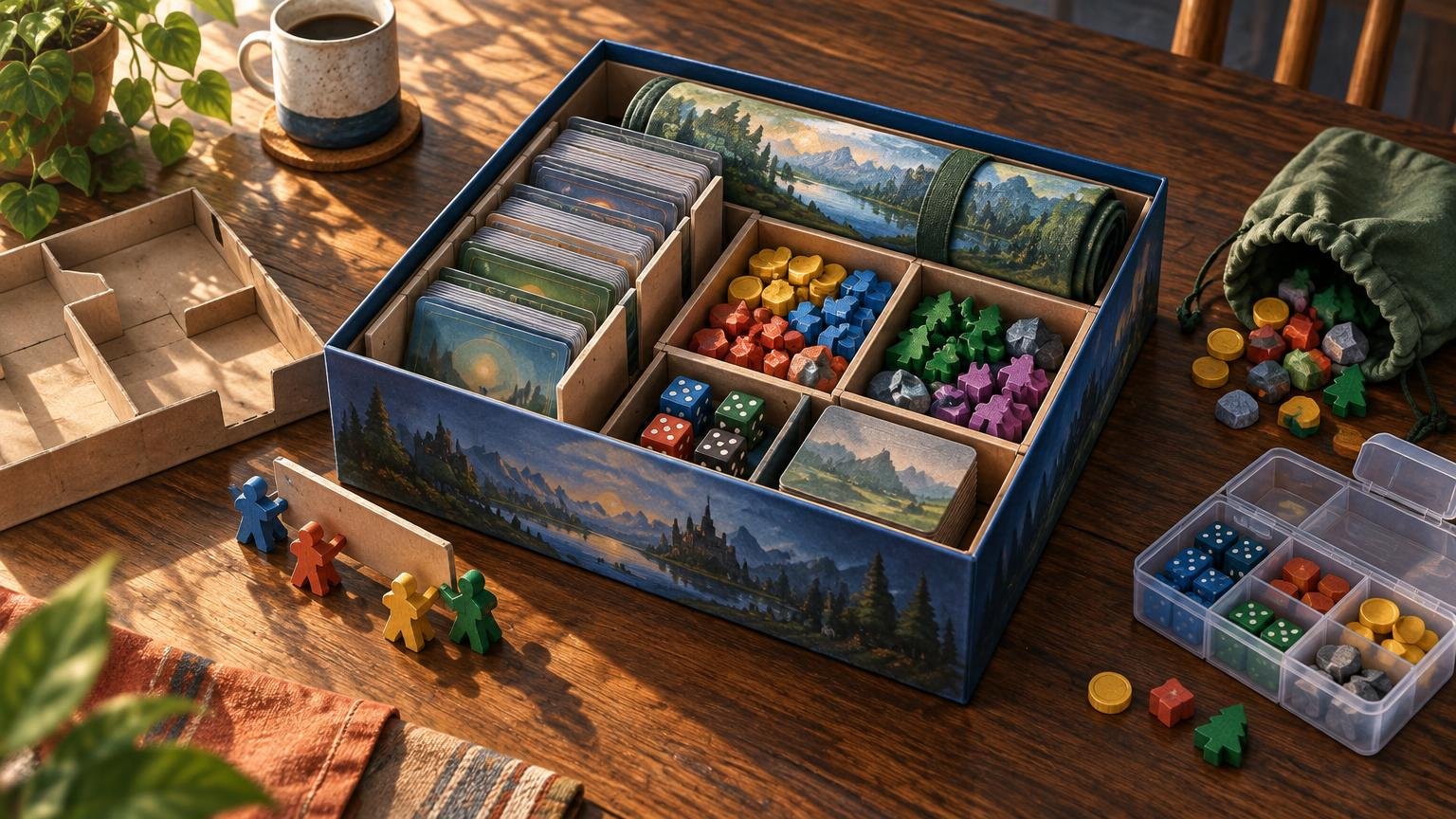
The best board game storage system is not automatically the fanciest one. It is the one that removes the specific friction keeping a game off your table. Bags are flexible, cheap, and surprisingly effective. Fitted inserts can turn setup into a much shorter sorting exercise. Plano-style compartment boxes excel at controlling piles of tokens. A custom 3D-printed organizer can do all three jobs—provided the designer correctly anticipated your sleeves, expansions, storage orientation, and tolerance for adding another brick of plastic to an already heavy box.
That makes board game storage inserts vs bags less of a quality contest and more of a systems question. Start with what slows down setup, what moves when the box is vertical, and what content you expect to add. Then choose the least elaborate solution that fixes those problems.
The quick comparison
| Storage method | Best at | Main tradeoff |
|---|---|---|
| Resealable bags | Flexible sorting, low cost, changing component sets | More opening, closing, and table sorting |
| Original insert | Protecting the retail configuration | Often leaves little room for sleeves or expansions |
| Fitted aftermarket insert | Fast setup and game-specific organization | Compatibility and capacity are design-specific |
| Plano-style compartment box | Separating many small tokens and counters | Adds bulk and may not fit the original box |
| 3D-printed organizer | Highly tailored trays, labels, lids, and player kits | Can add weight and may have material or fit limitations |
| Hybrid system | Fixing different problems with different containers | Less visually tidy than a single unified organizer |
Setup speed depends on what reaches the table
An insert saves meaningful time when its trays can move directly from the box to the table. A removable bank tray, token tray, or player box eliminates repeated sorting and gives every component an obvious destination during teardown. Game Trayz makes this setup-time argument for its Wingspan tray system, while other organizer makers advertise similar table-ready designs. Those are claims about particular products, not proof that every fitted insert beats every bag.
A poorly divided insert can merely relocate the sorting problem. If one well holds six unrelated token types, you still have to separate them before play. Conversely, a few labeled bags can be extremely efficient when each contains everything for one player, scenario, or module. Instead of sorting by component type, sort by the moment at which the game needs the component.
This is the useful test: count the number of container-opening and sorting actions between lifting the lid and taking the first turn. The storage method that reduces those actions wins the setup contest for that game. Sometimes that is an elaborate tray system. Sometimes it is five bags labeled “red,” “blue,” “green,” “market,” and “please stop buying expansions.”
Sleeved cards are where stock inserts often fail
Card sleeves change both dimensions that matter. A sleeved card is wider and taller than a bare card, while an entire sleeved deck is also substantially thicker than its unsleeved version. A stock card well may therefore fail even when an individual sleeved card appears to fit.
Do not treat “supports sleeved cards” as a universal specification. Capacity depends on the organizer, sleeve thickness, card count, dividers, and whether expansions share the same well. Organizer listings illustrate how specific these claims can be: Laserox gives sleeve-related dimensions or capacities for individual products, including a stated 168-sleeved-card capacity for one Munchkin insert.
Before buying or printing an organizer, measure a fully sleeved deck under light compression. Compare its length, width, and stack thickness with the usable internal dimensions—not merely the external size of the tray. Leave room for dividers and for fingers to remove the cards. A mathematically perfect fit can be functionally equivalent to sealing your deck in a tiny plastic tomb.
Expansion plans should decide how permanent the solution is
Bags adapt well when a game is still growing. You can add another bag, combine rarely used modules, or remove content without rebuilding the whole system. A fitted insert offers less improvisational space because every compartment represents a decision about what belongs in the box.
Expansion-compatible organizers also support specific configurations, not the abstract concept of “all expansions.” For example, Laserox describes its Sleeping Gods organizer as accommodating the base game and Tides of Ruin. Other community-listed organizers identify selected supported content rather than promising unlimited capacity. Check the exact edition and expansion list before ordering.
This matters because expansion ownership often becomes an organization problem before it becomes a gameplay benefit. If you are still deciding which modules deserve permanent residence, the frameworks in our board game expansion buying guide and discussion of expansion bloat can help. Storage should support the version of the game you play, not preserve every optional module in ceremonial cardboard suspension.
Vertical storage requires containment, not just compartments
A tray with open wells may look immaculate while lying flat and become a component snow globe when placed vertically. The important features are lids, tight-fitting stacked trays, covered card wells, secure drawers, and a packed height that reaches the box lid without leaving components room to escape.
Some commercial organizers explicitly advertise flush closure or secured compartments for vertical storage. Hobbyist accounts also describe supplementing stock inserts with bags or choosing trays with lids to keep pieces contained. The practical lesson is that “has an insert” and “can be stored vertically” are separate claims.
- Turn the packed box slowly onto each edge before shelving it.
- Listen for components moving between compartments.
- Open it again and inspect card stacks, miniatures, and loose tokens.
- If pieces migrate, add lids, bags, foam spacers, or a different organizer before trusting the shelf.
A hybrid solution is often ideal here. Keep the useful stock wells, but bag small tokens that can jump between them. This lacks the visual grandeur of a perfectly coordinated insert, but it prevents the next setup from beginning with an archaeological dig.
Match protection to the component, not the price of the organizer
Different components face different risks. Miniatures can collide or bend. Cards can shift, compress, or catch against rough edges. Painted pieces benefit from individual clearance. Cardboard tokens mostly need protection from mixing, crushing, and moisture.
A rigid insert is useful when shaped wells or padded holders stop delicate pieces from colliding; Laserox, for example, lists foam-padded miniature holders for its ISS Vanguard organizer. Bags are usually adequate for robust wooden pieces and tokens, but they should not be packed so tightly that sharp components press into cards or painted surfaces.
Plano-style boxes are particularly good for games with many small counters because their compartments remain visible and can often function as token banks during play. Their drawback is geometry: a general-purpose box may waste space, increase table footprint, or require storage outside the original game box. Measure the available internal space before buying one, including the height needed for boards and rulebooks above it.
Weight is the hidden cost of elaborate inserts
Organizer weight varies too much to make a blanket claim about wood, foam, or 3D-printed plastic. Published examples in the supplied material range from a 290-gram PLA organizer to heavier wooden systems listed at 600 grams, 950 grams, and 2.3 kilograms for different games and configurations. These are individual designs, not controlled material comparisons.
The consequence is straightforward: an organizer can make a dense game noticeably less pleasant to lift, transport, or shelve. That may be a fair exchange for protected miniatures and faster setup, but it should be deliberate. If the game already approaches your comfort limit, bags, foamcore, or selective token trays may solve the worst organization problems with less added mass.
When a 3D-printed insert makes sense
3D-printed organizers are attractive because they can be designed around a particular component layout. Available designs may include integrated lids, labeled dividers, removable player boxes, sleeved-card wells, and features intended for vertical storage. Seller disclosures also note practical limitations: made-to-order production, minor cosmetic imperfections, and heat-related deformation cautions for some PLA products.
Choose one when the design clearly maps to your edition, owned expansions, sleeve configuration, and shelf orientation. Inspect photographs or diagrams for finger access and tray order. A beautiful organizer that requires unloading four layers to reach the first setup component has not defeated friction; it has given friction a modular architecture.
Ditch the original insert when it wastes large areas, damages sleeved cards, cannot contain components vertically, or forces expansions into separate boxes you never remember to bring. Keep it when it protects unusual components well, supports the retail configuration, or matters to you as part of a complete collectible package.
Original materials and resale concerns
There is no supported universal rule that an aftermarket insert raises or lowers a game's resale value. Buyers differ: one may value ready-to-play organization, while another wants the original presentation and every factory component.
BoardGameGeek’s game-condition guidance treats completeness and the condition of the original box and materials as relevant when describing used games. Its Marketplace Seller Guide also recognizes accessories as items that may be listed separately. Neither policy establishes a standard resale premium for an organizer.
If future resale or collection completeness matters, retain the original insert when practical. Store it separately and label it with the game and edition. When selling, describe the organizer as an accessory, state whether the stock insert is included, and photograph the actual storage configuration. Accuracy is more useful than guessing whether the upgrade adds a particular amount of value.
Use the smallest system that fixes the real problem
Choose bags when the component mix changes, cost matters, or you need maximum flexibility. Choose a fitted insert when table-ready trays remove substantial setup and teardown work. Choose a Plano-style box when numerous small counters are the main source of chaos. Choose a 3D-printed system when its exact design matches your edition, sleeves, expansions, and storage orientation.
Most importantly, allow hybrid storage. Bags inside a stock insert, one compartment box beside sleeved card wells, or a few printed player trays can outperform a total replacement. The goal is not to make the inside of the box look like a luxury kitchen drawer. The goal is to make playing the game easier than deciding not to.
References
- Wingspan – Game Trayz
- Sleeping Gods | Insert | Sleeping Gods Organizer | Laserox
- Munchkin Box | Board Game Insert | Laserox
- old.laserox.net
- New Insert/Organizer now Available on Kickstarter | BoardGameGeek
- Arkham Horror Organizer | Laserox
- Grand Austria Hotel: Upended Games Organizer | Board Game Accessory | BoardGameGeek
- Boxes and Part Trays and Bags, oh my! – A Game Organization Discussion | Proto-typing | BoardGameGeek
- ISS Vanguard | Insert | ISS Vanguard Organizer | Laserox
- Krysy z Wistaru: Inserty Herman Insert | Board Game Accessory | BoardGameGeek
- old.laserox.net
- old.laserox.net
- Creature Comforts: Maple Valley Organizer – 3D Printed Board Game Insert – Etsy
- Dominion Game Organizer – Modular Storage, Sleeved Cards, Kallax Compatible – Etsy
- Condition of a game | Wiki | BoardGameGeek
- Marketplace Seller Guide | Wiki | BoardGameGeek